
In January, President Claudia Sheinbaum announced what she called Mexico’s most significant archaeological find in a decade: a 1,400-year-old Zapotec tomb discovered in Oaxaca. A polished government video celebrating the discovery shows a striking stone mask suspended above a carved human face relief above the entrance, with traces of ancient paint still visible.
What the president failed to mention is that the discovery had occurred months earlier, when looters emptied the tomb and took all the artifacts, leaving only a few scattered bones, according to employees of the country’s antiquities institute who spoke on condition of anonymity. The National Institute of Anthropology and History (INAH) sent researchers to the already looted site only after a local resident alerted the authorities.
Although Mexico is what Sheinbaum often calls a “cultural powerhouse”—where Spanish colonial architecture coexists with imposing pyramids built by star-gazing civilizations, teeming with poets, painters, potters, and priests—critics warn that very little is invested in preserving the country’s oldest and most fragile sites.
With few exceptions, major tourist destinations operate on limited budgets, affected by accumulated cuts in recent years that jeopardize the long-term viability of an international tourism industry valued at more than $30 billion. “We have about eight Machu Picchus in Mexico,” says Alejandro Zozaya, a Mexican hotelier. Other Caribbean destinations “would give anything” to have a single historical site of that magnitude, he says, while emphasizing the need to better conserve and promote these unique assets. “There’s no amount of money that could ever rebuild an archaeological site like that.”
Since late 2018, when Andrés Manuel López Obrador took office, the budget for the Ministry of Culture has been cut by more than 20 percent, according to official data.
The office responsible for deciding how archaeological sites are preserved has seen cuts of up to 70 percent during the same period. In the first two years of Sheinbaum’s administration, the budget for the National Institute of Anthropology and History (INAH) has been reduced by nearly 40 percent. Government-funded field research, including archaeological excavations, has practically ground to a halt. Some researchers report that they are maintaining active projects by funding them out of their own pockets.
Historical sites are a key driver of tourism in Mexico, both international and domestic, which together represent about 9 percent of the national GDP (twice the size of the automotive sector).
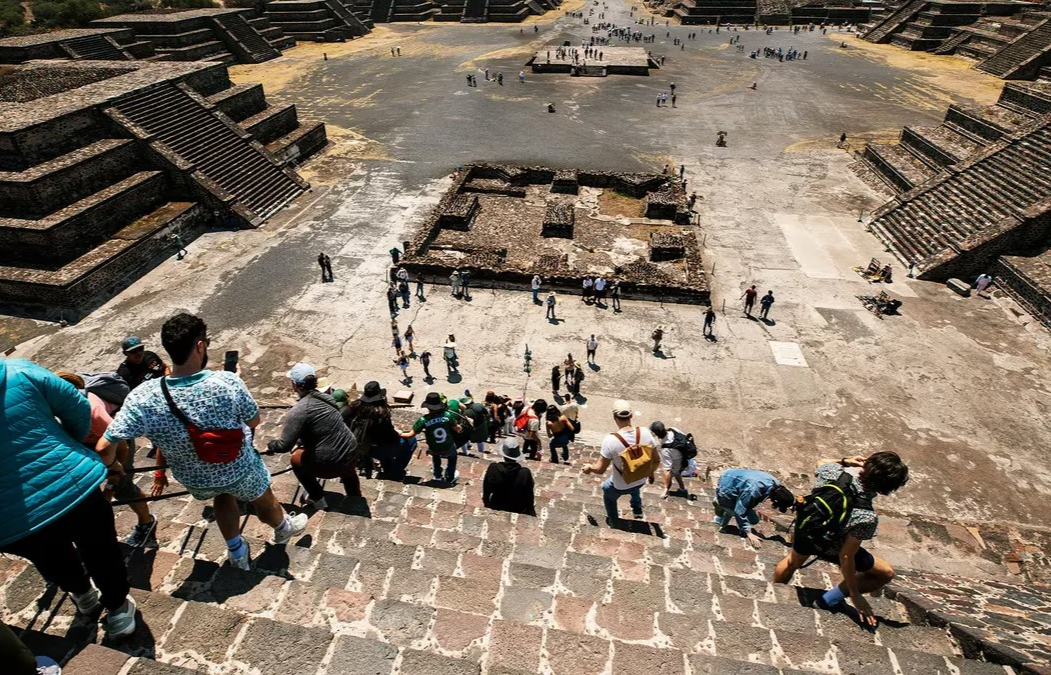
The major archaeological zones confirm this: Chichén Itzá received more than 2 million visitors last year, while Teotihuacán surpassed 1.6 million.
“The reason tourists travel is no longer sun and sand; it’s now cultural,” says Josefina Rodríguez, Secretary of Tourism. “Mexico is in vogue.”
This summer’s World Cup—with 13 matches in Mexico City, Guadalajara, and Monterrey—could attract an additional 5.5 million international tourists, implying an estimated 14 percent growth by 2026.
Like López Obrador, Sheinbaum has defended the austerity policy as necessary to maintain healthy public finances, while increasing social spending and allocating subsidies to Pemex, which is heavily indebted.
Diego Prieto, a member of Sheinbaum’s government and former director of the National Institute of Anthropology and History (INAH) for a decade, denies that current spending levels pose a risk to Mexico’s cultural offerings and asserts that the drastic reduction in funds is due to the elimination of extraordinary allocations.
However, more than a dozen academics consulted by Bloomberg Businessweek warn that the cuts to the cultural sector contradict the official narrative that exalts the country’s pre-Hispanic past.
There are plenty of signs indicating what is a priority and what is not. In 2021, the protective roof over the ruins of an important Aztec warrior shrine was destroyed by a storm, while the government spent a fortune on a nearby replica and a light show. The reduction of a private security contract led to the closure of Mexico City’s three main history museums for several days in June. Museum workers have occasionally reported a lack of basic supplies, such as toilet paper in the restrooms.
Source: elfinanciero