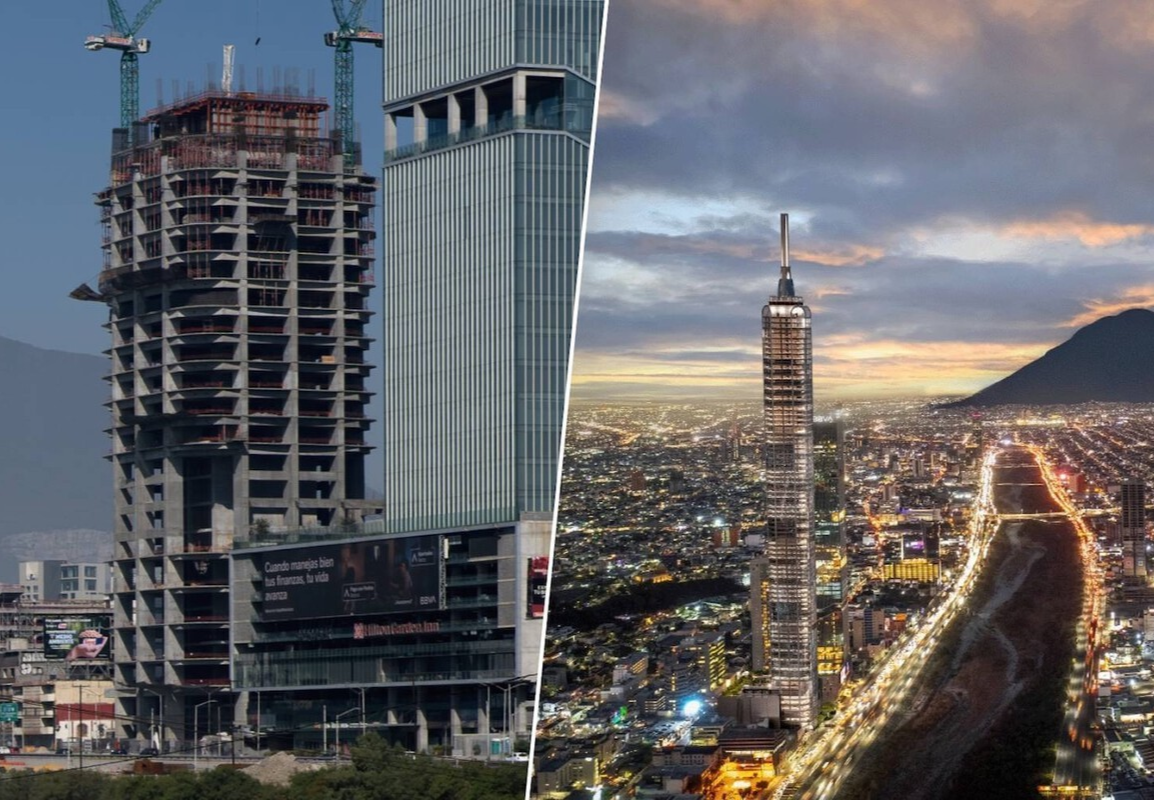

For decades, it seemed that the saying “the sky’s the limit” applied to architecture was a maxim only found in Asia and the Middle East. In fact, in recent times the world has witnessed a frenetic race to see who can build the biggest (the skyscraper) between Dubai and Saudi Arabia. But there are some notable exceptions, such as the one about to open in Monterrey: the Rise Tower, a skyscraper that will not only be the tallest in the Central American country, but will also lead the skies of all of Latin America. If we broaden the scope to the entire continent, only the legendary One World Trade Center in New York rivals it.
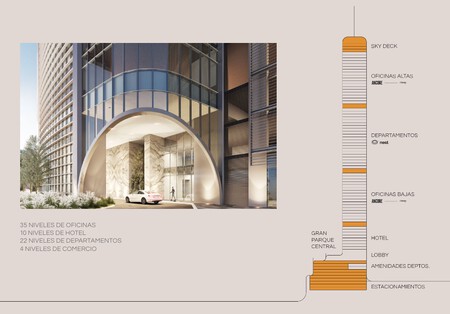
The project. The Rise Tower is a mixed-use skyscraper under construction in Monterrey (Nuevo León). It will reach a height of 484 meters, of which 408 comprise 96 residential floors, and the remaining 76 form the architectural spire that crowns the structure. More specifically, it will house residences, offices, a hotel, retail, and leisure facilities all within a single structure, as is typical of skyscrapers of this kind, effectively making it a city within a building.
It will be located in the Obispado neighborhood, on Avenida Constitución facing the Santa Catarina River, in one of the city’s densest and most iconic urban corridors. The project is a collaboration between Nest and Ancore Group, and was designed by Ancore’s architectural team and Mexican architect Esteban Ramos. Pozas Design Group and Next are responsible for its luxurious interior.
Why it matters: Rise Tower will surpass the Obispado Towers, also in Monterrey and currently the tallest skyscraper in the country, by 170 meters. Once completed, it will officially be the tallest building in Latin America, a title that grants Mexico symbolic and technical leadership in the urban and architectural sector. Furthermore, it will also surpass the Gran Torre Santiago in Chile. The building also positions Mexico in the global leagues of vertical architecture, a field dominated by Asia and the Middle East.
For Mexico, it is also a demonstration that the region can conceive, finance, and execute projects on the scale of major global urban centers and, at a metropolitan scale, can act as an engine for urban repopulation, encouraging investment in infrastructure.
Context: Monterrey has spent two decades consolidating itself as the laboratory of vertical urbanism in Mexico. For example, the construction of the Obispado Towers in 2020 had already surpassed the 300-meter mark that defines it as a “supertall.” The Rise Tower itself has evolved from its initial plans, when it aimed for “only” 350 meters.
The project is part of the mixed-use supertall trend that began to emerge in Asia and the Middle East in the 2000s and is now beginning to materialize in Latin America. Monterrey is located in an area with wind and seismic activity, which adds a layer of technical complexity to any potential design.
In numbers. Some numerical data for this stratospheric construction:
484 meters tall: 408 meters habitable and 76 meters for the spire. It will be the 13th tallest skyscraper in the world.
35 office levels, 22 apartment floors, 10 luxury hotel levels.
4,300 square meters of green areas and 8,000 square meters of leisure spaces.
In detail. The tower has a rectilinear shape with a reinforced structural core and a perimeter truss system designed to withstand lateral loads, essential given that Monterrey is in a region with seismic activity and strong winds. The building envelope consists of a modular aluminum and glass curtain wall system, a striking combination aesthetically and effective for thermal control and managing dynamic wind pressures at high altitudes.
The facade design is strongly reminiscent of mid-20th-century skyscraper architecture. The Civil Engineer notes that initial sketches suggested a more robust, metallic aesthetic inspired by Mexico City’s historic Torre Latinoamericana (the grandfather of Mexican skyscrapers, built in 1956), but as construction progressed, a greater use of glass became evident. In terms of sustainability, the project has already achieved LEED Silver, Green Globes, Building EQ, and WELL certifications from the International Well Building Institute.
Source: xataka