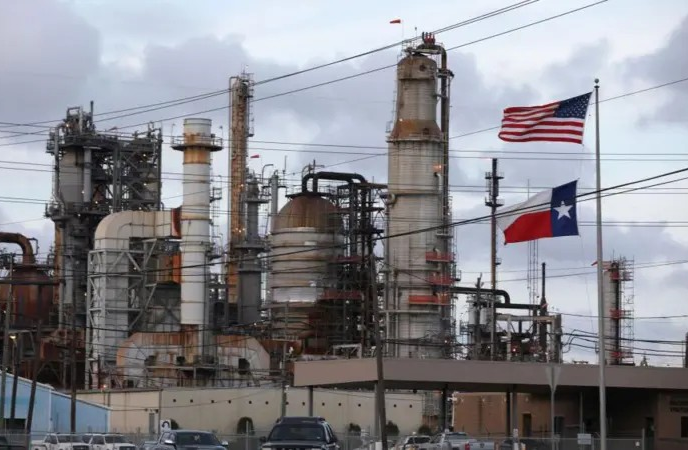

At least 75% of Mexico’s daily gas consumption comes from its northern neighbor, mostly from the border state of Texas. And almost half of the imported gas is used to generate electricity.
If, for any reason—political, economic, or even natural (as happened with a severe storm in 2021)—the cross-border gas pipeline were to shut down, Mexico would be in a dire situation.
What to do to avoid such a risk is the question posed by Mexican President Claudia Sheinbaum, sparking a debate among politicians, analysts, and scientists connected to the energy sector.
The president has promoted the idea that the country explore a solution opposed by the leftist movement to which she belongs: the exploitation of so-called unconventional gas through fracking, an extraction technique controversial for its harmful environmental effects.
“For many years, I myself said ‘no to fracking.’ But when I see the new technologies and the country’s situation in terms of dependence, the worst thing we can do is simply say ‘no’; instead of ‘let’s find out if, in fact, there are new technologies with less environmental impact,’” she recently said.
Her statement came as she presented a panel of scientists and experts who will determine whether there is technology that makes fracking a less harmful technique for the environment and the communities where it is carried out.
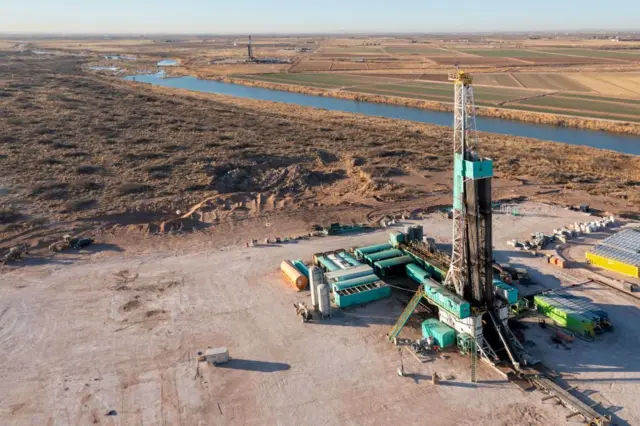
While this verdict is pending, Sheinbaum has repeatedly stated that the decision involves not only the country’s energy sovereignty, but also the very “viability and development” of the country and future generations of Mexicans.
Mexico currently requires approximately 9 billion cubic feet of natural gas per day, but only produces 2.3 billion. The remaining 6.8 billion (75%) are acquired from the United States market, primarily from the state of Texas (80%).
Just over half of that natural gas (56%) is used to generate the country’s electricity, while 19% is used by the state-owned oil company Petróleos Mexicanos (Pemex) for fuel extraction. Industry (13%) and households (11%) consume the remainder.
These figures reflect the country’s vulnerability to an adverse event.
The country has only installed enough gas storage to last about three days, and other energy sources would not be sufficient to meet the demand of a nation of 130 million people.
In 2021, a severe winter storm in Texas and northern Mexico led to the closure of gas pipelines, causing blackouts across nearly half of Mexico for several days.

“By constantly building more combined-cycle power plants to produce electricity, Mexico has become increasingly dependent on gas. The problem is that we passed peak domestic gas production in 2009. So, when domestic production began to decline, gas imports skyrocketed,” explains geologist Luca Ferrari, an Italian researcher specializing in the global energy sector at the National Autonomous University of Mexico (UNAM).
The scenario “is dramatic,” he continues, because if you remove from the equation what Pemex uses for its oil activities, the dependence on U.S. gas for consumption in the rest of the country’s sectors is almost 90%.
And a parallel and no less serious problem, he warns, is the constant decline in oil production, which forces Mexico to import almost 50% of the gasoline and diesel it currently consumes, a situation that will worsen in the next decade as the country’s rich oil wells reach the end of their productive lifespan.
“We are at the end of the oil era,” she asserts. And not only in Mexico, but in many parts of the world.
In her first year in office, President Sheinbaum presented an energy plan that aims to increase electricity generation from renewable sources from 24% to 38% by the end of her term (2030).
But even with that and other domestic sources added to the energy mix, the growth in demand could not be met in the short and medium term.
“If we do nothing, we will continue to import more and more. What’s wrong with importing fuel? Look at what so many countries around the world suffered with what happened in Iran,” Sheinbaum said, referring to the global surge in energy prices resulting from the war in the Middle East.
For Sheinbaum, who was an energy research scientist in her academic career, a medium-term solution is the exploitation of unconventional gas beneath Mexico’s subsoil through hydraulic fracturing, or fracking.
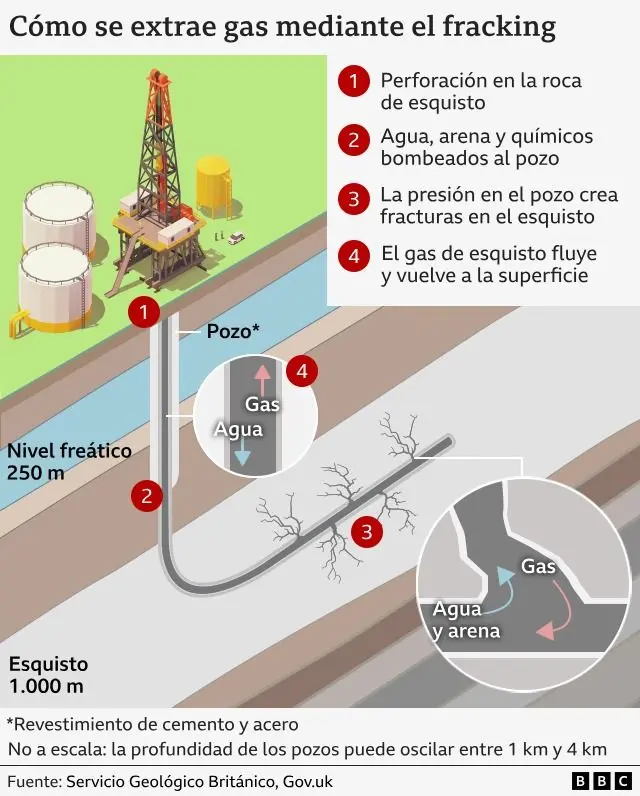
This technique allows the extraction of shale gas, a type of hydrocarbon literally trapped in layers of rock at great depths. After drilling down to the shale rock, large quantities of water mixed with chemical additives and sand are injected at high pressure to fracture the rock and release the methane gas.
When the gas begins to flow back out, it does so with some of the fluid injected at high pressure.
Fracking has been used worldwide since the mid-20th century, and since then the technique has been criticized for its excessive water consumption, the contamination of the water with harmful chemicals, leaks into underground aquifers, the seismic activity it causes in the surrounding area, and the impact on nearby communities, among other problems.
The president has acknowledged that it has effects, like “all human activity,” and that it is neither the primary solution nor a definitive option for the problem. However, since opening the debate on its implementation, her discourse has leaned toward using fracking as a solution for the country’s energy sovereignty. “If I’ve dedicated so many years to climate change, I’m not going to say that ‘oil is the solution.’ But we need it for a while, while we develop other alternatives. Yes, we have to keep using it, while we continue to reduce energy consumption,” he said recently.
The key to using fracking, he believes, is to employ new techniques that don’t require massive amounts of water, don’t use such harmful chemicals, and have the consensus of local communities.
Source: bbc