
Thirty minutes by road from the industrial port of Guaymas and an hour and a half from Hermosillo International Airport, the Mexican landscape offers one of its most extreme and least documented contrasts: the absolute convergence of the Sonoran Desert and the Sea of Cortez.
At this point in the northwest of the country, the white sand dunes are not a prelude to the ocean, but its direct companion, in a geographical and ecological phenomenon that led the federal government to declare this town a Pueblo Mágico (Magical Town) in June 2023.
San Carlos, also known as San Carlos Nuevo Guaymas, is not a conventional beach destination. Unlike jungle or mountain beaches, here the extreme aridity—with cacti and xerophytic scrub as the only terrestrial vegetation—is abruptly interrupted at the high tide line.
The recognition of this unique character is significant: the Mexican Ministry of Tourism (Sectur) awarded it the title of Pueblo Mágico (Magical Town) on June 26, 2023, after two previous unsuccessful attempts, making it the fourth municipality in Sonora to receive this distinction, along with Álamos, Magdalena de Kino, and Ures.
Furthermore, National Geographic magazine ranked the ocean view from the local scenic overlook as one of the best in the world.
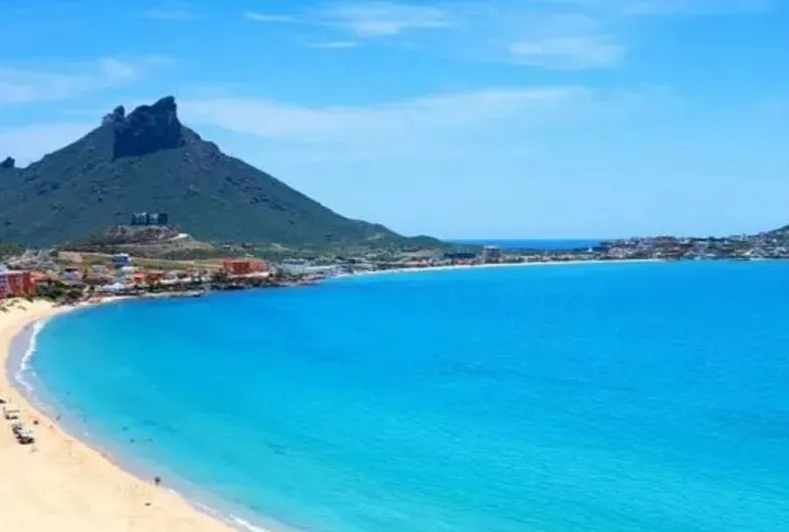
The territory of San Carlos is located on the eastern coast of the Gulf of California, within the municipality of Guaymas. Its dominant topographical feature is Cerro Tetakawi—whose name in the Yaqui language means “split hill”—a volcanic massif that rises almost vertically above the bay.
The town originally developed as an extension of Guaymas, with historical influences from cattle ranches and the Yaqui and Seri communities, whose cultural vestiges persist in local crafts, although it does not constitute a dense urban center.
In terms of accessibility, the site is located approximately four hours by car from the Arizona border (United States), making it a magnet for American and Canadian tourists, as well as domestic tourists from Sonora and neighboring states.
The defining element of San Carlos is not the secluded quality of its beaches, but rather the juxtaposition of two contrasting biomes. The Sonoran Desert—characterized by its annual rainfall of less than 250 millimeters and its drought-adapted flora—reaches the water’s edge without any vegetation transition.
There are no native palm trees or low-lying forest; there are dunes and reddish hills that drop directly onto white sand and turquoise waters.
This fusion becomes most evident at sunset, when sunlight bathes both the desert and the sea in golden and orange hues.
The Scenic Lookout, inaugurated by the state government a few kilometers from the center of the town, offers a panoramic view considered one of the best ocean views in the world, precisely because of its ability to show in a single frame the aridity of the land and the depth of the sea.

What are the beaches like in San Carlos?
All the beaches in San Carlos are free and open to the public, in accordance with Mexican federal law, which declares the Federal Maritime Terrestrial Zone (the first 20 meters from high tide) as unrestricted. However, some of them border residential or tourist developments that limit physical access from land.
Among the most notable is Los Algodones Beach, the most emblematic of the destination. Its name comes from its white dunes of fine sand, whose texture is reminiscent of cotton. Its waves are gentle, making it ideal for swimming, snorkeling, shore fishing, and kayaking or windsurfing. It is considered suitable for families.
San Francisco Beach, on the other hand, is the most central and spacious. It is frequented by both locals and tourists and offers a direct view of Cerro Tetakawi.
Other notable beaches include Piedras Pintas Beach—with rock formations that offer privileged views—La Manga, and El Tomate Beach.
They all share similar characteristics: fine sand, calm waters in the bay, and the absence of strong waves in most of the coves.
The Sea of Cortez, where San Carlos is located, was dubbed “the Aquarium of the World” by oceanographer Jacques Cousteau due to its extraordinary biodiversity.
Its waters are home to dolphins, sea lions, manta rays, colorful fish, corals, and, during the winter and spring seasons, gray whales. In 2005, parts of its islands and coastal areas were declared a Natural World Heritage Site by UNESCO.
Off the coast, San Pedro Nolasco Island is a sanctuary for sea lions and birds such as the brown booby and the pelican. This mixed ecosystem—desert, estuary, and sea—makes San Carlos a natural conservation laboratory, but also a point of tension between tourism and environmental protection.
What activities are there to do?
The range of activities in San Carlos is clearly divided between aquatic and terrestrial pursuits.
At sea, snorkeling and diving are highlights at San Pedro Nolasco Island, as well as at the artificial reef of the Santos P0-106, a World War II shipwreck sunk by the Mexican Navy.
Sport fishing is top-notch, with species such as marlin and dorado. Yacht and sailboat tours are also offered for dolphin and whale watching, as well as kayaking in Estero el Soldado.
On land, hiking to Cerro Tetakawi—which holds sacred significance for the Yaqui community—is one of the most popular activities, offering panoramic views of the entire bay. Other excursions include Cañón de la Herradura, where rappelling, rock climbing, and natural pools are popular.
Flora and fauna observation in Estero el Soldado is conducted with certified guides.
Among the distinctive experiences are the shows at the Sonora Dolphinarium—which offers dolphin and sea lion-assisted therapy—and the sunsets from the sea or the viewpoints, which combine desert, dunes, mangroves, and ocean into a single picture-perfect scene.
San Carlos is not a picture-perfect beach. It is a geographical point where the desert doesn’t yield to the sea, but rather confronts it with a stark, abrupt, and visually dramatic line of contact. Its sunsets, sheltered by the Tetakawi volcano and framed by dunes and mangroves, offer a surreal experience that has been validated by international organizations and supported by its federal designation as a Pueblo Mágico (Magical Town).

Source: milenio