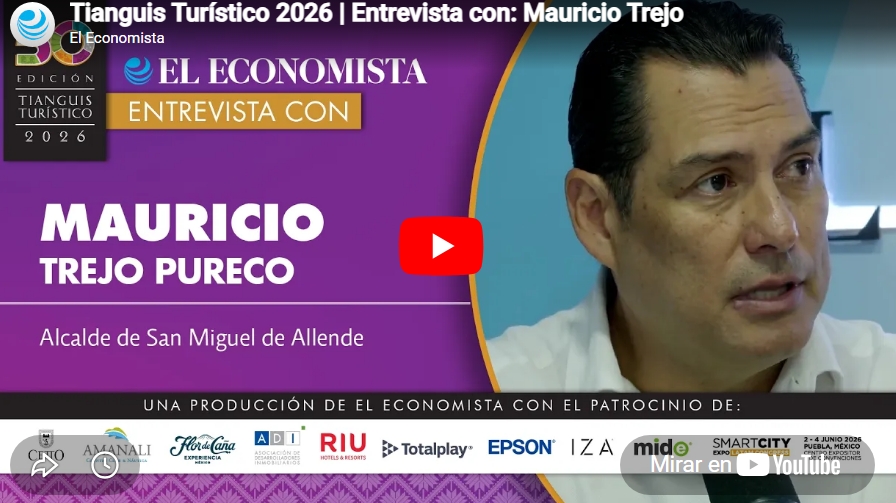

San Miguel de Allende doesn’t want to be defined solely by its architecture, hotels, or cultural life. For Mauricio Trejo Pureco, mayor of this Guanajuato destination, food is part of a broader economic structure: wedding tourism, wine, restaurants, culinary events, and an international community that has transformed the way people eat in the city.
During the Tianguis Turístico 2026, held in Acapulco, the mayor explained that San Miguel de Allende has grown not only as a cultural municipality but also as a destination where that culture finds economic expression. And in this equation, gastronomy emerges as a point of connection between different forms of tourism.
“In San Miguel de Allende, we leverage the various facets of tourism, but all of them lead back to gastronomy,” Trejo Pureco said during the interview.
The goal is not to sell food as an isolated attraction, but rather to integrate it into the overall tourism experience of the destination. Visitors arrive for a wedding, a hotel, a wine experience, the architecture, or a weekend getaway, but they end up seated in a restaurant, on a terrace, at a banquet table, or in a vineyard.
Weddings, banquets, and an industry that also fuels the destination. One of the clearest indicators is romance tourism. According to the mayor, San Miguel de Allende closed 2025 with 902 weddings, a figure that confirms the importance of this segment to the local economy. It’s not just about the ceremonies: around each wedding, a value chain is activated that includes hotels, florists, planners, transportation providers, photographers, chefs, caterers, and beverage suppliers.
Trejo Pureco emphasized that San Miguel de Allende has been working in this sector for 13 years and that part of its strength lies in the caterers and wedding planners who operate in the municipality. In a destination where the celebration often lasts more than a day, food is not a complementary service, but rather a central part of the experience and tourist spending.
Therein lies one of the keys to San Miguel’s gastronomic growth: its cuisine doesn’t depend solely on restaurants open to the public. It also thrives on wedding menus, private dinners, hotels, vineyards, and events that transform the city into a hub for food consumption.

According to the mayor, San Miguel de Allende boasts 320 restaurants. This figure helps to illustrate the role of food in a municipality that also has a significant foreign presence: Trejo Pureco mentioned 62 nationalities living or coexisting in the city.
San Miguel doesn’t present itself as a destination focused solely on traditional local cuisine. Its profile, according to the mayor himself, is cosmopolitan. Mexican, Italian, and French cuisine, fusion offerings, and specialty restaurants all coexist on its tables.
Distinction is important. While other tourist destinations build their culinary narrative around traditional cooks, local products, or regional recipes, San Miguel de Allende seems to be taking a different approach: a cuisine marked by cultural fusion, hospitality, wine, and high demand from visitors with diverse consumer profiles.
Wine occupies another key place in San Miguel de Allende’s gastronomic strategy. Trejo Pureco stated that the municipality was recently named by Food and Travel as the most important wine region in Mexico, attributing this recognition to its infrastructure, rapid growth, and the quality of its offerings.
The mayor spoke of 14 vineyards that integrate hotels, restaurants, and wine-related experiences. This model is significant because it goes beyond wine production: it transforms the vineyard into a destination, the restaurant into a place to stay, and wine into a reason to travel.
According to Trejo Pureco, on November 29 and 30, San Miguel de Allende will host the Concours Mondial de Bruxelles, an international event focused on the evaluation of wines and spirits. For the municipality, hosting an event of this scale reinforces its position on the national wine tourism map.
In this case, wine isn’t merely an embellishment to the tourist experience. It functions as a consumption infrastructure: generating stays, tours, meals, dinners, shopping, and specialized conversations about the destination.
In addition to restaurants and vineyards, San Miguel de Allende hosts events that aim to bring its culinary offerings closer to the public. Trejo Pureco mentioned “San Miguel and its Flavors,” an initiative in which chefs leave their restaurants to cook in the street, allowing more people to sample their creations.
Source: es-us.noticias.yahoo