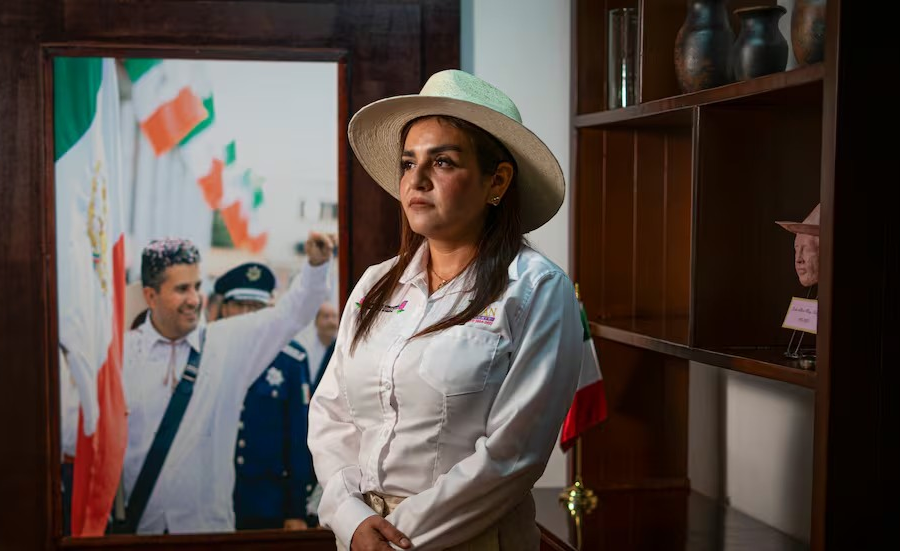

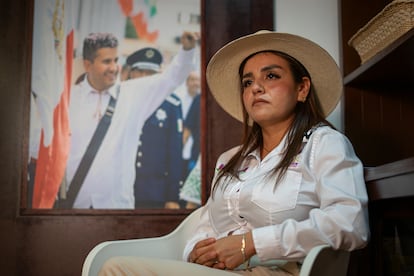
Grecia Quiroz (Uruapan, Michoacán, 36 years old) walks surrounded by bodyguards. A circle of escorts accompanies her every step through Uruapan, the troubled municipality in the state of Michoacán that she has governed for the past six months and where normalcy was suspended the night her husband, Carlos Manzo, was murdered. The mayor cannot sit alone in the plaza or cross the city center without a dozen armed soldiers watching her closely. She learned to wield power amidst National Guard checkpoints, military convoys, and a grief that offers no respite. She assumed office days after the murder, on November 1, 2025, in the midst of the Day of the Dead celebrations. “My life changed completely,” she tells EL PAÍS.
A few meters from the House of Culture where she works, in the small plaza where Manzo was gunned down, a woman recites the Lord’s Prayer in front of his cenotaph. The candles remain lit, as if time has stood still. At the foot of the altar, among withered flowers and photographs, lie piles of children’s letters: folded sheets of paper, drawings in vibrant colors. “You are and will always be the best mayor of Uruapan,” reads one. The drawing depicts him wearing the hat that became the symbol and name of his political project: the Hat Movement.
In Uruapan, people still pray for Manzo. His image remains on makeshift altars and in government advertisements that bear his likeness. “Thank you, Mr. Mayor, for all the progress on public works,” reads a banner at the entrance to the municipality. Below it: “Justice for Carlos Manzo.” The indignation has not subsided. Six months later, the wound is still open. There have been arrests, but no mastermind has been identified. “They haven’t gotten to the bottom of it,” Quiroz maintains. Her accusation is direct: the political angle has not been investigated with the seriousness it deserves.
Grecia Quiróz in Uruapan City Hall. Carlo Echegoyen
The avocado capital of the world is no longer the same. The National Guard is part of the landscape: armored trucks on the avenues, soldiers on street corners, routine checks that disrupt daily life. The city smells of tension. And of mourning.
The military deployment hasn’t been enough. The fear remains. Crime rules Michoacán, the mayor asserts from a makeshift office, where portraits of Manzo stand out. Quiroz governs along these lines: between the military presence and institutional fragility, between mourning and the promise to uphold her husband’s legacy and achieve justice. At the same time, she’s setting her sights on the next step: governing Michoacán, a territory where, she says, the power of the State coexists daily with drug trafficking.
Question: How has your life changed since November 1, 2025?
Answer: It changed completely. Not a single thing remains the same. As a mother, I became the head of my household and my children, and also of a municipality that is not easy to govern. Now all the responsibility falls on me, starting with the security the Federation provides for my children and me. There are days when I just want to go for a walk alone, have an ice cream without anyone watching over me. I wasn’t used to this, but I’m committed. The social struggle I began with Carlos is a moral commitment to myself, and I’m going to continue.
Q. How have you coped with the grief as a wife, mother, and leader?
A. There hasn’t been time to process it. There are days when I feel like he’s going to walk into the house, that I’m going to see him at any moment. It’s a difficult process. I’m trying to understand God’s purposes. At first, I asked myself, “Why us?” Now I try to ask myself, “What for?” I understand that I’m an instrument for things to change in my municipality.
Q. How do you deal with fear?
A. Fear is natural. I think about what would happen if the same thing happened to me. My children would be left adrift. That’s my biggest fear. But I can’t stay silent. I must speak out. Fear cannot paralyze you.
Q. What has changed in Uruapan in these six months?
A. At first, the municipality felt desolate, without hope. It lost the person who looked after its interests. It has been difficult, but I have tried to demonstrate that Carlos’s social conscience is still present. Regaining trust has been hard. He pursued a disruptive and confrontational style of politics; I have chosen to be cautious. That doesn’t mean I’ve been bought off. I will continue demanding justice.
Q. What is missing from the investigation?
A. More arrests and an investigation into the political motivations. I don’t see that the authorities are giving it the necessary attention. Carlos was going to be governor of Michoacán. There are reasons to believe they wanted to eliminate him. I have pointed to Raúl Morón, Leonel Godoy, and former mayor Ignacio Benjamín Campos. They shouldn’t be ruled out. If there are no links, let it be proven. But why haven’t they been summoned?
Q. What is the basis for those accusations?
Days before the murder, people on motorcycles threatened us at our house. Nothing like that had ever happened before. It happened after Carlos spoke out against Leonel Godoy. There is sufficient evidence.
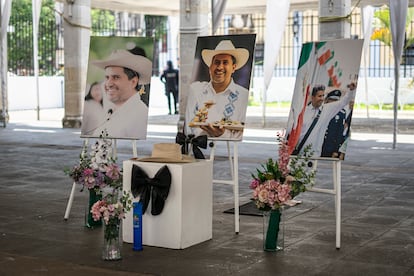
Altar of Carlos Manzo in Uruapan, April 29. Carlo Echegoyen
Q. Godoy maintains that these are campaign statements.
A. Justice matters more to me than any election. They are avoiding the issue. An investigation would restore confidence.
Q. Have you detected any irregularities in the investigation?
A. The authorities have the power to get to the bottom of this. Why, after six months, has Jorge Armando not been linked to organized crime, if there is evidence?
Q. Was there anything irregular about the head of security?
A. No. Carlos would have been the first to notice.
Q. Who won and who lost politically?
A. Many of us lost. The citizens.
Q. Did the government win?
A: Yes. They removed someone who would be a thorn in their side.
Q: What leeway does a mayor have against the powers that be?
A: It’s a complicated municipality. We’re surrounded by criminals, and people know it. They keep watch from the hills. I acknowledge the federal support: the Army and the National Guard have helped reduce homicides, but the perception of insecurity remains high.
Q: Who governs in Michoacán?
A: If we look at the actions that happen to citizens every day, it’s organized crime. When the butcher, the tortilla vendor, the taxi driver, the minibus driver, they say they’re still being extorted, kidnapped, and intimidated, you realize that they are organized, and we aren’t. The moment a president, a governor, or a representative has ties to organized crime, that’s when the support for the citizens ends. You’re no longer the one governing. They govern through you. Carlos said it, and I reiterate: I don’t need them to sponsor me, to pay for my campaign. I never want to make deals with these kinds of people. Let me work, let me continue helping people. We’re not going to mess with them, but they shouldn’t mess with us or with innocent people.
Q: Have they contacted you?
A: No.
Q: What do you mean by “we’re not going to mess with them”?
A: I’m not going to go into the hills like Carlos did, to uncover labs or weapons. I’m not going to put myself in that situation.
Q: Would you report them?
A: Of course. But I’m not going to confront them directly. I’m all my children have. I’m trying to be prudent.
Q: What have you learned in these six months?
A: That public administration is an enormous responsibility. Carlos was more operational; I’m more administrative, without losing touch with the people.
Q: How can the security policy be continued without risk?
A: Crime can be combated without taking such risks, if we work together. I acknowledge the arrests spearheaded by Omar García Harfuch. I hope that those involved in the homicide are arrested and reveal whether there was a political connection.
Q: Have you met with Mayor Claudia Sheinbaum?
A: Yes. I submitted a project for a Municipal Police station, and it was approved.
Source: elpais