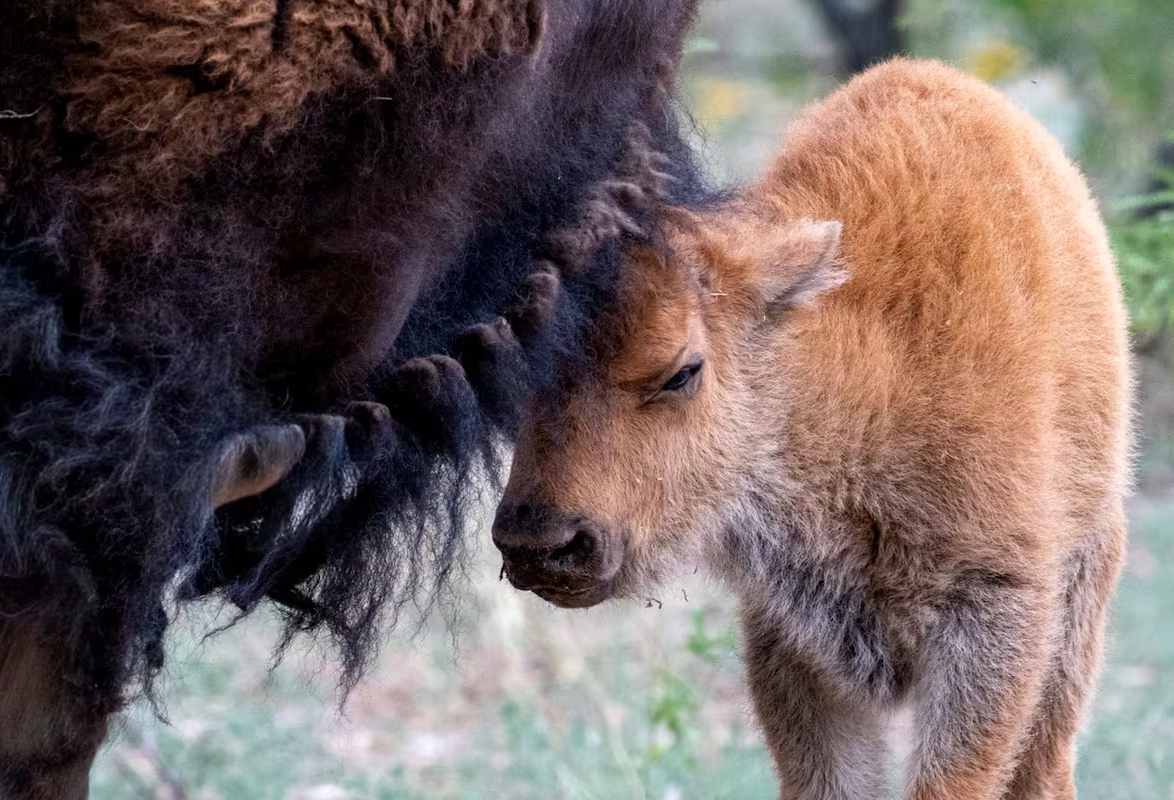

The American bison has reappeared in Sonora with the arrival of a new calf, already a symbol of the long battle for the conservation of its species. After more than 200 years without any recorded births, the bison—a female named Lista, in honor of the Mexican biologist Rurik Hermann List—was born on April 28 in the Cuenca Los Ojos reserve, in the wild and without human intervention, although with constant remote monitoring. Since several females in the herd are pregnant, several more calves are expected in the coming months, during the birthing season that runs from April to June.
Just in February, the National Commission of Natural Protected Areas had relocated 29 bison—19 females and 10 males—to the reserve located near the border between Mexico and the United States. The operation was part of the Bison Project, which seeks to expand and strengthen the species’ population on private lands that meet the necessary technical specifications for its conservation.
The American bison (Bison bison) is an emblematic species of the North American grasslands, whose original range also included northern Mexico. Uncontrolled hunting and habitat modification led to its disappearance from the wild in the country at the beginning of the 20th century. This animal, which is gradually regaining its presence in the region, plays a vital role in the restoration of its ecosystem, as its natural activity disperses seeds, mobilizes soil nutrients, and promotes the natural regeneration of the land.
This new birth comes after almost two decades of efforts to reintroduce and establish American bison populations in northern Mexico. The largest herd in Mexico now roams the Janos Biosphere Reserve in Chihuahua: around 500 individuals descended from the 22 purebred bison that arrived 17 years ago as part of a binational protection and reintegration project. That initiative, conceived when the animal was believed to be extinct in Mexico, opened the door to an ecological restoration that is now beginning to show visible signs in other parts of the border, such as Sonora.
The bison’s recovery is, at the same time, a story of resilience in one of the territories most ravaged by drug-related violence. Janos and the area it shares with Sonora have been the scene in recent years of multimillion-dollar drug seizures, the discovery of clandestine graves, and massacres such as the attack against members of the LeBarón family in 2019, just a few kilometers from the reserve.
In this region marked by crime and army patrols, the herds move about as an anomaly: animals that survive bullets, the border wall, and the extreme droughts that dry out the grasslands. Of the estimated 40 to 50 million bison that once grazed in North America, only about 300 remained by the end of the 19th century. The birth of this new calf—and those expected in the coming months—injects a sense of survival and optimism into an ecosystem that, for decades, seemed definitively lost.
Source: elpais