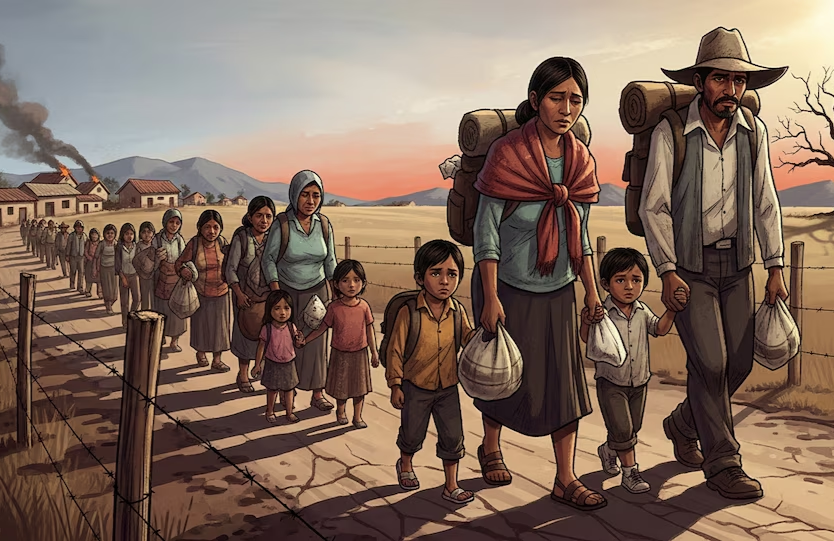

The lack of federal legislation and the absence of official figures on internal displacement in Mexico have left communities vulnerable and without a unified support protocol, according to the report “Geographies of Cruelty,” prepared by the Citizen Security Program (PSC) of the Ibero-American University.
This document brings together the voices of more than 33 experts from academia, civil society, and journalism, who agree that the country lacks a comprehensive response for those who have been forced to flee their homes due to violence.
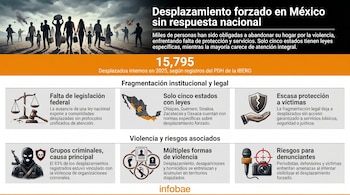
Currently, only state laws in Chiapas, Guerrero, Sinaloa, Zacatecas, and Oaxaca address the prevention, support, or reparation of this phenomenon.
Accumulated Violence and Forced Displacement in Mexico
The section “The Continuum of Violence: Displacement and Disappearance” highlights that these two phenomena are often treated separately in public debate.
However, the PSC analysis asserts that they are mutually reinforcing processes and form part of the same pattern.
“Disappearances, forced displacement, and homicides are part of ongoing and accumulated violence intertwined with territorial disputes between criminal organizations,” the report explains.
In Zacatecas, researcher Jairo Antonio López, from El Colegio de México, contributed an analysis based on four years of fieldwork and support for victims.
Organized crime in the country was identified as the main cause of internal displacement, although in Chiapas the situation is more complex due to the existence of historical social and territorial conflicts.
On the other hand, the study also warned that, to date, it has not been possible to categorize those affected by sex, age, or ethnicity, which hinders the creation of targeted policies.
Another section highlights the additional risks for journalists, human rights defenders, and the displaced people themselves who attempt to report these events.
The testimonies collected reveal patterns of forced recruitment of minors, the use of drones to spy on communities before armed attacks, mass displacement of families, and prolonged separations.
In 2025, the IBERO Human Rights Program (PDH) recorded at least 15,795 internally displaced persons in 73 incidents across 11 states. Eighty-three percent of these cases were linked to violence perpetrated by criminal groups, with Sinaloa, Chihuahua, and Michoacán being the most affected states.
Violence almost never occurs in isolation; rather, it is interconnected with gender-based violence, domestic violence, dispossession, and a lack of legal protection.
Source: infobae