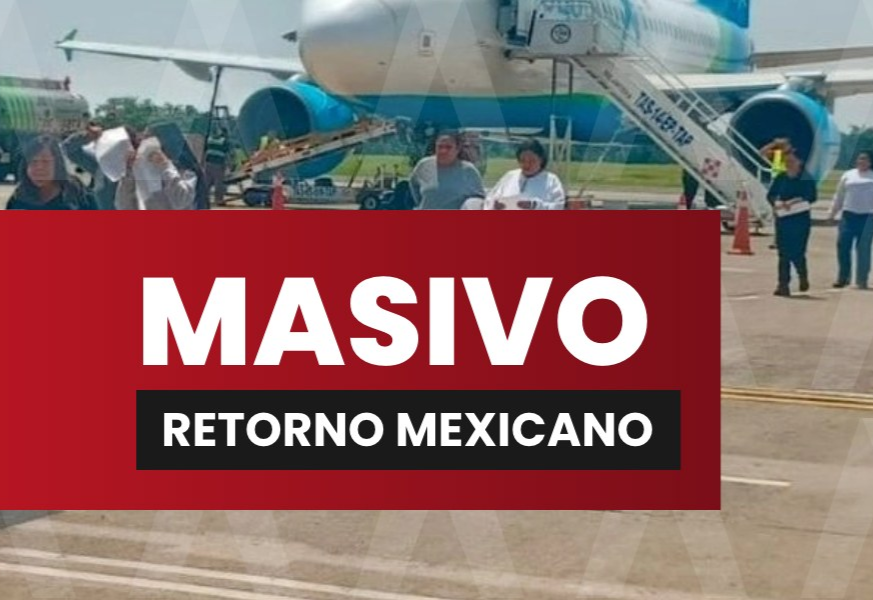

During this period, 203,685 Mexicans were returned to the country from the United States, 39,441 of whom arrived by air, reported the Secretary of the Interior, Rosa Icela Rodríguez.
Tapachula—located on the southern border of Chiapas—operates, alongside Villahermosa, as one of the two airports in the southern part of the country designated to receive repatriation flights under the federal México te Abraza (Mexico Embraces You) strategy.
The Official Tally
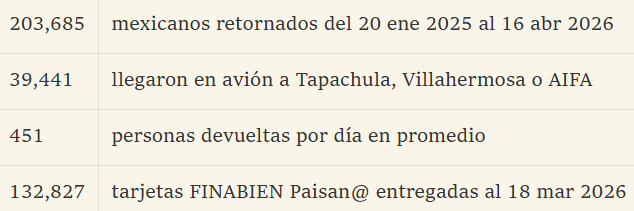
The figures come from two press conferences held at the National Palace. During the March 19 conference, led by President Claudia Sheinbaum, the head of the Ministry of the Interior (Segob) presented the numbers for the first time: 189,830 repatriations between January 20, 2025, and March 18, 2026, including 154,072 by land and 35,758 by air.
One month later, during the April 17 morning press conference, the figure was updated to 203,685 people, averaging 451 returns per day.
Secretary Rodríguez herself stated that the figures represented an 87% decrease compared to the previous year. However, the statement overlooks a qualitative shift that several specialized organizations have already pointed out: the profile of those being deported today.
“90% of deported individuals had lived in the United States for an average of four years.”
— Manuel Orozco, director of the Migration, Remittances, and Development Program at Inter-American Dialogue
For Orozco, the most relevant fact is not the total number, but the transformation in the profile of returnees. It is no longer mainly recent arrivals being deported, but workers who had already built stable lives in the United States. According to BBVA Research, 12 million Mexican migrants currently live in the United States, of whom 4.1 million are in an irregular immigration situation. The median age is 44 for men and 46 for women, reflecting a mature community with decades of residence and strong family ties now exposed to forced return.
Why Are Flights Landing in Tapachula?
The obvious question is why the United States is sending Mexican nationals all the way to the border with Guatemala. The official explanation from Mexico was provided by the National Migration Institute (INM) in February 2025: the INM proposed that U.S. authorities diversify repatriation flights to different parts of Mexico, including Chiapas, Tabasco, Jalisco, the State of Mexico, Morelos, Michoacán, and the Felipe Ángeles International Airport.
Specialized organizations offer a different interpretation. Analyses published by international think tanks argue that migrants detained in the central or northern United States may be transferred to cities along Mexico’s southern border as part of a strategy designed to increase the cost and difficulty of attempting to reenter the United States. Returning someone to a location 2,500 kilometers away from the northern border can triple the costs of return migration.
The Jesuit Refugee Service Mexico, which monitors arriving flights in Tapachula, has documented a recurring pattern.
“Several of them told us they were never informed that they would be deported to southern Mexico,” said Karen Pérez, director of the organization, referring to testimonies collected from repatriated individuals arriving in Chiapas.
Remittances: The Other Consequence
The impact of deportations is also reflected in financial figures. In 2025, remittances sent to Mexico ended an 11-year streak of continuous growth. The country received 61.791 billion dollars, a 4.56% decrease compared to 2024. According to data from the Bank of Mexico analyzed by BBVA Research, this was the first annual decline since 2013 and the sharpest drop since 2009.
For Chiapas, the numbers are especially significant. The state received 4.16 billion dollars in remittances during 2025, making it the fourth-largest recipient state in Mexico, behind Guanajuato, Michoacán, and Jalisco. Nationwide, more than 1.7 million households and 6.1 million people depend directly on these resources.
BBVA Research attributes the decline to three combined factors: U.S. immigration policies, the changing profile of deportees — now individuals with deeper roots and family ties in the United States — and the appreciation of the Mexican peso against the dollar.
Information for Repatriated Individuals
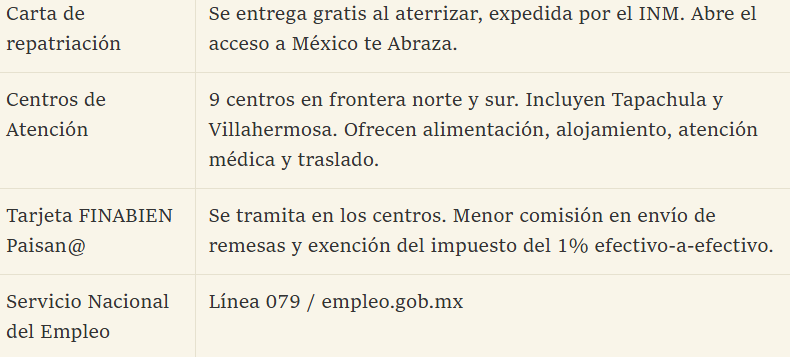
Those arriving in Tapachula do not enter Mexico as tourists. They receive an official document that serves as the key to accessing federal assistance programs.
How to Access Support
Procedures and contact information for repatriated individuals and their families.
Official Information and Resources
- Mexico Embraces You Program (Segob)
- Asylum Applications for Foreign Nationals (COMAR)
- UNHCR Mexico Assistance Portal
The repatriation air bridge was established without a formal bilateral treaty or legislative debate. It operates under an institutional framework that the federal government presents as humanitarian, while human rights organizations describe it as aligned with the tightening of U.S. immigration enforcement policies.
Several technical questions remain unanswered: what the final destination is for the people arriving in Tapachula, what percentage successfully reintegrates into formal employment, how many attempt to cross back into the United States, and what happens to those who are not originally from Chiapas but become stranded in southern Mexico.
Neither the Ministry of the Interior (Segob) nor the National Migration Institute (INM) has published a detailed breakdown of this information. Alerta Chiapas has stated that it will continue monitoring the situation.

Source: alertachiapas