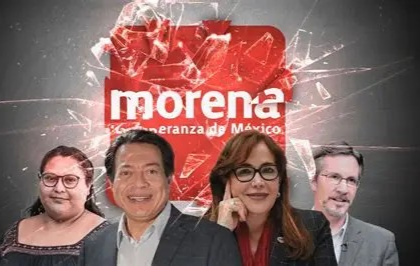

In Morena, the political battle that officially does not yet exist has already begun. The succession race in Sonora has accelerated the timeline and opened a fracture that could eventually reach the National Palace itself.
On one side stands Alfonso Durazo. On the other, Claudia Sheinbaum. Between them lies the future gubernatorial candidacy and an uncomfortable question: who truly controls Morena?
Durazo is backing Lorenia Valles, while Sheinbaum appears to lean toward Javier Lamarque. Publicly, everyone continues smiling, but the political signals are no longer subtle. In politics, gestures often carry more weight than speeches. And when the president breaks protocol to personally invite Lamarque onto the stage while ignoring other mayors, the message hardly requires interpretation.
Lamarque is not just another political figure. He was Morena’s first candidate for governor of Sonora back when the party barely survived electorally and earning 2.8 percent of the vote represented ideological stubbornness more than any realistic possibility of victory. Today, that long-standing militancy has acquired symbolic value. Morena increasingly needs to reconnect with its origins because the party is beginning to resemble the very political system it once promised to destroy.
The problem for Durazo is that an early succession battle also exposes weaknesses earlier than expected. And in that scenario, another dangerous element appears: the movement’s decline in the polls.
While political factions in Sonora fight over future candidacies, Morena nationally faces growing wear caused by scandals, internal divisions, and excesses.
A recent poll by Latinus journalist Lorena Becerra raised alarm bells. Morena reportedly lost ground in public perception, while Sheinbaum experienced a sharp decline in approval ratings.
The honeymoon period appears to be ending, and the ruling movement is beginning to discover something fundamental: governing produces political desgaste. Especially when a discourse of austerity coexists with accusations involving luxury lifestyles, fiscal fuel smuggling, and alleged uncomfortable ties to figures connected with organized crime.
And there, another problem emerges for Morena: Andrés Manuel López Beltrán, known politically as “Andy.”
The former president’s son has stopped being merely a symbolic political asset and has increasingly become a political liability. In Chihuahua, he reportedly had to leave an event under escort while protesters openly rejected his presence.
The failed mobilization against Maru Campos became a visible measure of Morena’s political erosion. Organizers expected at least 20,000 supporters but reportedly gathered fewer than 5,000 people. Even political mobilization machinery appeared unable to withstand the current political climate.
Yet perhaps the most delicate issue is not electoral decline itself.
What appears truly concerning for the ruling movement is the growing perception of arrogance. Morena increasingly behaves like the traditional political parties it once condemned — parties that treated public institutions as extensions of partisan power.
According to journalistic allegations, Mexican consulates in the United States have allegedly been used as political outposts to promote party affiliations and organize support structures favorable to Morena.
The old model of the party-state relationship — precisely the system they once criticized.
History often possesses a cruel sense of irony. Morena was born denouncing abuses of power, yet today faces accusations that closely resemble those same practices.
The movement criticized the electoral use of public institutions, and now accusations point toward consulates, political operators, and official government structures. They fought against the old regime… until they discovered the comforts of operating like the old regime.
Meanwhile, in Sonora, the silent war for 2027 has already begun.
Durazo is playing his cards. Sheinbaum is sending signals. Lorenia waits. Lamarque smiles. And Morena continues trying to convince the country that no internal division exists.
The difficult part will be maintaining that narrative once the internal wounds begin opening more visibly.
Because Morena’s real problem no longer appears to be the opposition.
Morena’s real problem increasingly seems to be Morena itself.
As often happens in politics, the most dangerous enemy eventually ends up sitting at the same table.

Source: sonorapresente