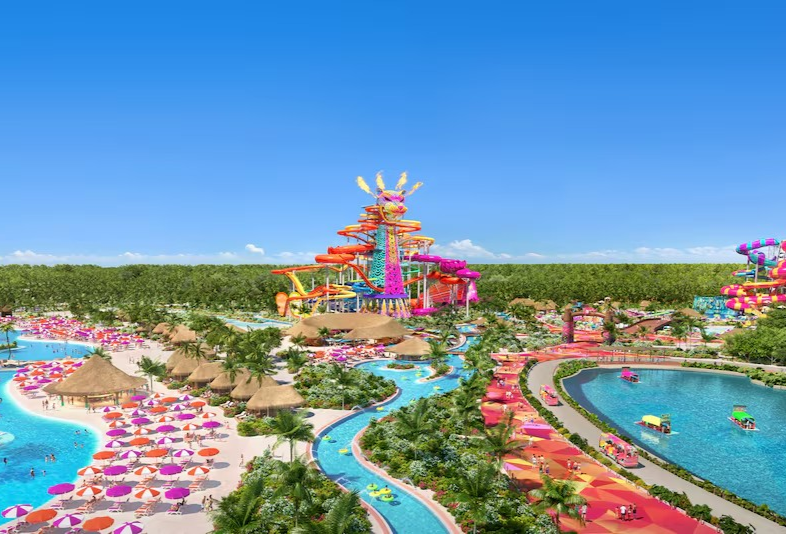

The cruise company Royal Caribbean appointed Ari Adler Brotman, a Mexican businessman and former director of the Institute for Development and Financing of the State of Quintana Roo (Idefin), as its representative in Mexico in 2025. Since then, the company’s multimillion-dollar investment plans have started to take shape with the proposal of a water park in Mahahual, a small fishing community of just over 2,600 inhabitants located on the Caribbean coast and near one of the world’s most important coral reefs.
The interview with Brotman took place days before Alicia Bárcena, Mexico’s Secretary of Environment and Natural Resources (Semarnat), announced that the federal government would not allow the construction of Perfect Day. The executive spoke about what he described as misinformation surrounding the project and explained the company’s commitments in the state of Quintana Roo.
Question: Royal Caribbean stated that there were inaccurate claims being made about Perfect Day. What is your position?
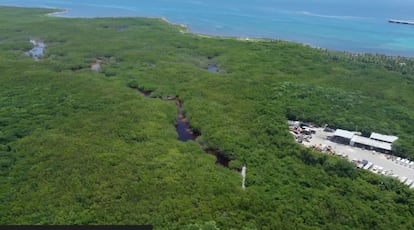
Answer: Royal Caribbean is a company with nearly 60 years of experience, and we also have many years of experience operating destinations similar to the one we are proposing with Perfect Day. We are very careful with environmental issues and legal compliance wherever we operate, and Perfect Day Mexico is no exception. We prepared a very thorough Environmental Impact Assessment (MIA). However, we see a lot of misinformation in the media and on social networks. Mahahual has long suffered from a lack of infrastructure, and as neighbors and investors, our goal is to help address those deficiencies and bring what the community truly needs. It has been said that we are going to destroy 90 hectares of mangroves in the jungle and that this is the last remaining stronghold, when in reality the opposite is true. Our project is being built on 45 hectares of land that already contains buildings, streets, and urban development. The other 45 hectares are a mangrove reserve that we acquired solely for the purpose of restoring it because it is currently badly damaged.
Q: What can you say about the approval of the land-use change that the municipality of Othón P. Blanco authorized quickly, and about Greenpeace’s analysis of your Environmental Impact Assessment?
A: The Urban Development Plan (PDU), if viewed without context, may appear to have been approved hastily. However, I should point out that the PDU had already been authorized since December 2024 and remained sitting on a desk for months without anyone paying attention to it. When we arrived and made the state government aware of the urgency of obtaining the necessary authorizations for the benefit of Mahahual’s population, and especially the southern part of the state, all that was done was to resume that process.
Q: And regarding the criticism of your Environmental Impact Assessment?
A: There is no perfect Environmental Impact Assessment. Someone can read one looking for its positive aspects or looking for flaws. I believe all MIAs can be improved, and we are open to incorporating any well-intentioned suggestions.
Q: What about the suspension ordered in January by the environmental protection agency (Profepa), which temporarily halted your work?
A: That closure by Profepa resulted from a public complaint that prompted an inspection. Due to a series of misunderstandings, the people handling the visit did not have the correct information. They answered questions incorrectly, and the official report stated that there was still damage and removal of mangroves. During later inspections by Profepa, it was confirmed that these damages were not real and that the only activity taking place was the demolition of an old abandoned water park that was even dangerous for anyone entering it. The debris was being removed, and we had municipal, federal, and state authorization for that work, which was confirmed.
Q: And what about the legal injunctions filed against the project?
A: Our position regarding these injunctions or any other legal action is that we have full confidence in the country’s environmental and judicial authorities. That is where these issues should be addressed. Unfortunately, our critics, for reasons we do not understand, have chosen to debate this entire process on social media. Because of our reputation as a 60-year-old company and because we believe it is the right thing to do, we handle all legal matters through the proper channels, and we have been successful in the different stages so far. We are certain there will be more legal obstacles, but we are fully prepared to face them. Not through the media, not by attacking or discrediting others, but simply by presenting the legal arguments necessary to support our position.
Q: What do you mean by critics?
A: I think all projects of this size and with this level of media attention always have people who support them and people who oppose them. Sometimes those opinions come from informed perspectives, and sometimes simply out of habit. People hear, “There are mangroves and they are going to be destroyed,” and immediately oppose the project. Those are the people I call critics: individuals without knowledge of the project details who spread harmful opinions on social media, damaging not only the project but also the Mahahual community. Mahahual and southern Quintana Roo have suffered from historical underdevelopment, and one of our first goals is to help reduce those social and infrastructure gaps. People who do not take the time to understand the project and simply repeat what they heard in a café or on social media are the ones truly causing harm—not to the project, but to the future of the Mahahual community. It is very sad to see the future of a community that has been neglected for so many years being decided on social media by people thousands of miles away who have never even visited the area. Many of them probably could not even point to Mahahual on a map.
Q: What can you say about the alleged conflict of interest regarding your appointment as president of Royal Caribbean Mexico after leaving your position at Idefin?
A: We have been very careful to ensure that there is no conflict of interest. My role at Idefin was to attract investment to Quintana Roo. I never had any contact with Royal Caribbean until after they purchased the port. Later, the company obtained authorization from Cofece (the Federal Economic Competition Commission), a process in which I was not involved. I also had nothing to do with the transfer control of the pier. Since joining Royal Caribbean, no major authorization has been obtained that changes the course of the project. If I truly had some magical key or conflict of interest, construction would already be underway.
Source: elpais