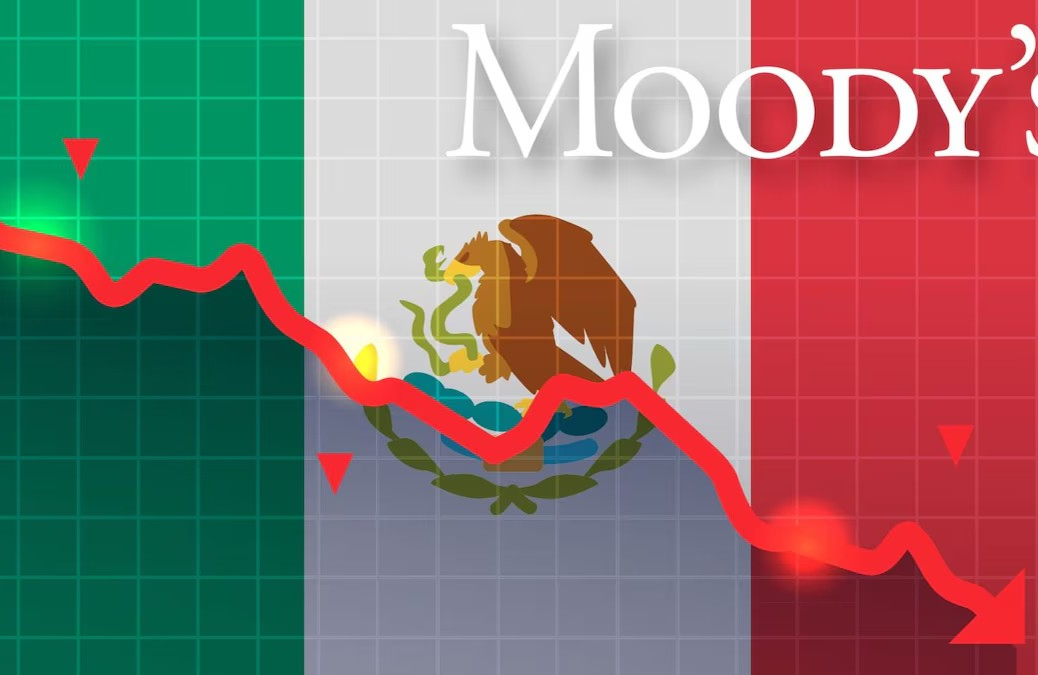

Faced with a sustained weakening of fiscal strength that accelerated in 2024 and is expected to persist, Moody’s Ratings downgraded Mexico’s sovereign rating to “Baa3” from “Baa2” and revised its outlook from “negative” to “stable.”
This is the third time the agency has downgraded the sovereign rating in recent years. The first was in April 2020, when it lowered it from “A3” to “Baa1.” Then, in July 2022, it lowered it to “Baa2.” In November 2024, it changed the outlook from “stable” to “negative,” and with its latest adjustment, it left the rating just one notch above speculative grade.
Moody’s justified this action by citing the observed rigid spending, a narrow revenue base, and continued support for Petróleos Mexicanos (Pemex), which limit the government’s ability to stabilize debt in a low-growth environment. It even noted that the fiscal position has weakened relative to countries with a “Baa” rating.
“Despite efforts to reduce the fiscal deficit, other policy priorities, such as energy sovereignty and a redistributive spending model, have weakened the pillars and effectiveness of fiscal policy, contributing to larger deficits and a faster-than-expected deterioration of debt indicators,” it stated.
The agency explained that the current rating recognizes a balance of factors: economic strength, preferential access to the U.S. market, and public initiatives to encourage investment. However, growth is limited by high levels of informality, insecurity, and bottlenecks in energy and water infrastructure.
In fact, it lowered its real GDP growth forecast for this year to less than 1.0 percent and expects growth of only 1.3 percent in 2027. In the long term, it anticipates growth of 2.0 percent.
Meanwhile, he clarified that the stable outlook reflects the expectation that further weakening of fiscal capacity will be gradual and offset by macroeconomic stability, although support for Pemex will continue to limit fiscal consolidation.
Carlos López Jones, director of Economic and Financial Trends, noted that Moody’s move was expected; however, he urged that the agency’s recommendations be heeded to avoid losing the investment grade rating.
“They are giving us an 18-month deadline. They want to know what spending will be like in 2027 and 2028. And if Mexico doesn’t change by the end of next year, they will put us on negative outlook, and then we could have problems,” he told El Financiero Bloomberg.
Both Moody’s and Fitch Ratings, which has Mexico rated at “BBB-” with a stable outlook, rate the country just one notch above speculative grade. S&P Global Ratings recently confirmed its foreign currency rating at “BBB” but changed the outlook to “negative.”
Analysts at Banamex anticipated the downgrade and emphasized that if Mexico fails to achieve sustainable growth and successful fiscal consolidation, including the finances of Pemex and CFE, it could lose its investment grade rating in the medium term.
Banorte highlighted that the three major rating agencies have updated their outlook on sovereign debt in recent months, with a more cautious bias prevailing across the board.
The Finance Ministry rules out further changes to Mexico’s credit rating. The Ministry of Finance expressed confidence that Moody’s Ratings will not lower Mexico’s credit rating further over the next 18 months and ruled out new cuts, emphasizing the strength of the country’s macroeconomic framework, as well as the size, diversification, and resilience of the Mexican economy to external shocks.
The agency noted that Moody’s highlighted Mexico’s track record of prudent monetary and macroeconomic policy management in the face of external shocks. “It pointed out that Mexico maintains limited external vulnerabilities, with no significant macroeconomic imbalances or signs of financial stress in the private sector or the balance of payments.”
The agency emphasized that the inflation targeting framework and the autonomy of the Bank of Mexico (Banxico) remain key elements for anchoring inflation expectations and preserving financial stability.
It added that international reserves total US$257 billion and that the country has a Flexible Credit Line of US$24 billion, factors that strengthen its capacity to respond to episodes of financial volatility.
Source: elfinanciero