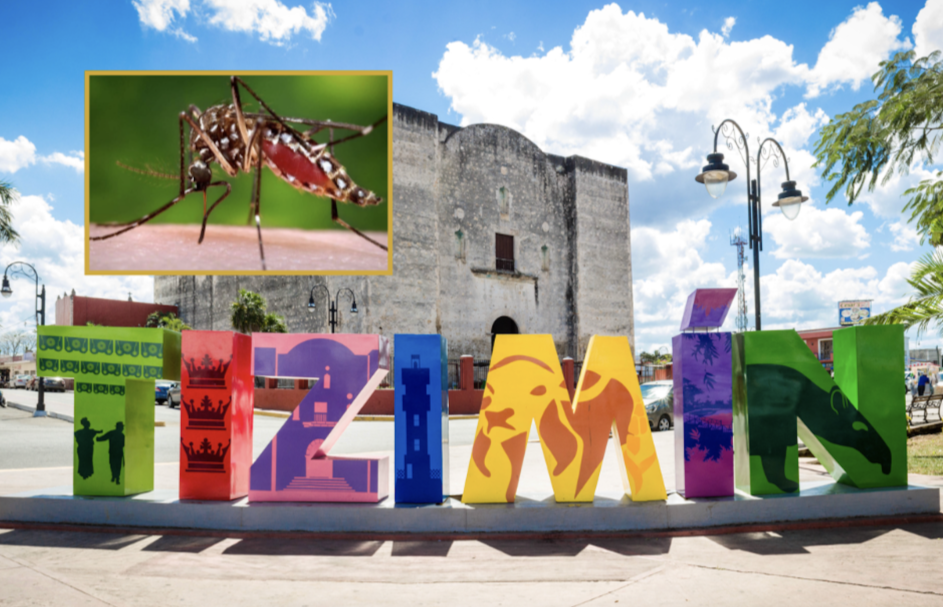

Yucatán reported only one confirmed dengue case during epidemiological week 19 (May 12–18, 2026), according to Mexico’s Secretaría de Salud. The case, detected in Tizimín, is the municipality’s first confirmed dengue infection of the year.
Health authorities also warned that two dengue virus serotypes capable of causing severe clinical complications are currently circulating in Yucatán, especially among people who have previously contracted dengue.
Located in eastern Yucatán, Tizimín has now become the fourth municipality in the state with confirmed dengue cases.
First dengue case in Tizimín
The Health Ministry did not specify whether the patient is male or female, but confirmed that the person was diagnosed with non-severe dengue, which includes symptoms such as fever, skin rash, red spots on the skin (petechiae), eye pain, muscle pain, joint pain, and bone pain.
However, authorities noted that the DENV-2 serotype is circulating in Tizimín.
According to Dr. Julián García Rejón, head of the Arbovirology Laboratory at the Dr. Hideyo Noguchi Regional Research Center in Mérida, “Type 2 is very, very aggressive.”
Óscar Flores Munguía, an epidemiologist with Mexico’s ISSSTE health system, also stated that the most severe dengue cases — including hemorrhagic dengue — are commonly associated with DENV-2 and DENV-3.
In fact, the Health Ministry identified Tizimín as Yucatán’s first dengue alert zone, marked in yellow on epidemiological maps, replacing Mérida as the state’s primary yellow-alert focus.
Red alert zones in Yucatán
Meanwhile, the southern municipality of Tixméhuac became the state’s first dengue epidemic zone, marked in red, followed by Progreso.
Authorities also reported that DENV-3 is circulating in Progreso and Mérida, while the serotype present in Tixméhuac has not yet been identified.
Dengue situation by municipality
- Tixméhuac has recorded one dengue case with warning signs, giving it the highest infection rate in the state: 18.37 cases per 100,000 residents.
- Progreso has one non-severe dengue case and a rate of 1.51 cases per 100,000 inhabitants.
- Tizimín’s first confirmed case gives it a rate of 1.15 cases per 100,000 residents.
- Mérida has accumulated five non-severe dengue cases and two cases with warning signs.
Although Mérida has the highest number of dengue patients overall, its infection rate remains low because the city has a population exceeding one million residents.
The geography of dengue outbreaks in Yucatán has shifted significantly compared to 2025. During the same epidemiological week last year, the red-alert municipalities were Dzemul and Chikindzonot, while yellow-alert areas included Akil and Tinum, home to Chichén Itzá.
Women account for most dengue cases
In total, Yucatán has recorded 10 confirmed dengue cases through week 19 of 2026, representing only 13.3% of the 75 cases reported during the same period in 2025.
According to the Health Ministry:
- Three women developed dengue with warning signs, including severe abdominal pain, bleeding, persistent vomiting, irritability, and fluid leakage.
- Of the seven non-severe dengue cases, authorities identified six patients by gender: two men and four women.
As a result, women currently represent the majority of dengue cases in Yucatán this year.
As of May 18, 2026, Yucatán has reported no confirmed dengue deaths, whereas one fatality had already been recorded by the same time in 2025.
Because both DENV-2 and DENV-3 are circulating in the state, health experts strongly advise people who have already had dengue to protect themselves from mosquito bites. Dr. García Rejón warned that “people who have had dengue once usually experience more severe infections in subsequent cases, regardless of which of the four virus serotypes is involved.”

Source: yucatan