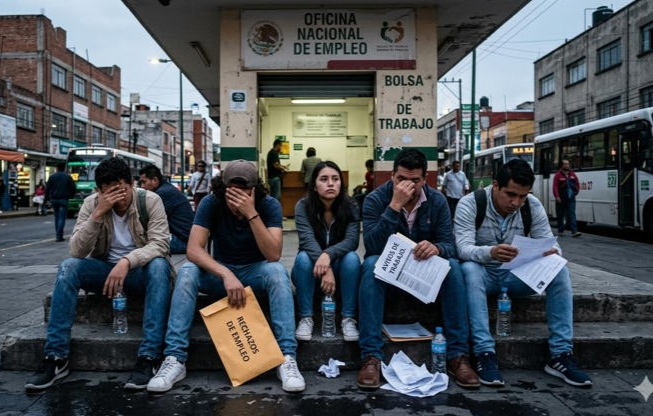

The economy lost momentum, investment stalled, and formal employment is no longer sufficient for everyone. This is how Mexico began the second quarter of 2026: with slower growth, heightened uncertainty, and flashing red warning signs regarding the financial well-being of millions of families.
The Bank of Mexico (Banxico) cut its economic forecast for 2026, warning that the country will grow by a mere 1.1%—well below the 1.6% previously projected and far removed from the optimistic outlook of up to 2.8% still maintained by the Ministry of Finance. The central bank acknowledged that the economy got off to a start this year that was “considerably weaker than expected.”
The blow is coming from multiple fronts. Banxico warned that investment will remain sluggish due to the uncertainty surrounding trade relations with the United States and the review of the USMCA (T-MEC) trade agreement, which officially kicked off this week in Mexico City.
It noted that, compounding this situation, are the risk of slower growth in the U.S. economy and the impact of the war in the Middle East—a conflict that has heightened pressure on financial markets, sent global energy prices soaring, and is affecting the trajectory of the global economy.
The Central Bank indicated that it will not be until 2027 that the national economy’s performance improves enough to reach a growth rate of 2.1%—a level that would, in turn, allow for the creation of more job opportunities for Mexicans and their families. “The downward revision of expected growth for 2026 stems primarily from economic activity performance in the first quarter of the year that was considerably weaker than anticipated.
“For the remainder of the forecast horizon—the rest of the year—expectations for a moderate pace of economic expansion remain unchanged.”
The country’s slower growth is also taking a toll on formal employment. In its January–March 2026 Quarterly Report, the Bank of Mexico estimated that throughout 2026, the country would generate a mere 260,000 to 460,000 jobs—positions featuring social security coverage, formal contracts, and all statutory benefits.
The report highlighted that the labor outlook improves slightly for 2027, when a range of 400,000 to 600,000 new formal jobs is projected; however, the central bank itself acknowledged that the economy would continue to operate under conditions of weakness.
Under both scenarios, the Bank of Mexico’s figures demonstrate that the country will remain far from meeting the annual demand for jobs—the number of positions Mexicans require to integrate into the economy—which the Organization for Economic Co-operation and Development (OECD) estimates at 1.2 million positions.
Based on this latter figure, even if companies and businesses were to generate the maximum number of jobs projected by the Bank of Mexico—460,000—they would succeed in covering only 38% of the employment opportunities required by the population, particularly for young people.
Along the same lines, even if the Central Bank’s upper-bound employment target of 600,000 formal jobs is reached in 2027, there would still be job opportunities available for barely half of the people actively seeking work—and this figure does not even account for the jobs that failed to materialize in 2026.
The Bank of Mexico reported that there are six significant risks that could stifle Mexico’s economic growth in 2026:
Increased uncertainty regarding U.S. trade policies and the review of the USMCA trade agreement, which could negatively impact Mexican exports, as well as domestic consumer spending and investment.
New military escalations in various global conflicts. Geopolitical events—such as the wars in Iran and Ukraine—that affect the global economy or international trade flows.
Episodes of volatility in domestic or international financial markets.
Slower-than-expected economic growth in the United States—driven by its trade policies—that impacts the export of Mexican products to that country.
Increased tariffs on certain imports originating from countries with which Mexico does not have trade agreements, thereby affecting economic activity.
Meteorological phenomena—such as extreme temperatures, cyclones, or droughts—that disrupt domestic economic activity.
Source: msn