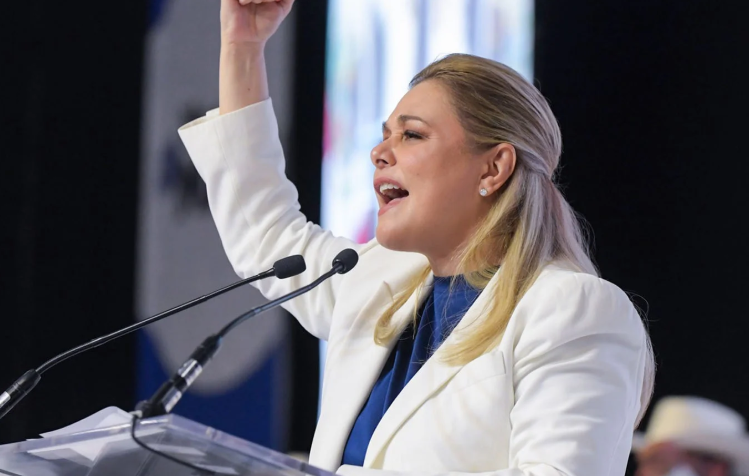

The governor of Chihuahua, María Eugenia Campos Galván, delivered one of the harshest statements by a state leader against the government of the Fourth Transformation, publicly admitting that she erred in attempting to maintain a cooperative relationship with the federal government and accusing Morena of having built a political system that favors organized crime.
During the “I’m with Maru” event, organized by members of the National Action Party (PAN) at the Chihuahua Convention Center, the governor maintained that at the beginning of her administration she opted for an institutional relationship with the federal government to guarantee resources, coordination, and stability for the state. However, she asserted that this strategy ultimately proved to be a mistake.
“Today, I tell you with all my heart and with all humility that I was wrong,” the governor declared, recalling the accusations leveled against her during presidential press conferences and what she described as a campaign of political persecution.
The statements come amid growing confrontation between the state government and the federal administration, particularly following allegations that have surfaced amid investigations and controversies related to public safety, drug trafficking, and accusations traded between political actors.
Campos escalated the situation further, asserting that the problem is no longer just a lack of government results, but rather the construction of a political model that seeks to concentrate power and weaken institutional checks and balances.
“Morena has not only run a bad government. Morena has already built a totalitarian regime to wield absolute power, concentrate it, and then hand that power over to organized crime,” she stated.
The governor went even further, maintaining that the country is facing a process of institutional capture by criminal groups. According to her assessment, organized crime not only operates with impunity but also directly influences political and electoral decisions.
“What they have built in these years is an absolute narco-government,” she declared before hundreds of supporters.
One of the central themes of her speech was the situation in Sinaloa, a state she presented as an example of the risks of so-called narco-politics. Campos maintained that criminal groups have interfered in electoral processes through threats, forced displacement, and pressure on opposition candidates.
“The cartels used their territorial control to manufacture victories for Morena. They kidnapped candidates, threatened leaders, and forced opponents to resign. And where do you think the laboratory for this entire system was? In Sinaloa,” she asserted.
The governor also took the opportunity to question the government’s stance on the investigations launched by the United States against Mexican officials allegedly linked to criminal organizations. Referring to the demands for evidence made by Morena leaders and figures, she maintained that the violence, disappearances, and forced displacements constitute evidence of the government’s failure to combat crime.
“Do you want proof? Well, look at the fear of the people. Look at the families searching for the disappeared. Look at the devastated young people, look at the displaced communities,” she said.
Although she reaffirmed the principle of national sovereignty, Campos rejected its use to protect officials accused of alleged ties to criminal organizations.
“I will always defend that sovereignty. But not the false sovereignty, the one that narco-politicians try to use as a shield,” she asserted.
The message concluded with a defense of the state administration and a call to maintain political resistance against the advance of Morena. Addressing the attendees, the governor affirmed that Chihuahua continues to champion democratic institutions, security, and the rule of law, and thanked them for the support received amidst the political confrontation with the federal government.
The event’s final slogan summarized the day’s tone: “Out with Morena.”
Source: literalmex