
It was a night that seemed ordinary in the vastness of Mexico’s northern border, but a political storm of historic proportions was brewing in the air. Shrouded by the mantle of darkness, an aircraft belonging to the Attorney General’s Office (FGR) landed in Ciudad Juárez, Chihuahua. It was not a routine flight. It carried no supplies, nor was it an institutional courtesy visit. This plane carried the weight of a state machinery designed for a single, chilling purpose. A perfect trap, meticulously planned from the highest spheres of power, was about to close in on one of the country’s most prominent opposition figures: Governor Maru Campos.
The objective seemed clear at first glance, but the true intentions behind this deployment of official force concealed a much deeper mystery. Why would they send a federal aircraft in the middle of the night? What secrets and fears drove the authorities to orchestrate such an aggressive legal ambush? Throughout this investigation, we will unravel step-by-step how this plot was built and how, in an unexpected twist of fate, the prey became the strategist. However, the final answer to the grand question regarding the true impact this dark night will have on the future of an entire nation will be reserved for the end of our narrative. Prepare yourself, because what you are about to read is not a suspense movie script; it is the raw, palpable reality of contemporary politics.
The Context: The Desperate Need for a Smokescreen
To understand the magnitude of what occurred that night, we must first take a step back and observe the complete picture on the national political chessboard. The current administration, often self-styled as the regime of the “Fourth Transformation,” found itself crossing through one of its most critical moments of media vulnerability. The monumental scandal surrounding the Governor of Sinaloa, Rubén Rocha Moya, had hijacked the headlines, coffee shop conversations, and social media networks. Public opinion demanded answers, pressure mounted minute by minute, and the ruling party’s image of invincibility began to fracture alarmingly.
In politics, when your own house is on fire, the most primitive instinct of strateges is to point out a fire elsewhere, or better yet, ignite a new one. The desperation to divert public attention—to “even out the score,” as popular jargon goes—led to a drastic decision. The pinnacle of power needed a high-caliber scapegoat. A minor official would not suffice; they needed someone whose downfall would generate an explosion massive enough to deafen the criticism against Rocha Moya and his alleged accomplices.
The regime’s gaze fell upon the “big state,” Chihuahua. Maru Campos—a firm, vocal opposition governor with a track record of refusing to bow to the center of the country—became the perfect target. The official excuse they attempted to manufacture bordered on the absurd, but in times of crisis, truth is usually the first casualty. They used a security operation as a pretext, one that, ironically, had been successful: the dismantling of a narco-laboratory in the intricate, difficult region of the Sierra Tarahumara. The narrative they intended to impose claimed that during said operation, there was an alleged intrusion by CIA agents. Based on this premise, the State machinery aimed to weave a highly severe, surreal accusation against the governor: treason against the nation.
An accusation of treason against the nation is one of the heaviest, most archaic tools in the State’s legal arsenal. It is a phrase that evokes historical execution walls and, in a modern context, is utilized to annihilate an individual’s reputation and career before they even step into a courtroom. By accusing Maru Campos of this crime, the regime sought not only to imprison her but to destroy her morally, politically, and socially. They wanted to initiate an impeachment process (desafuero) and a political trial that would keep her occupied, exhausted, and above all, far from the ballot boxes and microphones.
The Machination of the Legal Trap
The master plan was designed with a precision that bordered on procedural perversity. The governor was sent a subpoena on an unusual day: a Saturday. She was required to appear at the Government Palace in Chihuahua to testify. However, the actual appointment was scheduled at the offices of the Attorney General’s Office in the border city of Ciudad Juárez. This detail, which might seem minor, was actually the central gear of the trap.
Subpoenaing the governor of a sovereign state, who enjoys procedural immunity or constitutional fuero, represents an inherent act of disruption to her investiture. But the malice lay in the location and the nature of the appointment. Given that the FGR possesses a fully functional delegation in the state capital (Chihuahua) and even in the nation’s capital (Mexico City), forcing her to relocate to Ciudad Juárez carried a clear intent of isolation and vulnerability.
Furthermore, the subpoena included a warning that set off all alarms within Maru Campos’s legal team: it indicated that she must present herself accompanied by a lawyer. This simple phrase unveiled the true nature of the meeting. In the justice system, a witness is under no strict obligation to attend with legal defense because, in theory, they are not accused of anything; they are merely providing information. By demanding the presence of an attorney, the FGR was implicitly confessing that the status of “witness” was merely a facade.
The strategy followed a textbook guide for political persecution. Once Maru Campos was inside the federal installations in Ciudad Juárez, isolated in a border city far from her immediate support circle in her state’s capital, the trap would spring. They would inform her that her legal status had changed. From one moment to the next, she would shift from being a mere witness to becoming an indiciada (the accused)—the primary suspect in the investigation for treason against the nation.
This is where the mysterious plane that arrived the night before came into play. The intention was neither dialogue nor genuine investigation. The plane was there “just in case,” which in the language of absolute power means only one thing: it was ready to legally abduct her. By altering her status to that of an accused individual, and under the excuse of the crime’s gravity, they would attempt to issue a justified or mandatory pretrial detention on the spot. They would board her onto that plane, strip her of her freedom, and transport her to a maximum-security prison in the center of the country.
But what about the constitutional fuero? The immunity granted to her by the Constitution ensuring she cannot be detained without a prior declaration of precedence trial. In the arrogance of a power that feels untouchable, the fuero was considered a minor obstacle. The directive seemed to be “lock her up first, and we will figure out the fuero later.” In a country where legality has been stretched and molded to the executive’s will on multiple occasions, the regime trusted that the media blow would be so brutal that any subsequent legal defense would be irrelevant.
The immediate historical precedent that surely lingered in the minds of the government’s strategists was the case of the former governor of Tamaulipas, Francisco García Cabeza de Vaca. Years prior, he uncovered a monumental network of corruption and fuel theft (huachicol fiscal). Instead of the federal government acting against the criminals, the official response was a fierce political persecution against the whistleblower. The Chamber of Deputies, controlled by the ruling party, attempted to strip him of his immunity by force. Fortunately, at that moment, the Supreme Court of the Justice of the Nation intervened and determined that, as a governor, his own state congress had to endorse the impeachment, which did not happen.
However, the current outlook for Maru Campos was far bleaker. With the recent onslaughts against the judicial power and the constant narrative of delegitimization toward the Supreme Court, the regime knew that if they executed this coup de main and imprisoned the governor, the scandal would be colossal, but the objective of crushing a dissenting voice would be achieved. They wanted public opinion to feed on the morbidity and say “let her sink,” entirely forgetting the original scandal involving Rocha Moya that they were attempting to cover up.
The Master Stroke: When the Prey Becomes the Hunter
Faced with a scenario that seemed like an inescapable condemnation, Maru Campos’s response was not to hide within the comfort of her state or shelter in panic. On the contrary, she demonstrated a political astuteness and a steel temperament that completely unmoored her adversaries. She knew that going to Ciudad Juárez meant walking straight to the guillotine. The recommendation from her advisors was audacious and brilliant: take the battle to the adversary’s terrain, but under her own rules.
Instead of blindly obeying the biased subpoena, Maru Campos took a flight—not on the FGR’s plane, but toward the heart of central power: Mexico City. She decided that if they wanted to speak with her, they would do so in broad daylight, in front of the country’s cameras, and surrounded by the national press.
If you found yourself in a situation where the full weight of the State was attempting to corner you and strip away your freedom with false accusations, what would you have done? Would you have fled, hidden behind your lawyers, or faced the entire nation’s cameras?
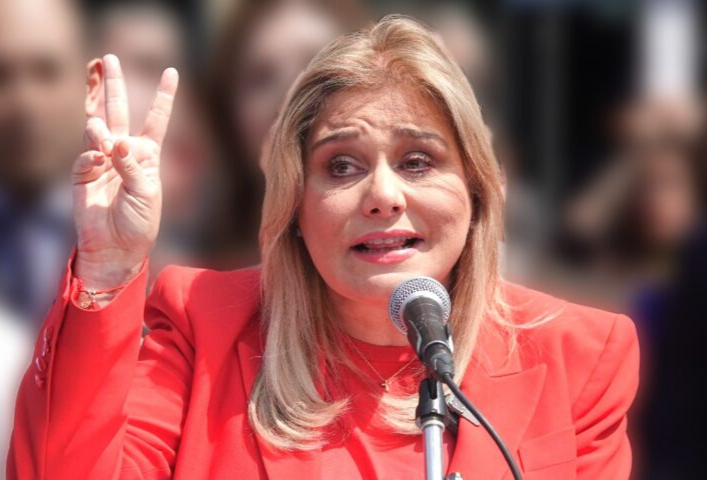
Maru Campos chose to face them. Upon arriving in the capital, she did not slip quietly into government offices. She summoned the media and stood firmly, flanked by key figures of her political party, the PAN, whom she managed to shake from their lethargy to accompany her in this act of historic defiance. Her message was not that of a frightened victim, but of a state leader defending the sovereignty of her institutions.
“Today I do not speak for myself. Today I do not speak for Maru Campos, today I do not speak for Chihuahua, today I speak for Mexico,” she declared with a forcefulness that echoed through the corridors of the National Palace. She transformed a personal attack into a national cause. She reminded the country of the true injustices the regime attempted to obscure: the lack of medications for children with cancer, the repression of teachers claiming their legitimate rights, and the cruel insensitivity toward searching mothers whom the government dismissively labels as “destabilizers.”
Maru Campos painted a raw portrait of a regime that, in her words, covers up for those who maintain links to trafficking and the crime that disappears families and fills Mexico with grief. Her call was directed straight to the conscience of the citizens: “Let us not normalize what is happening today. Let us not normalize the pain, the lies, and their eagerness to destroy anyone who thinks or acts differently.” She warned, with a chilling lucidity, that today she was the persecuted one, but tomorrow it could be any ordinary citizen.
Following this powerful demonstration of media and moral strength, Maru Campos walked under her own terms directly to the central facilities of the Attorney General’s Office. She entered the offices and confronted the authorities. “Here I am,” she told them. “I received this subpoena, but look at the legal grounds with which you are summoning me. It is completely improper. You summon me as if I were an accused individual, yet the paper says witness. The reality is that neither as a witness nor as an accused individual can you summon me this way, because I possess fuero and procedural immunity under the Constitution.”
After exposing the illegality and absurdity of the procedure, she turned around and left. She left them stunned. The state machinery, built to crush her in the darkness of Juárez, collapsed under the public light of Mexico City. They never saw the counter-stroke coming. The trap had failed catastrophically.
The Boomerang Effect: The Rebirth of Leadership and the Role of the Media
In politics, visceral actions frequently yield consequences diametrically opposed to those intended. In trying to destroy Maru Campos, the regime achieved the exact opposite. They handed her, on a silver platter, a national platform that otherwise would have taken her years to construct. Today, Maru’s figure has transcended Chihuahua’s borders. She has consolidated herself as a woman of potent leadership—a proven symbol of resistance who does not break before the state apparatus.
This act of abuse of power not only unified her own party but sent a glaringly clear message to other political forces. The opposition coalition, which at times appears fragmented and hesitant, received a shot of pure adrenaline. Leaders of other parties, such as the PRI, who have supported the governor unconditionally during this onslaught, realize that the only way to halt the authoritarian advance in the upcoming elections is through a ironclad alliance without fissures. It is foreseen that in the upcoming elections to renew power in Chihuahua, the opposition will march united to block Morena, thereby protecting one of its most vital bastions.
But the federal government’s clumsy handling of this crisis was not limited to the persecution of the governor. In its eagerness to control the narrative, the highest level of the executive committed a monumental miscalculation involving the mass media, specifically Televisión Azteca and its chairman, Ricardo Salinas Pliego.
During a press conference, the President of the Republic, visibly tense and cornered by criticism, issued an irresponsible appeal to the population: she requested that they stop watching TV Azteca’s broadcast. She attempted to disguise it as a “personal opinion,” but coming from a head of state, an opinion about a media outlet is never personal; it is a political directive, an attempt at censorship, and more gravely, a call for an advertising boycott.
The objective was to financially suffocate the network by scaring away advertisers who supported the news segments where the regime was questioned. However, this display of authoritarianism demonstrated a profound lack of political stature, straying drastically from what is expected of a world-class statesman.
The result was, once again, a spectacular boomerang effect. By asking the public not to watch TV Azteca, she drove millions of Mexicans, moved by curiosity and civic rebellion, to tune into the network. Anchors like Javier Alatorre, Manuel López San Martín, and even sports commentators like Christian Martinoli and Luis García experienced an astronomical surge in their audiences. The network’s nightly ratings broke records, reaching figures of 11 and 12 million viewers. In its rush to censor and punish, the federal government handed Ricardo Salinas Pliego and his company the largest, most effective free publicity campaign in recent history, strengthening the media muscle of those who do not fear questioning power.
The Future: A New Alliance and the Road to 2030
The failure of this dual assault—the legal one against Maru Campos and the media one against TV Azteca—has left a fascinating political landscape filled with possibilities for the Mexican opposition. Maru Campos is projected not only to win and retain hegemony in her state in the next local elections thanks to a consolidated alliance, but her name has automatically been catapulted into the major leagues.
As a woman with a vast and successful trajectory as a local deputy, a two-time federal deputy, mayor of Chihuahua’s capital, and now a governor who has confronted and defeated centralist authoritarianism, Maru Campos positions herself as a natural and highly formidable candidate for the 2030 presidential elections. She has proven that she knows how to confront not only organized crime within her territory but also the factional use of government institutions.
At this new level of political influence, a golden opportunity opens up for Maru to lead a grand national civic and political front. Her voice now carries sufficient weight to summon and rally other public figures, journalists, and politicians who, like her, are being harassed and persecuted by the state apparatus. There is already talk of the urgent need to Forge alliances with brave figures like Grecia Quiroz, uniting forces across all sectors that have suffered the horror of persecution. Forming a collective protective shield could be the key to stopping authoritarian strikes at their root.
The Resolution of the Mystery and the Final Answer
At the beginning of our story, we posed the grand enigma regarding the FGR plane that arrived in Ciudad Juárez under the cover of darkness. The mystery of its immediate purpose was quickly resolved: it was the physical tool to execute a legal abduction and silence a dissident. But the greater mystery—that of its long-term impact—is the true moral of this historic event.
The regime sent that plane not just to detain a woman, but to sow absolute terror throughout the nation. They sought to decapitate the opposition’s hope and send a mob-like message: “If we can imprison a constitutional governor holding fuero by inventing crimes against her, we can do whatever we want to any ordinary citizen.” They wanted the darkness of Juárez to blanket all of Mexico.
But the plan failed. The light of publicity, the courage to confront them face-to-face, and the absurd clumsiness of the government itself in simultaneously attacking the mass media caused the trap to blow up in their hands. In its desperation to extinguish a regional scandal (that of Rocha Moya), the regime inadvertently paved the path and forged in fire the temperament of the woman who could become its greatest adversary in the 2030 presidential race. The mysterious flight intended to be the end of Maru Campos turned out to be the vehicle that elevated her to the status of a national leader.
Do you consider these government intimidation tactics to be the beginning of the end for the current regime, or do you believe this is barely the start of something much worse and more aggressive? Leave your comment below and let’s discuss it in depth!
Because when blind, abusive power attempts to smother the truth in the darkness of the night, there will always be unyielding spirits ready to ignite a light that no one—absolutely no one—will ever be able to put out.

Source: trendingnews24