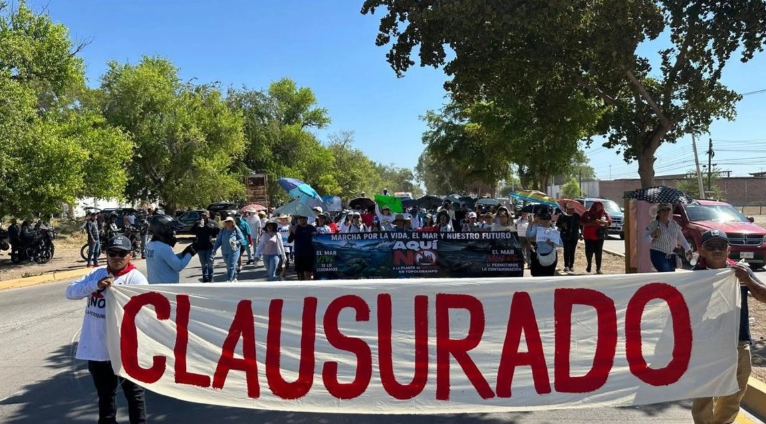

Thousands of people, mostly Mayo-Yoreme Indigenous community members, marched from Los Mochis to Topolobampo to symbolically shut down the ammonia plant that Proman-Gas and Petroquímica de Occidente (GPO) has been building on the shores of Ohuira Bay since 2014. They demanded that the federal government permanently cancel the project and relocate it elsewhere.
Led by the movement “¡Aquí No!” (“Not Here!”), the Indigenous demonstrators carried Mexican flags and flags representing the Indigenous nation. Citizens and environmental activists also joined the mobilization on foot, bicycles, motorcycles, and automobiles, traveling approximately 24 kilometers along Centenario Boulevard from Los Mochis to Topolobampo in northern Sinaloa.
With the goal of protecting Ohuira Bay and the future of their families, residents from across Sinaloa participated in the demonstration, chanting slogans such as “GPO Out, GPO Out!”, “Claudia, the Homeland Is Not for Sale!”, and “Not Here, Build It in Germany!”
Signs and banners displayed messages including: “I Don’t Want a Time Bomb for My Daughter!”, “Progress Must Not Destroy Life!”, and “Behind Every Student in This March Is a Fisherman Fighting for the Future of His Children!”
Other slogans included: “Not Here! Any government official who hands natural resources over to foreign companies betrays the nation!”, “Progress Must Not Destroy Life!”, and “But if a foreign enemy dares to profane your soil with its plant, GPO Out!”
Due to the large number of participants—including children, young people, senior citizens, and entire families—traffic authorities in the municipality of Ahome implemented road closures and security measures to protect the demonstrators.
At the entrance to the GPO facilities, in front of a large reactor that has been unable to enter the plant due to ongoing protests, participants performed traditional Indigenous ceremonial dances.
Felipe Montaño Valenzuela, representative of the Mayo Nation Association and leader of the Indigenous community of Ohuira, urged the government to abandon the ammonia project, which began more than ten years ago.
He stated: “Now it is our turn to defend our territory, which is being threatened by foreign interests and by municipal, state, and federal governments that are corrupt, because those who are not from here do not care what happens to us and only think about economic investment.”
He emphasized that Indigenous peoples were present long before the Spanish arrived and therefore have the right to justice and respect. He added that if the government wants respect, it must also respect the ethnic communities living around the bay.
Montaño Valenzuela stressed: “We must defend our territory, which is under threat. We have rights under Article 2 of the Mexican Constitution, which recognizes the multicultural composition of the nation and the rights of Indigenous peoples.”
He noted that the Constitution recognizes Indigenous peoples’ rights to self-determination, autonomy, cultural preservation, and self-governance. “We will demonstrate to the Germans and to the government that we will enforce those rights by defending what belongs to us, our children, and future generations.”
He added: “This day will remain in the memory of all of you—the struggle against foreign interests, the Mexican government, and state and municipal governments. Our traditional authorities will fight until the end to defend our territory.”
The protesters then unfurled a massive banner that symbolically canceled the project and warned that they would not allow the ammonia plant to begin operations.
“We do not want it. Take it somewhere else where it will not cause harm,” the Indigenous demonstrators declared.
Ecological Risks in Topolobampo
The protesters demanded that the Ministry of Environment and Natural Resources revoke the permits granted to the German-backed company GPO, arguing that the project could damage the ecosystem of Ohuira Bay.
Ohuira Bay is not only the primary source of income for hundreds of fishing families because of its rich marine productivity, but it has also been designated a Ramsar Site since 2008—a wetland of international importance recognized for its ecological, botanical, zoological, limnological, and hydrological value. It is also considered sacred territory by the Mayo-Yoreme Nation.
The bay serves as habitat for migratory birds, sea turtles, white-nosed dolphins, and breeding grounds for numerous marine species.
Opponents of the GPO project argue that the plant could pose serious environmental risks, including the discharge of heated water or chemicals, destruction of mangrove ecosystems, and the possibility of ammonia leaks, a highly toxic gas that could endanger nearby communities.
GPO initially invested approximately $1.6 billion USD in the fertilizer plant at the Port of Topolobampo. The facility is projected to produce 2,220 metric tons of fertilizer per day.
Despite public consultations and legal proceedings over the years, Indigenous communities have maintained their position that industrial development cannot and should not come at the cost of their homes, traditions, and environment.
Source: jornada