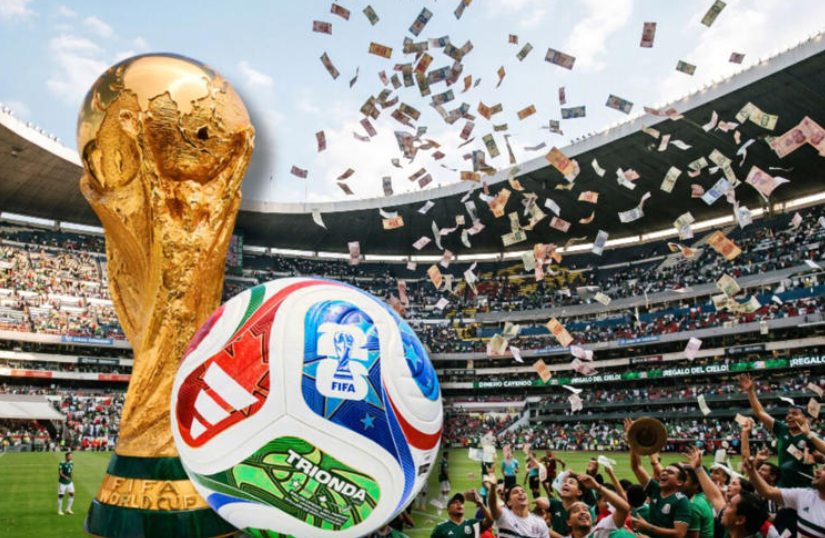

With less than a week to go before the start of the 2026 World Cup, Mexico is already calculating what could become one of the most economically impactful events in recent years. Between hotels, restaurants, transportation, souvenirs, and tourist spending, business owners anticipate an economic boost of up to 65 billion pesos, a figure that promises to significantly stimulate commercial activity in the host cities.
However, this economic enthusiasm is also accompanied by an uncomfortable contrast. That same amount is practically equivalent to the estimated annual cost of piracy and illegal trade in Mexico, an informal economy that threatens to capture some of the tournament-related spending and negatively impact formal businesses.
While the country prepares to welcome thousands of visitors and make history as the first nation to host three World Cups, economists warn that the impact on economic growth could be much more modest than the multimillion-dollar figures suggest.
According to El Economista, the Confederation of National Chambers of Commerce, Services and Tourism (Concanaco Servytur) projects an economic impact of up to 65 billion pesos from the 2026 World Cup, especially in sectors such as lodging, restaurants, transportation, convenience stores, entertainment, and local businesses.
The impact will be concentrated primarily in Mexico City, Guadalajara, and Monterrey, where the hiring of approximately 12,000 additional formal jobs is expected to accommodate the increase in visitors. Unlike the 1986 World Cup, this time spending will be much more digital, measurable, and diversified, driven by electronic payments, booking platforms, and connected tourism experiences.
However, one of the most striking figures is not solely the expected revenue. Concanaco estimates that annual losses due to piracy and illegal trade are around 63 billion pesos, a figure practically equivalent to the estimated economic benefit of the tournament. The problem is that some of the World Cup spending could end up outside the formal economy through counterfeit goods, informal tourism services, or illegal resale.
The expectation of a multi-billion dollar economic impact has fueled the idea that the World Cup could become a significant boost for Mexico’s slowing economy. However, specialists consulted by Expansión agree that the effect on Gross Domestic Product (GDP) will be limited.
Banamex estimates that the tournament will contribute around 0.1 percentage points to the country’s economic growth in 2026, while Grupo Financiero Ve por Más calculates an impact of between 0.1 and 0.2 percentage points. The activity would be concentrated in lodging, food, beverages, transportation, and entertainment, although its duration will be temporary and it is unlikely to change the structural course of economic growth.
In this context, economists believe that Mexico’s real challenge remains outside the stadiums: low investment, reduced productivity, and signs of economic weakening that a sporting event can hardly correct on its own.
In addition to the economic boost, the 2026 World Cup could also bring new risks for consumers and businesses. As the most digitally driven tournament in Mexican history, experts predict an increase in fraud related to counterfeit tickets, nonexistent accommodations, irregular tour packages, and online scams.
For this reason, Concanaco Servytur, along with Profeco, Amazon Mexico, and Meta, launched the “Don’t Let Them Scam You” campaign, focused on guiding consumers before making purchases related to the event.
Added to this is the potential for temporary inflationary pressure. Analysts at Banamex anticipate price increases related to lodging, food, and tourism services during June and July 2026, precisely when the influx of visitors is expected.
The World Cup could indeed bring more jobs, consumption, and economic activity for a few weeks. But if the estimates show anything, it’s that Mexico’s real economic game will continue long after the final whistle.
Source: msn