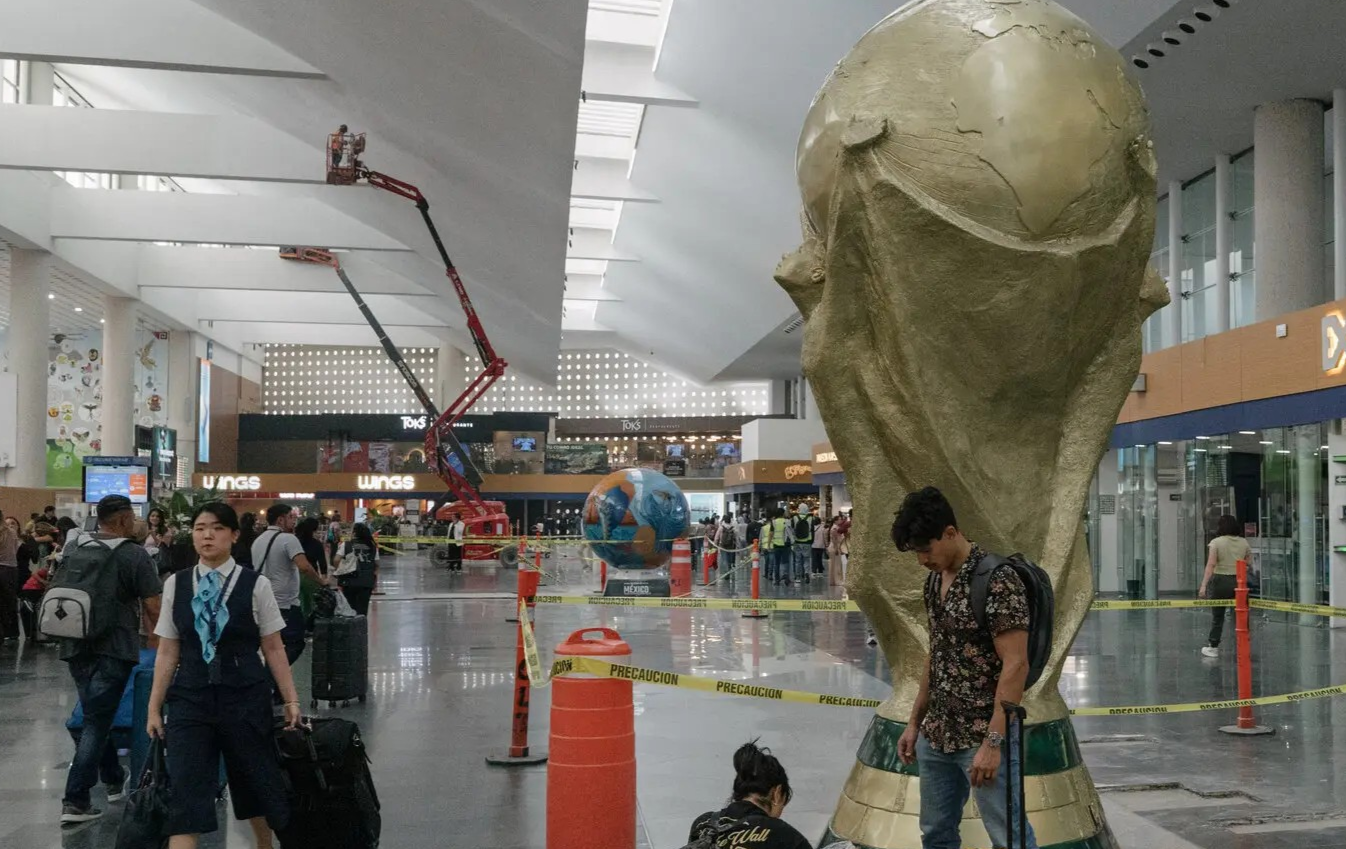

The scent of paint floated in the air at Benito Juárez International Airport. Jackhammers buzzed. Hallways were blocked with heavy machinery and caution tape.
Officials worked tirelessly to finish the $500 million in upgrades to the country’s most important airport before the World Cup begins this week in Mexico City. The challenge: the nearly 100-year-old airport, which has long ceased to be the necessary size, leaks, and is outdated, had to remain open during the remodeling.
More than five million visitors are expected in Mexico during the six-week tournament, which is jointly hosted with the United States and Canada. Airport authorities said they expected between three and four million passengers to pass through Benito Juárez, and recently insisted that the work would be completed on time.
“We are going to reach 100 percent,” said Admiral Juan Manuel Muñoz Gómez of the Mexican Navy, who helped oversee the airport remodeling ordered by President Claudia Sheinbaum a year ago. “We are prepared for that figure.”
But the World Cup has put Mexico City’s airport infrastructure under uncomfortable scrutiny.
Although passenger-related renovations were completed on May 31, it remains to be seen how the renovated airport will respond to the surge in demand that the tournament will generate. However, more work is needed, and officials said the remaining operational upgrades would resume after the World Cup. And doubts have already arisen about the speed and quality of the works last week, when part of a pedestrian bridge collapsed and blocked traffic.
Airplanes parked near a new runway exit at Benito Juárez International Airport.
Interior of the airport control room. Last year, Benito Juárez International Airport handled about 45 million passengers. It was originally designed to serve only about 32 million.
The overcrowded facilities had been neglected for decades, according to experts. They argued that they are neither worthy of one of the largest cities in the world —a metropolitan area of 23 million people— nor of a country of 133 million people with a growing economy.
The airport’s problems stem from a decision made years ago. In 2018, the country’s then-president, Andrés Manuel López Obrador, canceled the construction of a new $13 billion airport about 24 kilometers from the city center, even though the project was one-third complete. Instead, he built a $4 billion commercial airport at a military airbase twice as far away.
The result is the less-utilized Felipe Ángeles International Airport, which has grown since its opening in 2022, but last year only handled seven million passengers, compared to 45 million at Benito Juárez.
The renovations taking place at Benito Juárez are largely cosmetic, said Peter Cerdá, regional vice president for the Americas at the International Air Transport Association. The airport —which opened in 1928, with its first terminal expanded in 1952 and the second opened in 2007— had reached “a point of collapse,” he said, and the work of recent years has consisted of “band-aids.”
A new exhibition space near Terminal 1 features a scale model of the airport. Some critics say the ongoing renovations are mostly cosmetic and do little to improve operations.
Passengers waiting at a new rideshare car pickup station outside Terminal 1.
He pointed to the transfer of cargo operations to Felipe Ángeles and the cap imposed on flights bound for Benito Juárez, which had exceeded its original design capacity of 32 million passengers per year. These measures provoked outrage from the government of President Donald Trump, which accused Mexico of artificially propping up Felipe Ángeles and increasing costs for U.S. companies by millions of dollars with the transfer of cargo operations.
Cerdá said he was not worried about safety. But he was concerned about the capacity to handle projected regional growth of up to 6 percent annually without major works, such as the expansion or construction of new terminals and runways.
“These are positive measures, but they are short-term solutions for a World Cup,” he said. “It is not a medium- or long-term solution to deal with the growth that Mexico City and Mexico will experience.”
Officers from the Mexican Navy, who operate the Benito Juárez airport, insisted that the airport remodeling was more than cosmetic. Yes, the terminals have better decor, there are better food options, new flat screens, renovated bathrooms, improved waiting areas, and wider hallways recovered from old office and retail spaces. But they said operations had also improved.
Captain Arturo Flores Melgoza, coordinator of the airport renovation, left, and Admiral Juan Manuel Muñoz Gómez, who helped oversee the remodeling.
Aeroméxico crew members walk past a new mural depicting iconic Mexico City landmarks in Terminal 2.
With nearly 60 new automated boarding pass readers and more powerful baggage scanners, the officers said, they had reduced average security time from 17 to seven minutes. Immigration now has up to three times more interview booths and automated gates. A new facial recognition security system covers the airport, and an improved baggage claim process has been implemented.
New software aims at optimization in aircraft flow management, drainage has been improved on the airport’s two runways, and new taxiways allow planes to reach boarding gates faster. Those improvements, officials said, helped the airport recently obtain approval to increase the number of flights per hour from 44 to 46, still well below the peak of 61 in 2022.
“It’s not just a matter of painting,” said Admiral Muñoz Gómez. He added that Mexico would benefit from the renovations long after the tournament ends. “It is a demand from the people. It is something we all need.”
As workers laid tile recently, Roger Limon, 54, waited for his flight to Los Angeles. He visits the airport several times a year and lived in Mexico City for three decades. Back then, he said, the airport was already too old and small for a metropolis of that size.
“It’s too many people suicide,” he said.
Nearby, José Luis Cruz Ovando, 68, waited with his wife for a flight to southern Mexico. He said they had been to Benito Juárez several times a year, for years.
“They are putting on makeup, as we say here, to make it look beautiful,” he said. “It is. The gates have been made easier. But the runways and the space still worry me.”
Source: nytimes