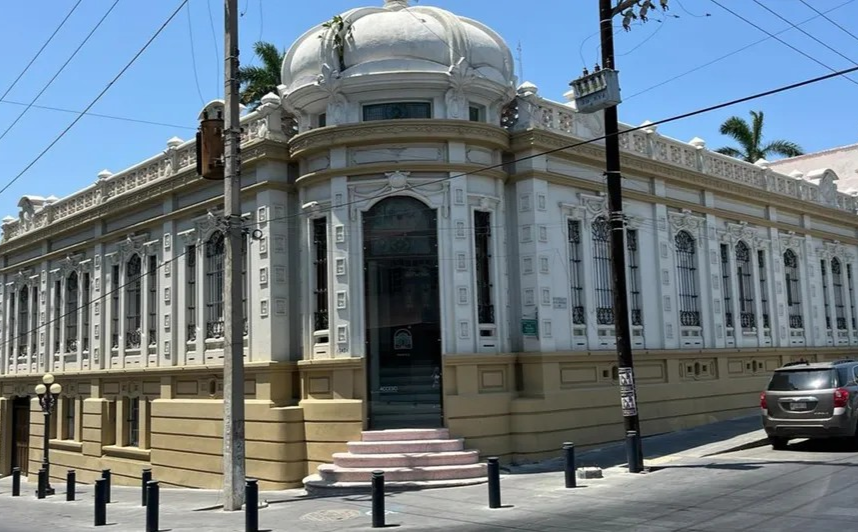

The Casa Fernández marks a century since its construction in 2026 and today shines as the majestic Museo de la Ciudad Tampico (Tampico City Museum), repurposed into a space that articulates past and present.
Known as “La Casa del Pastel” (The Cake House) due to the exuberance of its facade, it is a place where the city looks at itself, traces its history, and recognizes the footprints of those who built it. The building breathes through its walls, its moldings, and the way light still settles upon its stained glass windows. Within it, time has not stopped; it has accumulated layer upon layer as a silent way of narrating the history of a city open to the world, shaped by those who arrived from afar and decided to stay.
The Origin of a House with Memory
“Tampico was not built solely on oil. It was also built with human displacements, with trajectories marked by uncertainty, with memories that crossed the ocean and found a place to take root in this port,” explains the museum’s historian, David Granados Ramírez.
He relates that different languages arrived there and that architecture, in that context, was a form of permanence—a way to rebuild, in a foreign land, something that resembled one’s origin. The Casa Fernández embodies that impulse with clarity.
“Its history begins at sea. Luciano Fernández Gómez, a 16-year-old Spanish youth, undertook his journey to Mexico driven by the promise of a different life in the face of the crisis in his country. The journey, however, was not safe: a shipwreck interrupted his crossing and forced him to reach the shores of Tuxpan by swimming, literally clinging to survival.”
When he finally reached Tampico, the only certainty that had guided him—meeting a relative—had disappeared. His uncle Federico had died. What followed was a story of reconstruction.
The Community That Helped Build a Future
Like many other immigrants, he found a support system within the community that operated without formalities but with great efficacy: work, companionship, and networks of trust. Within this framework, Luciano started from the bottom, observing, learning, and gradually inserting himself into the dynamics of an expanding city.
“Everyone supported each other tremendously. The Spaniards had a system that was almost like a savings fund; you started working with a family, they would keep part of your salary for 10 years, and when the time came, they would give it to you so you could invest in a business.”
With time, his effort translated into stability and, later, growth. From an employee, he became a partner and, later, an owner. The hardware store “El Comanche” became a key business within an economy driven by the oil boom, where the demand for materials and tools grew at the pace of a city that never stopped transforming.
The Era of Splendor and the Construction of the Casa Fernández
“That context is fundamental to understanding the house. At the beginning of the 20th century, Tampico was living through a moment of effervescence. The port did not just export oil; it imported ideas. Ships returned with European materials, architectural pieces, and aesthetic references that were quickly reinterpreted into the urban landscape.”
The city looked outward but also reinvented itself from within. Old constructions began to yield to new aspirations: modernity, sophistication, and a sense of belonging to a wider world.
“It was at that moment when Luciano Fernández—married to Heliodora Viñas, who was born in Llano de Bustos, Veracruz, and was of Spanish descent—decided to build something more than just a house. He commissioned the project to engineers Bartolo Rodríguez Saunders and Antonio G. Aréchiga, who designed a residence influenced by the French academicism of the École des Beaux-Arts in Paris, known as Beaux-Arts.”
Its ornamented and symmetrical facade, the use of classical elements—columns, arches, and pediments—and the rich decorative details crafted to convey a sense of monumentality and elegance provoked collective admiration.
It was not common to see a decorative display of such intensity in Tampico. The comparison arose spontaneously: the house looked like a cake. And so it was named. Far from being a derogatory label, it ended up becoming a form of popular appropriation and a way to integrate it into the city’s imagination.
A House That Was Also a Home
“On the inside, the aesthetic continues with the same intensity. Each room possesses a different floor design, as if each space had its own personality. Stained glass windows soften the light, the doors preserve the trace of artisanal craftsmanship, and the details speak of an obsession with beauty,” explains Granados Ramírez.
But the house was not just an architectural gesture or a declaration of success. It was, above all, a lived space. For decades, it sheltered the daily life of a family with nine children: births, illnesses, celebrations, and farewells. It was a refuge in private moments and a stage for collective ones.
Once uninhabited, the property assumed diverse functions: a maternity clinic, a laundry facility for the England Hotel, the municipal directorate of culture, and a cultural center. Each stage left a mark.
From Family Residence to Everyone’s Heritage
“With the passage of time and as the city changed, many historic constructions disappeared. The modernizing impulse, which was once a sign of progress, also began to erode the material memory of Tampico. In that context, the Casa Fernández resisted when everything around it was transformed or lost,” underlines the historian.
Its destiny changed when it was incorporated into the municipal heritage. The subsequent restoration did not seek to freeze it in an idealized past, but rather to return meaning to it in the present. It was a process that implied both physical recovery and the symbolic reinterpretation of the space.
That transformation reached its highest point when, now in the 21st century, the house opened its doors as the Museo de la Ciudad Tampico. The change was significant. The rooms stopped being private to become exhibition halls; domestic hallways transformed into historical routes, and the beauty that previously belonged to a few became shared heritage.
A Museum Where the City Recognizes Itself
“Today, whoever walks through its doors does not just observe architecture. They participate in a conversation between eras. In its halls, large-scale processes—commerce, migration, the oil boom, and modernization—coexist with personal histories, everyday objects, family tales, and fragments of life. It is at that intersection where the house acquires a deeper dimension,” points out Elvia Holguera Altamirano.
The director of the Museo de la Ciudad Tampico emphasizes that the old “Casa del Pastel” is not just an aesthetic curiosity or a vestige of the past. It is a space where the city recognizes, thinks about, and narrates itself. A place where the past is not exhibited as something distant, but as something that still resonates.
At one hundred years old since its construction, the Casa Fernández is the past, but also the present. It is testimony, but also interpretation.
The Centennial of a Shared History
On Thursday, April 23, the Museo de la Ciudad Tampico held the event “La Casa Fernández: 100 años de historias” (The Casa Fernández: 100 Years of Stories), a journey through time that featured the participation of Graciela Fernández Cavazos de Alzaga.
With the presence of several family members, the memories, characters, and moments that have given life to one of the city’s most emblematic spaces were revived. On that night of reunion with Tampico’s history, memory, and identity, the event contextualized the relevance of the property, which solidifies itself as a key space for understanding the city’s evolution.
During the event, the museum director, Elvia Holguera, expressed gratitude on behalf of the board to the Fernández Cavazos siblings for all the support provided during the acquisition process of the house.
The site remains a source of local pride. Its preservation not only safeguards a built heritage but also the success story that gave rise to it. Currently, it is the meeting point between the city and its history, a living testimony to the origins and legacy of Tampico.
The museum was inaugurated in December 2023 as part of the city’s bicentennial celebrations and features 16 rooms, an auditorium, a souvenir shop, a cafeteria, and an outdoor garden. The rooms are organized chronologically and thematically, creating environments that transport visitors to different historical moments, enriched by a valuable collection of objects, documents, and images. Models, dioramas, and interactive multimedia elements complement the narrative, offering a deeper connection to each represented historical period.

Source: milenio