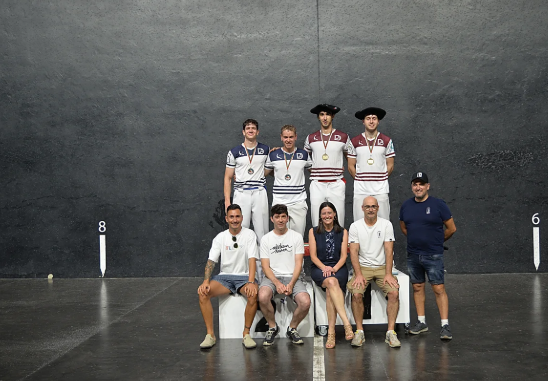

Last Saturday, Durango hosted an event rich in symbolism and high-level athletic performance at the Ezkurdi Jai Alai fronton, the venue for the men’s elite cesta punta championship final. Aaron González de Matauco and Oier Díaz—known as “Oierdi”—playing in the red sash, asserted their dominance to claim the txapela (champion’s beret) and the €1,000 prize.
The “red” pair defeated Amets Aldazabal and Iker Zarandona—the “blue” pair—in a decisive 2-0 victory, with set scores of 15-10 and 15-8; the champions displayed a rock-solid performance from start to finish.
The championship, which began in April, reached its conclusion following several preliminary rounds and a final stage that saw a clear rise in the level of competition. The decisive match brought together the tournament’s four standout players, yet it was González de Matauco and Oierdi who stepped up when it mattered most.
Both delivered a high-caliber performance, showing great composure in both their pacing and the execution of crucial points—reflecting their experience as regulars in the winter season at Miami’s Dania Jai Alai. Across the court, the blue pair fought hard to stay in the match, but their youth and nerves were evident in such a high-profile event. Notably, Iker Zarandona had played a near-perfect semifinal in the previous round, knocking out the favorites, Bonnin and Caparrus; however, he could not replicate that form in the final and appeared more nervous—though he will undoubtedly grow accustomed to competing at the elite level in future championships.
Moreover, the final was no ordinary day for cesta punta in Durango. June 13th marks the anniversary of the inauguration of the Ezkurdi Jai Alai fronton—which opened on that very day in 1955—meaning the championship final took place on a date of special significance for the town’s sporting history, notes the local Durango Jai-Alai club.
Following the match, the awards ceremony was held, presided over by the Mayor of Durango, Mireia Elkoroiribe; she and councilor Iker Urkiza presented the traditional txapelas (champions’ berets) to the winners. Also participating in the event were Iker Txertudi, the Durango City Council’s Councilor for Sports, and Egoitz Urrejola, representing the Durango Jai Alai Cesta Punta Club.
The day concluded on a festive and cultural note with a modern dance performance by the group HOTZIKARA—a piece created specifically for this final event.
Reflecting on the event, Sports Councilor Iker Txertudi expressed his satisfaction with how the championship unfolded and highlighted the historical importance of cesta punta in Durango. Indeed, since the fronton’s inauguration in 1955, the town has produced 135 professional pelotaris (players), many of whom built careers in frontons abroad as well as within Biscay.
Veteran pelotari Ramón Zarandona—grandfather of one of the finalists—also shared his story, recalling a twenty-five-year career that took him to venues in Miami and Orlando (Florida), as well as numerous courts across the Basque Country and France, following his debut at Durango’s Ezkurdi fronton. Zarandona also reminisced about his early days in the 1950s, just as the Ezkurdi Jai Alai was opening its doors.
Meanwhile, Gudiker Alberdi, president of the Durango Jai Alai Cesta Punta Club and School, offered a very positive assessment of the championship and the atmosphere surrounding the grand final. Alberdi highlighted that this is the largest cesta punta championship currently being held, featuring a total of 72 players, and emphasized the competitive format, which allows all participants to advance through the stages based on their results until reaching the decisive knockout rounds.
The club president also wished to acknowledge the backing of sponsors, the public’s response throughout the tournament, and the support of municipal representatives—all of whom he considered essential to ensuring the continued practice of cesta punta in Durango.
Source: elcorreo