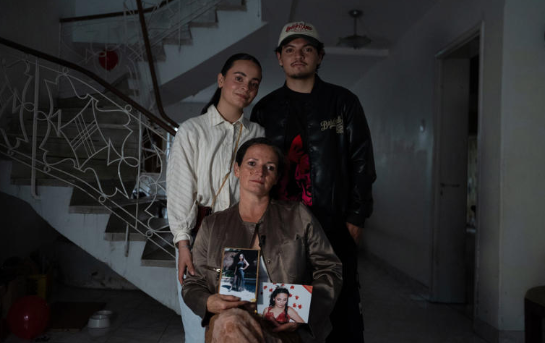

Manuela Silva was imprisoned for nearly two years in Mexico after being deceived by a binational criminal network that produced ketamine for illegal purposes in Bogotá and transported it to Mexico City. Based on evidence provided by the Prosecutor’s Office in Colombia, a federal judge in Mexico declared her innocent, yet she remained detained for another two months until a court once again ruled in her favor. Three days ago, she was deported to Colombia.
“Migration is a right,” reads, somewhat ironically, a colorful and cheerful mural at Agujas, the largest immigration detention center in Mexico, located on the southern edge of Mexico City. It is the place where hundreds of people are taken before being expelled from the country within less than 48 hours for lacking proper immigration documents. This is where Manuela Fernanda Silva Cortés, a 23-year-old Colombian woman, was taken in the early hours of Saturday, June 13, shortly before being deported to Colombia. Her feelings were mixed: she was happy to regain her freedom and reunite with her family, yet still deeply affected by everything she experienced during her nearly two years of unjust imprisonment in a Mexican prison.
I learned about her story six months ago, that of a Colombian woman who claimed she had unknowingly brought ketamine into Mexico after being deceived by a criminal organization. Mexican prisons are full of similar stories, but hers had an unprecedented element: the Mexican justice system recognized her innocence and still kept her imprisoned for nearly two more months, in addition to the almost two years she had already spent in prison while her case was being clarified.
Even the prison guards were unsure how to proceed. In fact, on March 31, 2026, they told Gladys Cortés that her daughter would be released.
“That day we were happy, we cried, we jumped with joy; Manu told me on the phone, ‘Mom, I’m finally getting out.’ She said goodbye to the friends she had made and gave away her belongings. I was waiting for her outside the prison. I brought food, flowers, and a change of clothes because they told us that, for good luck, anyone leaving prison should leave everything behind, even their clothes,” says Gladys, a 48-year-old Colombian single mother of five.
Shortly after one in the morning, the guard announced, “Alright, the last one,” and closed the entrance.
Gladys knocked desperately until the guard reopened the iron door.
“I told him, devastated, ‘Just a moment, sir, please, my daughter is still missing,’” Gladys recalls.
The guard asked whom she was waiting for and went inside to find out what had happened. He later returned and explained that Manuela had indeed been in the release line but had been removed and returned to her cell because, although she had been acquitted that day, the judge’s decision had not yet become final and the Prosecutor’s Office had appealed.
The Visit
At the beginning of June, I traveled from Bogotá to Mexico City to follow this story. The line to enter the Nezahualcóyotl Bordo de Xochiaca Penitentiary Center, known as Neza Bordo, on visiting day is long and exhausting and is composed mostly of women: mothers, sisters, daughters, and nieces waiting for 9:00 a.m. so they can enter.
Only immediate family members are allowed inside. They wear pink, beige, green, or red clothing to contrast with the inmates, who wear royal blue sweatshirts. They carry letters, hygiene products for both the inmates and the prison, and food, all in transparent bags or containers. In some cases, they hide food among their clothes—items that are restricted or very expensive inside, such as lettuce—as well as other goods intended to make life a little easier for their incarcerated relatives.
To get everything through, they usually carry between 200 and 300 Mexican pesos (about 17 U.S. dollars) in small bills, generally 50 pesos or less, to pass through each checkpoint without problems. Bribes determine what life is like inside the prison.
That day, Gladys Cortés is anxious to see Manuela as soon as possible, but she knows that the entry procedures can take up to an hour and a half. The time spent together inside is never more than two hours. That Saturday she was feeling down, but she always smiled so her daughter would not notice her sadness.
This state prison is enormous, covering nearly 121,000 square meters. It is an imposing structure of concrete walls that reflect the sunlight and tall gray bars. It houses nearly six thousand men and women in separate areas. The men’s section is larger than the women’s because the women’s area was built later as an annex.
Before the 1990s, Bordo de Xochiaca was a massive open-air landfill and sewage canal located on the border between Nezahualcóyotl and Chimalhuacán in the State of Mexico. In 1995, the prison, courthouse, and containment embankment were built on that flat, clay-filled peripheral land. Perhaps because of that, when the sun sets, a dirty cold settles in, freezing the nose and carrying the smell of dampness, garbage, and combustion.
“There’s Something Wrong in My Suitcase”
“I have a problem. There’s something wrong in my suitcase.”
Those were the last words Manuela Silva said to her mother on October 25, 2024. Gladys Cortés says that morning she imagined many possibilities, but never that her daughter’s suitcase contained something illegal.
Manuela had no criminal record. She was studying Social Communication and Journalism at the Santo Tomás University in Bogotá with the help of a government loan and had only one year left before graduating. She worked alongside her mother at a small family business that shipped packages and transported pets from Colombia to Mexico in order to cover her expenses.
According to the version of Mexico’s Attorney General’s Office contained in the case file, on October 25, 2024, at 11:40 a.m., National Guard agents Florencia López Maldonado and Francisco Vilchis Reyes, assigned to Felipe Ángeles International Airport, received a call to inspect a passenger.
According to their report:
“She carried objects in her suitcase that, according to the X-ray machine, due to their colors and characteristics, indicated the presence of an intensely orange organic material. The analysis determined it was ketamine hydrochloride. This substance is a controlled medication under the General Health Law. Therefore, we immediately moved to the Customs Tax Filter in the international arrivals area (…) We identified ourselves and asked whether she had any permit to transport the substance. She stated she did not because it was flavored powder for preparing beverages. Since one of the five bags contained a substance corresponding to a narcotic, Agent Florencia López Maldonado placed the passenger under arrest.”
The bag bore the label “Químicos Chemiandes,” weighed 107 grams, and the watermelon-flavored sweetened powder was mixed with ketamine and caffeine, according to the toxicology report.
The Investigation
For nearly four years, a businessman under investigation (whose name I will omit so as not to interfere with ongoing proceedings) sent powdered flavored-water packets from Colombia to Mexico through the shipping company where Gladys Cortés and her daughter Manuela worked, until Manuela was arrested. No one at the company suspected him. Luisa Fernanda Cortés, one of the owners, remembers calling him the day Manuela was detained and confronting him.
The businessman hung up, blocked the company’s numbers, deleted his social media accounts, and disappeared. As a result, the company filed a criminal complaint against him and hired a private investigator in Colombia who soon located him. After gathering enough information, they alerted Colombia’s Attorney General’s Office, which arrested him. During the investigation, two clandestine ketamine hydrochloride laboratories were dismantled.
In the criminal proceedings that followed, this individual admitted that Manuela Silva had no knowledge of his activities and had been deceived. This was recorded in a sworn statement he gave at the Attorney General’s Office headquarters in Bogotá on October 3, 2025:
—On October 24, 2024, at Felipe Ángeles International Airport in Mexico, a citizen named María Fernanda Silva Cortés was arrested carrying the narcotic substance ketamine. Could you indicate whether this person knew what she was transporting?
—No. I know for a fact that she did not. She knew nothing about it.
With this confession, Manuela’s defense team in Mexico requested a legal remedy used when new evidence emerges that could be decisive. They requested a dismissal hearing. During that hearing, her lawyers presented evidence proving that although Manuela had brought ketamine into Mexico, she had done so without knowing it.
An “invincible error,” her defense argued, because she had no way of knowing she was transporting something illegal.
Verónica Gutiérrez Fuentes, a district judge assigned to the Federal Criminal Justice Center in Hidalgo, reviewed the evidence and declared her innocent on March 31, 2026.
However, she stated that the decision to release her was not yet final…
Source: msn