
Mexico Also Needs the U.S., but the Economic Relationship Is More Interdependent Than Political Rhetoric Suggests
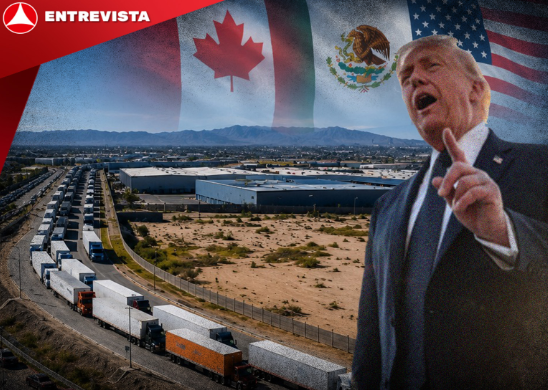
While U.S. President Donald Trump has once again raised doubts about the future of the trade relationship with Mexico and threatened to end the trade agreement between the three countries — including Canada — officials in Chihuahua see the situation differently: the United States also needs Mexico.
That is the position of Ulises Alejandro Fernández Gamboa, Secretary of Innovation and Economic Development for the State Government of Chihuahua, who argues that North America’s productive integration has reached such a level that a rupture of the trade agreement between Mexico, the United States, and Canada (USMCA) is unthinkable.
“We do not see any outcome other than the renewal of the treaty,” he stated.
In an interview with Norte Digital, the official supported his argument by pointing out that the productive supply chains linking both countries have existed for more than 60 years and continue to function positively for all parties involved.
He emphasized that economic reality goes beyond political discourse: the productive chains of the three countries are deeply integrated, and regional competitiveness depends precisely on that interdependence.
“It’s not as President Trump says: ‘I don’t need them.’ Yes, they do need us,” he asserted.
The statement carries particular significance at a time when the U.S. president has repeatedly advocated for a tougher trade stance toward Mexico and Canada while proposing new tariffs on various industrial sectors.
For Chihuahua, one of Mexico’s most export-oriented economies, the issue is especially important.
The Real Problem: Uncertainty
Contrary to what many might assume, the official believes that the main challenge facing the state economy is not the tariffs currently in place, since Chihuahua has maintained strong export performance despite them.
What is truly affecting business decisions is the lack of clarity regarding the future of the USMCA.
“What is impacting us is not having certainty about the treaty’s renewal,” he explained.
This uncertainty has caused some investments to remain on hold as corporations wait for clearer signals regarding the rules that will govern North American trade in the coming years. However, he insists that investor interest in Chihuahua remains strong.
Chihuahua Remains Attractive for Investment
Despite the complex international environment, Chihuahua continues to rank among the Mexican states with the highest number of announced investment projects.
According to data from Mexico’s federal Ministry of Economy cited by the official, the state ranks among the top three in investment announcements over recent months.
The sectors leading this momentum are electronics manufacturing, automotive production, and mining.
“We continue to see interest from companies seeking to establish operations in Chihuahua,” he said.
The explanation lies in the state’s strategic position within North America’s manufacturing supply chains, particularly in high-value-added industries.
Record-Breaking Export Growth
One of the clearest indicators of Chihuahua’s economic strength is its export growth.
According to figures provided during the interview, Chihuahua increased its exports from just over $75 billion to more than $109 billion in a single year, representing a 45 percent increase.
This growth is largely driven by the technological transformation of industries operating within the state.
The economy is no longer based solely on traditional manufacturing.
Today, companies in Chihuahua participate in the production of highly specialized components and equipment linked to data centers, artificial intelligence, and advanced technological systems.
From Electronic Components to Artificial Intelligence
Fernández Gamboa noted that the state’s electronics industry is undergoing a significant evolution.
Rather than producing only basic electronic components, some facilities now manufacture high-capacity servers for data centers.
These are systems whose value can range from $1.5 million to $2 million per unit.
This shift is fundamentally changing Chihuahua’s economic profile by generating more sophisticated supply chains and increasing the value added to exports.
“Electronics is no longer what it was ten years ago,” he summarized.
Nearshoring Remains a Major Opportunity
Although he avoids constantly using the term nearshoring, he acknowledges that the phenomenon continues to generate opportunities for the state.
Global companies are still seeking to relocate production closer to North American consumer markets, particularly following trade tensions with Asia and the logistical disruptions experienced in recent years.
In this context, Chihuahua stands out as one of the principal beneficiaries due to its geographic location, industrial infrastructure, and export experience.
Energy: The Challenge of the Next Decade
If there is one issue that particularly concerns both the Secretary of Innovation and Economic Development and the broader business community, it is the availability of electrical power.
The arrival of industries tied to artificial intelligence, data centers, and advanced processing technologies requires energy demands far greater than those of traditional manufacturing.
Some of these operations require between 25 and 50 megawatts to function, levels significantly higher than those of conventional industrial facilities.
For this reason, he views the federal government’s recent openness toward investments in power generation and transmission infrastructure as a positive development.
“Without energy, we will not be able to take advantage of the opportunities that are arriving,” he warned.
Reforms and Investor Uncertainty
During the interview, Fernández Gamboa acknowledged that certain reforms promoted by the federal government have generated caution among investors.
Among them, he mentioned judicial reform, the reduction of the workweek to 40 hours, and wage increases.
He clarified that the business sector is not necessarily opposed to these measures but seeks greater certainty in order to assess their impact on competitiveness and operating costs.
“Wages need to continue growing, but productivity must grow as well,” he concluded.
Source: nortedigital