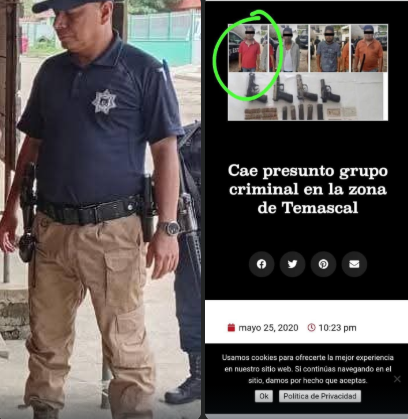

☝🏻They say that in Mexico even the humblest person can go far if they have connections, patience, and a good criminal record. And Donato Nolberto C. R. is living proof that, with the right “pull,” someone can go from being a bricklayer arrested for organized crime to commanding the municipal police of the town of Loma Bonita, Oaxaca. Does it sound like a Netflix script? Well, no—it is the chronicle of a kind of “self-improvement” that even Donato himself would not have dared to imagine.
🚔It turns out that Donato arrived at the position of head of the Loma Bonita municipal police not because of strategic skills or passing an entrance exam (which probably doesn’t even exist), but because he appeared in the State Public Security Secretariat’s bodyguard catalog as if it were a parts catalog. The municipal president—who according to local rumors owed a few million pesos to certain “respectable people” (read: mafias)—needed bodyguards who wouldn’t ask too many questions and who knew how to shoot, or at least looked like they did. Donato fit the profile: 46 years old, bricklayer by trade, and with a record that made him perfect for the job.
🚓Once in office, our protagonist earned the mayor’s trust with a loyalty that bordered on bovine obedience. So much so that when the position of police director became vacant (no one ever really knew why), Donato was chosen. Up to this point, one might think it’s a story of merit and effort. But no—the “goat always heads back to the hill,” and Donato, although now wearing a badge, was still the same man who appeared in a 2020 report as part of a criminal group in Temascal.
🍆And what did he do with his new power? Did he chase criminals? Seize drugs? Prevent robberies? No, that would have been too boring. Donato used his authority to turn the police station into an audition stage for harassment: he threatened, blackmailed, and harassed practically all female officers with the elegance of a drunk in a bar. His favorite tactic: “either you do me favors or you lose your job.” The women, tired of being treated like spoils of war, spoke up and filed a complaint with the SSP delegate, teacher Claudia Casarín.
👮🏻♀️But the universe of corruption is small, and Claudia was not exactly a saint either: she was allegedly a “ghost worker” in Loma Bonita, meaning she collected a salary without working, in exchange for advising the mayor. So instead of delivering justice, she went straight to tell the municipal boss. Because in this country, a complaint is like tequila: you drink it and pass it on.
🙇🏻♀️The harassment became so intense that the female officers organized to confront the mayor directly. That is when the detail that blew everything open came to light: one colleague who agreed to do “favors” for the director had been promoted almost instantly, without ranking, without exams, without anything. The last straw—and the glass wasn’t even a glass anymore, it was a swimming pool.
🤙🏻And what did the mayor do? Send him to jail? Fire him immediately? No, that would have been too logical. He only suspended him for a few days and demoted him. Donato remains in office, but now without the power to promote anyone in exchange for “favors.” A “model punishment,” as you can see.
📰As expected, social media users—faster than the INE at digging up information—rescued an old report from El Piñero de la Cuenca, dated May 25, 2020, where Donato Nolberto C. R., 46 years old, appears as one of the detainees in a criminal group alongside other bricklayers, mechanics, and housewives. Because, of course, all detainees claimed to be “residents of Temascal,” a municipality that, fun fact, is not Loma Bonita—but who is going to verify addresses or backgrounds when quotas need to be filled?
😮💨MORAL:
This story is not just local gossip. It is a portrait of how impunity works in Mexico. How is it possible that a person with a criminal record ends up in charge of the police? Because in this country, connections and secrets weigh more than records.
And that is the question that should hit everyone: why didn’t the mayor fire him outright? The answer is uncomfortable. Maybe Donato knows something very serious about the mayor, or maybe both are involved in the same mess. The truth is that keeping him in office sends a clear message: if you are friends with those in power, you can have a criminal record and it doesn’t matter—you might even become the boss of those who are supposed to protect us.
The officers who reported were exposed, Claudia turned out to be part of the system, and Donato, the former criminal, continues wearing his badge. Thus, between fake sanctions and decorative suspensions, the system keeps rewarding the wrong people. The lesson? In Mexico, it doesn’t matter if you have a dirty past—the important thing is who you know. And Donato, without a doubt, knows his boss very well. But the people—who do we turn to if the one watching over us is the same one we are supposed to be protected from?
Source: mexicodailypost