
Earthquakes in Yucatán Will Continue to Occur, Although Magnitudes Greater Than Those Already Recorded Are Not Expected
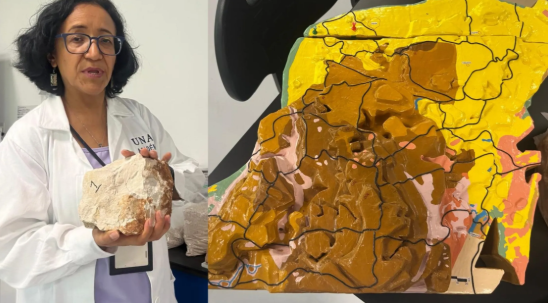
However, the type of soil found in the region can pose risks to buildings if appropriate measures are not taken, explains Juana Elia Escobar Sánchez, head of the Geology Laboratory of the National Autonomous University of Mexico (UNAM) in Yucatán.
“We cannot know when an earthquake will occur, much less how intense it will be, but the earth is always shaking… It is not true that there are no earthquakes in Yucatán,” she points out.
The geologist explains that the entire Yucatán block is a very homogeneous rock body, considered a passive tectonic plate. However, “that does not mean there are no earthquakes. There are movements, but they are very shallow and of very low intensity compared to those in the Pacific region.”
Why Are More Earthquakes Being Felt Now?
When asked why earthquakes seem to be more noticeable now, the professor at the National School of Higher Studies (ENES) in Mérida explains that modern instruments are increasingly sensitive, equipped with better technology, and capable of detecting a greater number of earthquakes than in previous years.
However, “there are records showing that earthquakes have been registered in Yucatán since 1900.”
Intensity of Earthquakes in Yucatán
Regarding the earthquakes that have occurred since last December, she explains that most originate in the area between Muna and Ticul, where the so-called Ticul Fault is located.
“It is a geological structure. It is a break in the Earth’s crust, but for it to be considered a fault, there must be displacement… There is fracturing and possibly slight movement… It is not an isolated rupture; there are several microfaults around it that are readjusting.”
The geophysics specialist explains that this fault is geologically very recent.
“It is about 30 or 35 million years old.”
She also mentions the North American Plate and the Caribbean Plate, which borders the Yucatán Peninsula.
The Caribbean Plate crosses Cuba.
“There are also movements in these two plates, and their intensity reaches us,” she explains.
Will the Yucatán Peninsula Break Away?
Regarding earthquake intensity, Dr. Escobar points out that statistically the strongest earthquakes recorded have been between magnitude three and four. Due to the tectonic setting of the region, it is expected that this pattern will continue.
“It is possible that a larger magnitude earthquake could occur, but it will not be as large as those that happen in Mexico City.”
As for the myths that have circulated recently, she says the one that has caught her attention the most is the claim that the Yucatán Peninsula will break away.
“How can people say that?
Maybe it will happen someday, but not in our lifetime, nor in two, three, or four human lifetimes… Tectonic plates are always moving. On average, they move about two centimeters per year, but that does not mean the Peninsula is going to break away.”
The Soils of the Peninsula Contain Soluble Rocks
The professor also emphasizes the importance of studying the soil and rocks, which have particular characteristics in the Peninsula that represent challenges and risks for construction.
“These rocks are mainly carbonate rocks: limestones and dolomites, which have a high rate of dissolution and are highly prone to fracturing… Studying rocks and the subsurface is very important for understanding, for example, water flow and the direction it follows. We do not have surface rivers; we mainly have underground water flows. And that water carries everything, including the contaminants that we release into the environment,” she explains.
On the other hand, Elia Escobar highlights a unique characteristic of the Peninsula:
“Sixty-six million years ago, a meteorite fell here. It possibly entered the atmosphere, disintegrated, and formed a large impact crater. That is why we should feel privileged…”
The Chicxulub Crater: A Scientific Laboratory
The researcher points out that the crater area functions as a scientific laboratory.
“When the meteorite entered, it is believed that it disintegrated in the atmosphere and only the impact wave reached the ground. Like a massive explosion, all the material was thrown upward and then fell back down. This is known as impact breccia. That breccia allows us to determine what types of rocks exist beneath the limestone layers and what the geological basement is,” explains the academic, whose primary research focuses on the impact area.
Final Message
As a closing remark, the specialist encourages people to stay informed, consult scientific sources, and avoid panic.
She also encourages interest in Earth Sciences, a field that studies soils, aquatic environments, environmental sciences, and other related topics.
“It examines how we are contributing to certain processes and how we can control them.”
Source: yucatan