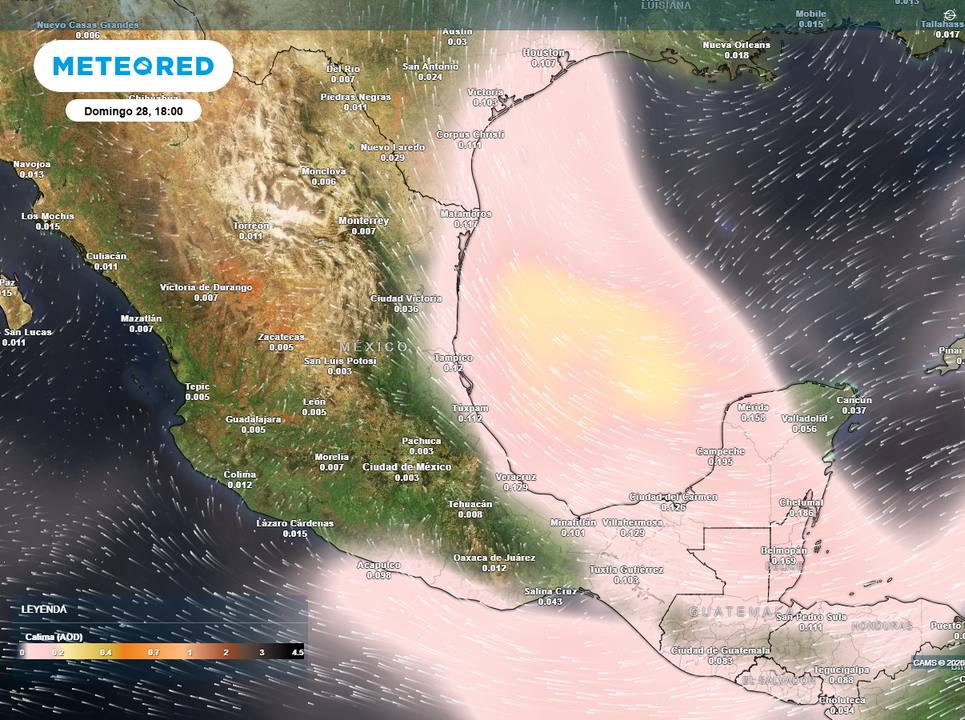

As is common during the summer, Saharan Dust will arrive in Mexican territory this weekend, crossing half the country and changing precipitation patterns.
Since midweek, low concentrations of Saharan Dust have crossed several states in Mexico, slightly altering rainfall patterns. However, concentrations are expected to increase in the coming hours due to a new pulse, the first of the summer of 2026, extending across half of the country.
Its full scientific name is the Saharan Air Layer, and it forms south of the Sahara Desert in Africa as a result of intense storms in the equatorial region, where tropical waves originate. It is then transported westward across the Tropical Atlantic and the Caribbean until it reaches Mexico.
Saharan Dust, a summer classic, will arrive in Mexico this weekend in moderate concentrations, creating hazy skies, reddish sunrises and sunsets, and altering rainfall patterns in several states.
For Mexico, its greatest impact occurs from late June, especially throughout July and into the first half of August, making it one of the factors contributing to the Canícula by helping reduce rainfall. As this dry, dusty air mass moves through, rainfall decreases while temperatures rise.
It also inhibits cloud formation, making tropical waves less active and even preventing the development of tropical cyclones or weakening existing ones. In Mexico, its greatest frequency and concentration occur in the southeast, the Gulf Coast, and the northeast, while it is less common in the southern Pacific, the Central Plateau, and western regions.
This Weekend Saharan Dust Will Arrive in Moderate Concentrations Over the Southeast, Gulf of Mexico, and Southern Pacific, Altering Rainfall Patterns
This dust also carries nutrients, traveling more directly toward the Amazon in South America. It does not pose a direct danger to the general population, although it may trigger symptoms related to dust allergies. This weekend it will be present in moderate concentrations, altering rainfall patterns and, to a lesser extent, temperatures.
General Forecast
As the dust moves across the southeast, east, northeast, and southern Pacific with fewer thunderstorms, tropical waves will move weakly across the central-southern region, the Mexican Monsoon will remain active over the Sierra Madre Occidental, and mountainous areas will continue to experience rainfall, while hot conditions persist across northern Mexico.
Between Heavy Rain and Sunshine
Today, Friday, the strongest thunderstorms are forecast for Quintana Roo, Veracruz, Guerrero, the State of Mexico, Guanajuato, Michoacán, Jalisco, Colima, Nayarit, and the mountainous regions of Sinaloa, Durango, Sonora, and Chihuahua, with rainfall totals of 10–30 mm and localized amounts of 50–75 mm. In the southeast, Saharan Dust may combine with these rains.
More isolated rainfall of 5–20 mm is expected in Yucatán, Campeche, Tabasco, Veracruz, Oaxaca, Puebla, Tlaxcala, Morelos, Mexico City, Hidalgo, Querétaro, San Luis Potosí, Tamaulipas, and Zacatecas. On Saturday, rainfall will decrease in the southeast while increasing across much of the east, central, and western regions, with very heavy rainfall events expected.
Much of Mexico will receive rain, with the heaviest expected in the central, western, eastern, and northwestern regions, bringing cooler conditions, while rainfall decreases in the southeast due to the Saharan Dust.
The heaviest rainfall is expected in Veracruz, Chiapas, Hidalgo, Puebla, Tlaxcala, the State of Mexico, Morelos, Querétaro, Guanajuato, Oaxaca, Guerrero, Michoacán, Jalisco, Nayarit, and along the Sierra Madre Occidental, with totals of 20–50 mm and localized amounts of 75 mm or more, extending into the state of Chihuahua.
On Sunday, rainfall will persist in these regions, becoming even more widespread and intense. The heaviest amounts are expected in Oaxaca, Guerrero, Morelos, Mexico City, the State of Mexico, Hidalgo, Querétaro, Guanajuato, Michoacán, Jalisco, Nayarit, Chihuahua, and the mountainous regions of Sinaloa, Sonora, and Durango, where localized totals may exceed 70–100 mm.
Temperature Trends
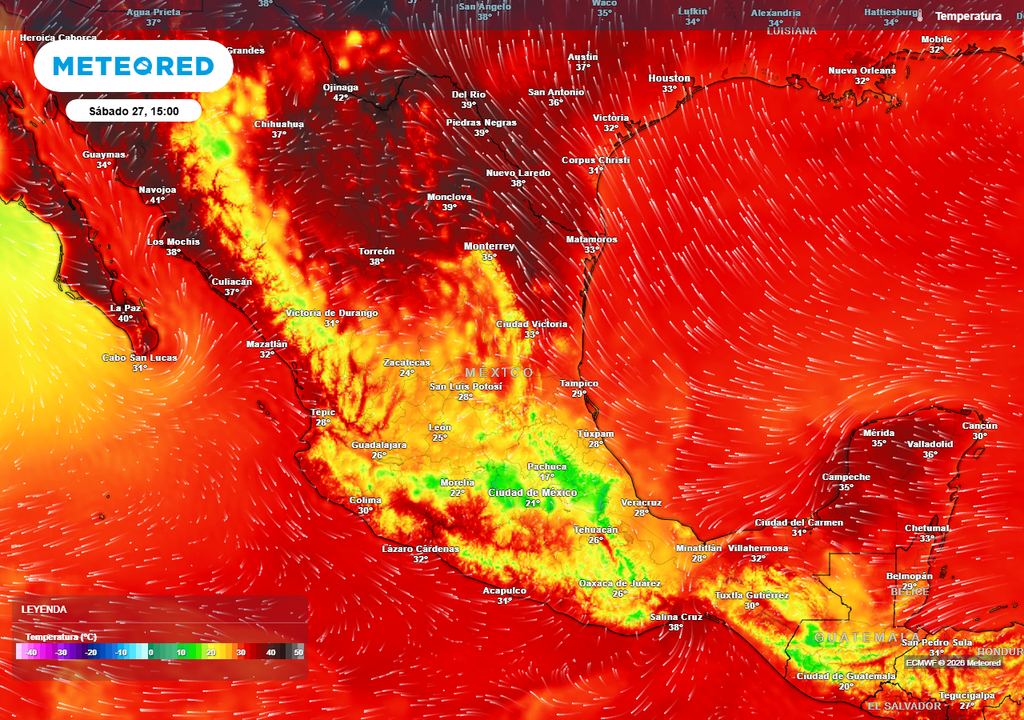
Hot weather will continue across the northwestern, northern, northeastern, Gulf Coast, southeastern, and Pacific states, with maximum temperatures of 35–40 °C and possible extremes of 41–46 °C in lowland and low-altitude municipalities, with even higher temperatures possible in parts of Baja California and Sonora. These conditions are typical for this time of year due to both the high-pressure system and the Saharan Dust.
Extreme heat will continue across northern, eastern, and southeastern Mexico, with temperatures of 40 °C or higher, while the Central Plateau will experience cooler conditions due to frequent rainfall, with highs between 15–25 °C.
In contrast, all states across the Central Plateau will continue to cool as a result of the expected rainfall, with maximum temperatures of 23–30 °C in western Mexico and the Bajío region, and around 15–25 °C in the central portion of the country, including the Valley of Mexico. Temperatures will drop even further after rainfall. During the nighttime, conditions will feel very cool to cold, especially in higher elevations and open rural areas.
Source: meteored