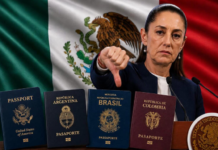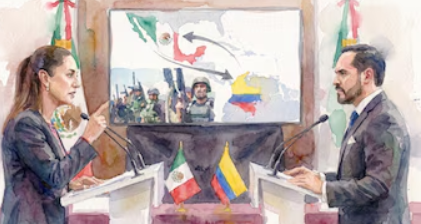

President Claudia Sheinbaum responded this Friday, June 26, 2026, to statements made by Colombia’s president-elect, Abelardo de la Espriella, who recently designated Mexican cartels as a military target and blamed them for the violence in the Cauca region.
During her morning press conference, the Mexican president addressed the issue, emphasizing that Mexico has a good relationship with Colombia; however, she asked that each country “take responsibility for its own actions.”
“There has been collaboration and cooperation with Colombia for a long time, not just recently. It’s not that there was collaboration specifically with President Petro. There is a relationship between the Colombian and Mexican Armed Forces, and there are mechanisms for collaboration. That exists,” the president emphasized.
In this way, Claudia Sheinbaum sought to distance bilateral work from recent political statements, insisting that cooperation transcends the governments in power.
The president was questioned about whether her administration would seek direct dialogue with the new Colombian government, particularly to discuss the possibility of combating Mexican cartels through mechanisms of cooperation, intelligence sharing, and respect for sovereignty, as is the case with the United States, and not through declarations of war. In response, Claudia Sheinbaum reiterated the importance of each country taking responsibility for its own internal affairs.
“Now, let each country take care of its own part, right? Let each country take care of its own part.” “Colombia should take care of its part, and we’ll take care of ours,” the president declared.
Throughout her address, she emphasized that any political differences between the two countries’ national projects should not become an obstacle to cooperation, nor should they translate into public confrontations or statements that strain bilateral relations.
In Colombia’s recent presidential elections, Abelardo de la Espriella emerged victorious, marking a significant shift in the country’s politics. De la Espriella, a lawyer and businessman with a strong media presence, presented himself as an “outsider” and quickly consolidated his candidacy, supported by a discourse focused on security, institutional order, and a frontal assault on crime and corruption.
De la Espriella’s victory was confirmed with 98.86% of the polling stations reporting in the official preliminary count, obtaining 49.65% of the total votes, surpassing Iván Cepeda, the candidate of the ruling Historical Pact. This result represents one of the most important contests. The closest elections in Colombia’s recent history, with a difference of just 250,800 votes and high voter turnout, marked a peaceful election day.
Mayor Claudia Sheinbaum attributed the claims that drug cartels control Mexico’s northern border to the U.S. election and maintained that the reduction in fentanyl trafficking is solely due to the coordinated efforts of both countries, following a U.S. official’s assertion that cartels dominate that region.
The mayor stated at her morning press conference that President Donald Trump himself posted on social media two days prior that the border with Mexico is the most secure and acknowledged a nearly 66% decrease in fentanyl trafficking. Sheinbaum added that, according to data from the last month, the drop reached almost 74%.
The mayor was responding to statements by Markwayne Mullin, identified in the source text as the U.S. Secretary of Homeland Security, who asserted that cartels maintain total control of the northern border. of the country through “plazas” (community centers) under criminal operation.
Sheinbaum maintained that a secure border could not exist without action on both sides and without collaboration between Mexico and the United States within their respective territories. She also reiterated a position that, she said, Mexican governments of different political parties have held: more bridges, not more walls, should be built between the two countries.
Source: infobae