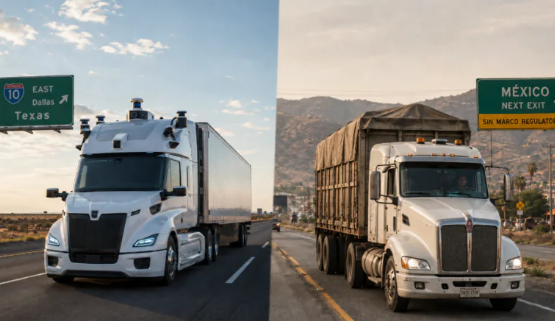

Aurora Innovation has surpassed 100,000 driverless kilometers on public highways and plans to deploy hundreds of autonomous trucks in 2026. Kodiak, Waabi, and PlusAI are competing for the same freight corridors. Less than 500 kilometers from the Mexican border, the trucking industry is undergoing its most significant technological transformation in a century, while a regulatory gap threatens to leave Mexican carriers behind.
The U.S. trucking industry generates nearly $1 trillion in annual revenue and faces a shortage of more than 80,000 drivers, according to industry data cited by multiple analysts. Experts agree that this combination of a massive market and a structural labor shortage is the primary economic force behind the race to commercialize fully autonomous freight trucks. By 2026, what was once considered a future technology has become a regular commercial operation.
Aurora Innovation: From Proof of Concept to Commercial Driverless Operations
Aurora Innovation, headquartered in Pittsburgh, became the first company to operate a regular commercial freight service using fully driverless Class 8 trucks on public highways in the United States.
Its first route, connecting Dallas and Houston, began operations in 2025. In October of that year, the company launched a second driverless corridor between Fort Worth and El Paso, covering approximately 965 kilometers.
By early 2026, Aurora had surpassed 100,000 kilometers driven without a human operator onboard, reporting zero crashes attributed to its autonomous system and maintaining nearly 100% on-time deliveries while serving customers such as Uber Freight, Hirschbach Motor Lines, and Driscoll’s.
An Aurora autonomous truck can travel approximately 1,000 miles in 15 continuous hours, nearly twice the distance achievable by a human driver, who is limited by federal regulations to 11 hours of driving within a 14-hour work period.
Competition Intensifies: Kodiak, Waabi, and PlusAI Join the Race
Aurora is far from alone.
Kodiak AI currently operates 15 autonomous trucks in Texas for customers including J.B. Hunt and Werner Enterprises. CEO Don Burnette has confirmed that the company plans to begin fully driverless interstate routes during the second half of 2026, with the Dallas-Houston corridor among its primary candidates.
Waabi, founded by Raquel Urtasun, plans to deploy a fleet of autonomous Volvo trucks in Texas on a timeline similar to Aurora’s.
Meanwhile, PlusAI intends to begin operations in Texas in 2027 by integrating its autonomous driving software into International trucks through partnerships with Traton Group—Volkswagen’s commercial vehicle subsidiary—as well as Iveco and Hyundai.
Volvo Autonomous Solutions has also entered the competition. The company plans to manufacture hundreds of autonomous trucks beginning in 2027 using technology developed by both Aurora and Waabi, with commercial deployment already confirmed in the United States.
Aurora’s newest autonomous hardware is being integrated directly into the production line of the Volvo VNL Autonomous at Volvo’s New River Valley plant, as well as into a new fleet of International LT trucks assembled at Aurora’s facilities in Pittsburgh.
Why Texas—and Why It Matters to Mexico
Texas was not chosen by chance.
The state combines high-capacity highway infrastructure, a regulatory framework favorable to autonomous vehicle operations, and exceptionally high freight volumes, according to Aurora Innovation’s analysis cited by specialized media.
Current deployment plans envision thousands of autonomous trucks operating across interstate and rural highways throughout Texas by 2027, according to reports from The New York Times. The principal economic incentive is the elimination of driver labor costs, which account for approximately 26% to 40% of total cost per mile in conventional trucking operations.
The proximity of this deployment to the Mexican border introduces an important issue that has received relatively little public attention.
While Texas has allowed commercial autonomous truck operations since 2025, Mexico’s Secretariat of Infrastructure, Communications and Transportation (SICT) still lacks both an Official Mexican Standard (NOM) and a specific legal framework governing autonomous vehicles on federal highways, according to an analysis by DUFREI.
Trade between Mexico and the United States exceeds $800 billion annually, with a significant portion moving through border corridors adjacent to the states where autonomous trucking is advancing most rapidly.
Challenges That Remain
Despite rapid technological progress, several technical challenges remain unresolved.
One of the most widely documented issues is “phantom braking,” in which autonomous systems mistakenly detect nonexistent obstacles and abruptly stop the vehicle. In heavy trucks, such sudden braking can have more serious consequences than in passenger cars because of the vehicle’s weight and momentum.
Industry reports indicate that companies plan to gradually increase the number of autonomous vehicles supervised by each remote operator as confidence in the technology grows.
Analysts describe this expansion as gradual and initially focused on hub-to-hub operations, in which autonomous trucks travel between specially equipped freight terminals while human drivers continue handling the more complex first-mile and last-mile urban segments.
Artificial Intelligence Beyond Driving
The automation of freight transportation extends well beyond vehicle operation.
Consulting firm Deloitte expects artificial intelligence agents to rapidly expand throughout supply chain management by autonomously optimizing inventory, logistics, and procurement processes in real time.
In practice, these systems are already capable of recalculating estimated arrival times dynamically instead of relying on fixed schedules, evaluating port congestion and chassis availability to recommend alternative routes, and automatically adjusting warehouse staffing and storage capacity as shipment schedules change.
What This Means for Mexico’s Trucking Industry
For Mexico’s freight transportation sector, the implications are not necessarily alarming—but they are urgent.
The primary challenge is not the technology itself, which will likely take years to reach large-scale deployment on Mexican freight corridors. Instead, the greater concern is the regulatory vacuum that prevents the country from beginning to establish the legal, liability, and infrastructure frameworks required before autonomous trucks eventually cross the border.
Until then, Mexican carriers competing directly with U.S. transportation companies along cross-border freight corridors risk losing competitiveness to fleets that, sometime during the next decade, may be able to operate for longer periods, at lower costs, and without the limitations imposed on human drivers.
Source: transporte