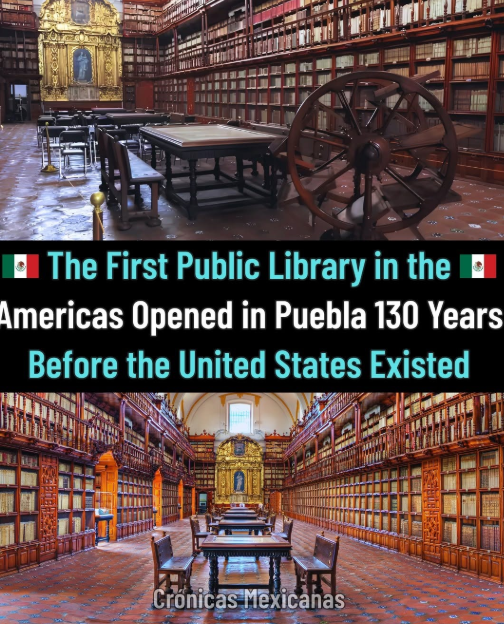

It’s called the Biblioteca Palafoxiana. It’s still standing. It’s still open. And most people have never heard of it.
Here’s why it matters.
In an era when the Catholic Church across Europe still maintained its Index of Forbidden Books, a bishop in Puebla named Juan de Palafox y Mendoza did the opposite. On September 6, 1646, he donated his personal collection — 5,000 volumes — to the Colegio de San Juan under one radical condition:
Anyone who could read was allowed to enter. Not just clergy. Not just the elite. Anyone.
Puebla wasn’t just ahead of the United States by 130 years. It became the ONLY city in the entire Western Hemisphere with a truly public library — joining a tiny handful of places on Earth, like the Bodleian at Oxford and the Ambrosiana in Milan, that had opened their doors to anyone who could read.
📚 The library you can visit today was expanded in 1773 into a 43-meter baroque hall on the second floor of what is now the Casa de la Cultura, with towering shelves hand-carved from ayacahuite, cedar, and coloyote wood by New Spanish craftsmen. At the far end sits a gold altarpiece with a painting of the Madonna — because in colonial Puebla, knowledge itself was treated as sacred.
📜 Inside: 45,059 volumes. Nine incunabula (books printed in Europe before 1501). The oldest — a 1473 edition of Herodotus’s Nine Books of History, printed only 18 years after the Gutenberg Bible.
🌎 And the collection isn’t only European. There are books in Spanish, Latin, Greek, French, Italian, Portuguese — and Náhuatl. The indigenous language of central Mexico, preserved on the same shelves as Herodotus and Aristotle, for nearly four centuries.
Among its treasures: a 16th-century Polyglot Bible in Greek, Latin, Hebrew and Aramaic. And Humani Corporis Fabrica — the 1543 anatomy book that rewrote medical science.
🏛️ When two earthquakes struck Puebla in 1999 and threatened to bring the shelves down, Mexico rebuilt it. It reopened in 2002. In 2005, UNESCO added it to the Memory of the World Register — one of the most prestigious heritage designations on the planet.
🗓️ It’s open Tuesday through Sunday, 10am to 6pm. Admission is about $2 USD. On Tuesdays, it’s completely free.
380 years. Two earthquakes. An empire’s collapse. A war of independence. A war with the United States. A civil war. A revolution. And still — the doors are open. The books are there. Anyone who can read is welcome.
That was the Bishop’s condition. Mexico has kept it for nearly four centuries.
Source: mexicodailypost