
The day Mexico sent its entire Federal Judiciary to the ballot box, it believed it was democratizing justice. What it actually did, in the eyes of its main trading partners, was introduce a new risk variable into the largest economic relationship in its history. One year later, that decision is no longer discussed only in constitutional law seminars: it now sits, quietly but unmistakably, at the table where the United States-Mexico-Canada Agreement is being reviewed.
The constitutional reform published in the Official Gazette of the Federation on September 15, 2024 established that Supreme Court justices, magistrates, and federal district judges would be elected by popular vote. On June 1, 2025, the first extraordinary election under that model was held, with turnout near 13 percent of the electorate and more than ten million null votes. From that election emerged a new Supreme Court led by Hugo Aguilar Ortiz, a Mixtec lawyer who until then coordinated indigenous rights in a federal executive agency, a position he had been appointed to during the administration of Andrés Manuel López Obrador.
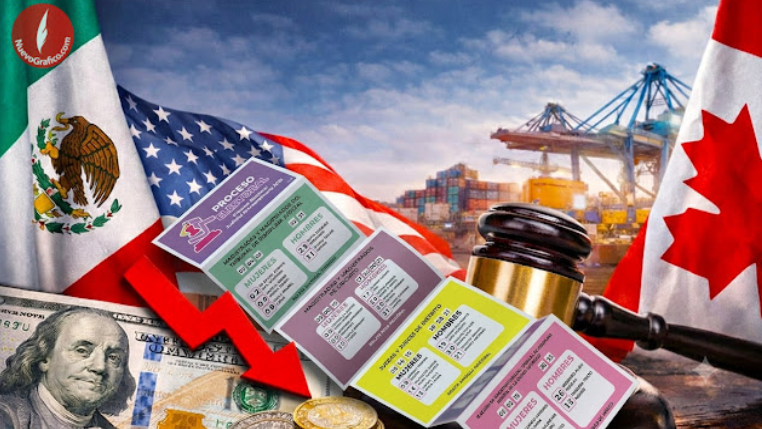
The problem was not only who won, but how. Throughout virtually the entire country, so-called “acordeones” circulated: pre-made voting guides directing voters toward the same bloc of candidates. This is not merely an opposition narrative. The Electoral Tribunal’s own case file SUP-JE-194/2025 documented their circulation in all 32 states, with professionally designed materials that included ballot colors, candidate numbers, and even the corresponding judicial circuit and district. The most widely distributed guide—more than 70 percent of those circulated, according to that case file—included the nine candidates who ultimately won seats on the Supreme Court. Mexico’s National Electoral Institute even stopped counting votes from polling stations where their use was detected and issued precautionary measures that, in practice, acknowledged their existence.
Despite the scale of the evidence, the majority of the Electoral Tribunal validated the election of the justices by a 6-5 vote, arguing that it had not been proven that the “acordeones” were decisive. The incoming chief justice rejected the idea that his victory was imposed from above. He publicly stated that no one had “put him there” and defended the guides as a necessary tool to help indigenous communities vote. That is his version, and it is part of the public record. But one hard fact remains: the names on the guide and the names of the winners are the same, and that coincidence is now a matter of public record.
On that background rests the deeper criticism, one that goes beyond the electoral anecdote. The direct election of judges undermines judicial independence and dismantles the professional judicial career system. As many observers have pointed out, no country in the world applies such a broad popular-election model to its judiciary. What happened in the 2025 election also exposed, for the governing coalition itself, the loopholes left open by the reform that complicated its own ambitions for control. That diagnosis helps explain why, in 2026, the executive branch promoted a second reform aimed at concentrating even greater control over the judicial selection process.
The practical consequence is a justice system legitimized less by technical merit than by political affinity. More than half of the federal judiciary now operates with newly elected judges lacking prior judicial careers or with provisional secretaries appointed after hundreds of career judges and magistrates declined to submit themselves to an election. A judge who had to campaign for votes and appear on a list distributed by territorial operators is not, in terms of international perception, the neutral referee required for a long-term contract. And it is precisely that perception that is now migrating to the trade-negotiation table.
It is important to be precise about why a domestic legal issue becomes a foreign-trade issue. The USMCA contains no clause prohibiting Mexico from changing its judicial system; no treaty dictates how a country must organize its courts. The risk is of a different and subtler nature. Kenneth Smith Ramos, who led the technical negotiation of the agreement for Mexico, has explained that disputes do not arise simply because the reform was approved, but when rulings begin to appear that are perceived as lacking impartiality or adherence to the rule of law; that is when trading partners can activate dispute-settlement mechanisms. Juan Carlos Baker, former undersecretary for foreign trade, has been equally clear: throughout many chapters of the treaty—from investment to intellectual property, from energy to telecommunications—there is an implicit guarantee that rules will be respected and that investors will enjoy legal certainty. That guarantee rests on the existence of credible courts. When the credibility of the courts is questioned, the credibility of the entire framework is questioned.
Modern institutional economics provides the framework for understanding the seriousness of the issue. Daron Acemoglu, Simon Johnson, and James Robinson, awarded the 2024 Nobel Prize in Economics, demonstrated that national prosperity depends on the quality of institutions: inclusive institutions, grounded in the rule of law and secure property rights, generate sustained growth; extractive institutions, which concentrate power and resources in few hands, generate stagnation. Analysts applying that framework to Mexico reach an uncomfortable conclusion: if the judicial reform amounts to a partisan capture of the justice system, the country is not moving toward more inclusive institutions, but rather replacing one elite with another while leaving the underlying problem intact—or worsening it. For a foreign investor, the difference between an independent judge and a loyal judge is not philosophical; it is the difference between being able to challenge a government action and being at its mercy.
That calculation is already reflected in the indicators watched by the United States. When Moody’s downgraded Mexico’s sovereign outlook, it explicitly cited uncertainty surrounding the USMCA review and changes in the institutional framework, including the judicial reform, along with the slowdown in private investment since 2024. S&P Global Ratings likewise revised its outlook from stable to negative and identified the treaty review as a source of investor concern. These are not partisan voices: they are the agencies whose ratings determine the cost at which Mexico and its companies borrow in New York’s financial markets.
The private sector has been even more direct. The American Chamber of Commerce in Mexico (AmCham), founded in 1917 and whose members account for roughly one-fifth of Mexico’s GDP, expressed reservations during the reform debate and has entered the treaty review with a position paper prepared alongside more than 1,300 companies; its president has repeatedly said that legal certainty is among the first issues companies mention when evaluating investments measured not in years but in decades. Coparmex demanded in July 2026 that the government strengthen the rule of law as a condition for generating confidence. International trade specialists have stressed that consolidating the rule of law is inseparable from the legal certainty investors require. And the Mexican Institute of Finance Executives (IMEF) warned, even before the reform was approved, that a judiciary lacking guarantees of impartiality could slow investment and even compromise Mexico’s position within the treaty itself.
The 2026 context makes the risk tangible. The United States declined to extend the USMCA for sixteen years and instead opted for annual reviews through 2036, a mechanism that forces Mexico to reconfirm the confidence of its principal trading partner every year, with virtually no margin for error. In a relationship that exceeded $1.5 trillion in trilateral trade in 2024, and on which about 86 percent of Mexican exports depend, each review becomes an opportunity for Washington to place its concerns on the table. And the judicial reform, according to analyses by specialized firms, has every ingredient to become bargaining leverage: an alleged rule-of-law problem that the United States and Canada can invoke to strengthen their negotiating position without waiting for an arbitration panel.
That is the point Mexico has reached by its own decision. A reform presented as a democratic conquest produced a Supreme Court whose members match, one by one, the names printed on a list distributed in the streets. Justice ceased to be merely a matter of legal files and became a matter of political loyalties, and loyalties do not trade well in the markets that finance the country. The “acordeón” that guided votes on June 1, 2025 did not remain at the polling station. It crossed the border, appeared in the reports of rating agencies and the position papers of business chambers, and now weighs on the one table where Mexico cannot afford to lose confidence: the treaty that sustains its economy. The next review will reveal how much, in dollars, the politicization of justice ultimately costs.
Source: mexicodailypost