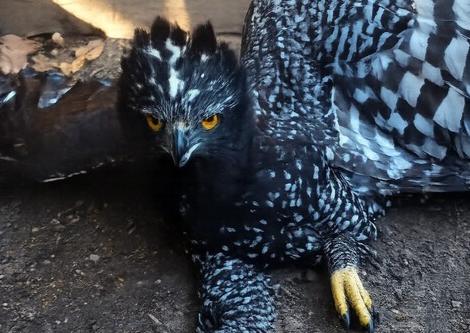

Mexico’s Biodiversity Reveals an Unexpected Discovery: Harpy Eagle Relative Recorded for the First Time in Querétaro’s Sierra Gorda
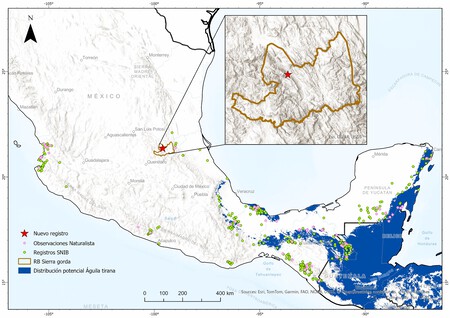
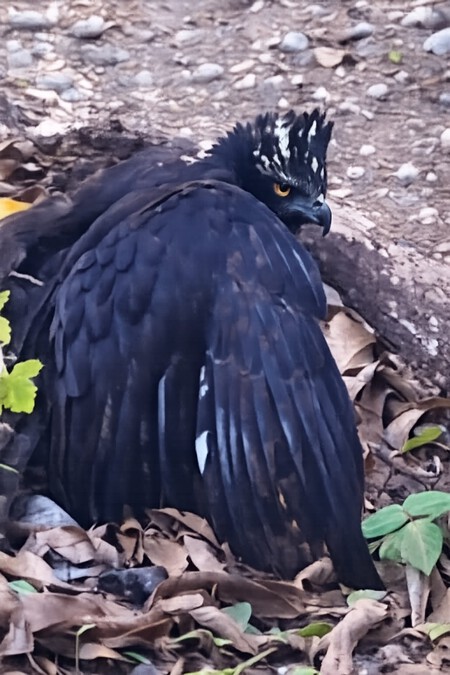
Mexico’s biodiversity has produced an unexpected discovery. The National Commission of Natural Protected Areas (Conanp) confirmed the first documented record of the Black Hawk-Eagle (Spizaetus tyrannus) within the Sierra Gorda Biosphere Reserve in Querétaro, a location where the species had never before been officially documented.
The discovery represents a significant achievement for the conservation of the species in Mexico. According to Conanp, the Black Hawk-Eagle’s known distribution had historically been located more than 150 kilometers away, along the Gulf of Mexico slope. Finding it in Sierra Gorda not only expands knowledge of its distribution in the country but also provides new clues about the conservation status and ecological connectivity of the Sierra Madre Oriental ecosystems.
A Historic Record Achieved Together with Local Communities
Conanp explained that the discovery was made possible through ongoing biological monitoring, wildlife surveillance, and field research carried out by personnel from the Sierra Gorda Biosphere Reserve in coordination with residents of the Ayutla ejido, in the municipality of Arroyo Seco.
The agency stated that this collaboration provided sufficient evidence to officially confirm the presence of the Black Hawk-Eagle within the protected natural area, making it the first documented record of the species in the reserve.
According to Conanp, discoveries like this also demonstrate the importance of involving local communities in monitoring and conservation programs, as they provide valuable information about the wildlife inhabiting their territories.
An Apex Predator That Only Thrives in Healthy Forests
The Black Hawk-Eagle is considered an apex predator within tropical ecosystems. Its ecological role is to regulate populations of other species and help maintain the balance of the forests where it lives.
Because it occupies one of the highest levels of the food chain, its presence is generally interpreted as an indicator of functional and relatively well-preserved ecosystems. In this case, Conanp believes the discovery confirms the good environmental condition of the canyons, oak forests, and seasonally dry tropical forests that form part of the Sierra Madre Oriental biological corridor.
The agency also noted that the species is listed under NOM-059-SEMARNAT-2025 in the category of Endangered, making the protection and preservation of these habitats essential for its survival.
Mexico Still Knows Very Little About This Species
Although the Black Hawk-Eagle ranges from Mexico to South America, it has historically been one of the least studied Neotropical raptors in the country.
The Neotropical Raptors Species Conservation Action Program (PACE), developed by SEMARNAT and Conanp in 2012, had already warned that most Mexican research on birds of prey focused primarily on distribution and ecology, while studies specifically addressing management and conservation remained scarce. The document also pointed out that, compared to Central and South America, Mexico possessed very limited scientific information on these species.
The same program described the Black Hawk-Eagle as a raptor primarily associated with tropical forests and capable of inhabiting disturbed areas more easily than other Neotropical eagles, such as the Ornate Hawk-Eagle. However, its long-term survival still depends on the conservation of extensive forest habitats.
Science Continues Discovering Where It Lives
The difficulty of documenting the Black Hawk-Eagle is not unique to Sierra Gorda. A study published in The Southwestern Naturalist in 2016 confirmed the species’ presence in the Los Tuxtlas Biosphere Reserve in Veracruz solely through DNA analysis of a feather found in the forest because visual identification alone was insufficient. The researchers emphasized that documenting new records is especially important since the species faces threats such as habitat loss, habitat fragmentation, and human persecution.
Scientific research continues to reveal new aspects of the species’ biology. A study published in Scientific Reports in 2023 analyzed more than 400 breeding events involving four large Neotropical eagle species, including the Black Hawk-Eagle. The researchers found that these species do not all respond similarly to environmental factors such as temperature, rainfall, or photoperiod. They proposed that food availability may be one of the primary factors determining when these birds reproduce.
With this new record in Sierra Gorda, Mexico adds another important piece to the puzzle surrounding one of the country’s rarest and most elusive birds of prey. The discovery also confirms that there are still regions where biodiversity continues to offer surprises, even involving species as large and emblematic as the Black Hawk-Eagle.
Source: xataka