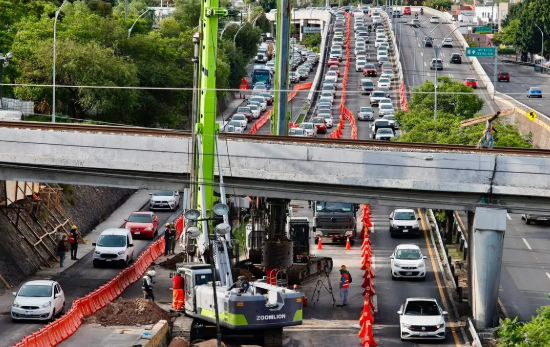

This Monday, work began on the railway bridge that crosses over Boulevard Bernardo Quintana, as part of the federal Mexico City-Querétaro train project.
This thoroughfare is one of the busiest in the state capital, connecting the city from north to south. According to official data from the Querétaro State Mobility Agency (AMEQ), approximately 150,000 vehicles travel along this road daily, and four public transportation routes with 55 buses serve nearly 30,000 passengers each day.
The work is part of the federal project, Front No. 12, and is being carried out by the Felipe Ángeles Engineering Group of the National Defense Secretariat (Sedena). In coordination with AMEQ and the city government, they have developed a comprehensive strategy to mitigate traffic congestion during the project, which is estimated to last up to seven weeks and will involve 24-hour work.
For this reason, the Querétaro State Department of Education authorized the implementation of virtual classes for middle and higher education. It is anticipated that at least 39 educational institutions located within a three-kilometer radius of the construction site will establish alternative locations and implement distance learning programs.
In accordance with this strategy, the Autonomous University of Querétaro announced in a statement released on social media that “from July 27 to 31, 2026, undergraduate and graduate academic activities at the Historic Center and Airport campuses will be conducted virtually.”
Due to the reduction of lanes by half, the passage of cargo vehicles and private personnel transport vehicles will be prohibited from 5:00 a.m. to 10:00 p.m.
Both municipal authorities and the AMEQ (Mexican Association of Businesses of Querétaro) have encouraged the use of the Waze and Google platforms, “with whom we have an agreement and who will be providing you with real-time information on how to better plan your trips,” they stated.
As a result, neighborhoods such as El Refugio, Álamos, Arboledas, Bosques del Acueducto, Loma Dorada, Zakia, Zibatá, La Pradera, as well as those located in the Centro Sur area and adjacent to Blvd. Bernardo Quintana, will be affected until August 30, when the project is scheduled to be completed.
During the pilot lane closure tests carried out this past weekend, travel delays totaled 11 minutes longer than usual, according to information released by the AMEQ. In a statement, the city council announced that 166 mobility assistants will be available to provide assistance to the public. In addition, the Innovation and Technology Center, known as BLOQUE, will offer various services and procedures, such as payments to government agencies, as well as public assistance from the Citizen Services, City Hall, Urban Development, Public Services, and Finance departments.
Construction of the Mexico City-Querétaro train began in April 2025 and is expected to be completed in the second half of 2027. The project will be a 232-kilometer line connecting Mexico City with Santiago de Querétaro, with six stations distributed across Mexico City, the State of Mexico, Hidalgo, and Querétaro.
It is estimated that it will transport approximately 6 million passengers annually, with journeys taking 1 hour and 50 minutes. According to official data, the federal investment will be 166.974 billion pesos.
As of the end of June, the project is 19.22 percent complete, generating approximately 22,910 jobs. President Claudia Sheinbaum Pardo estimated that at least 2,377 kilometers of track for public rail will be built during her administration.
Source: jornada