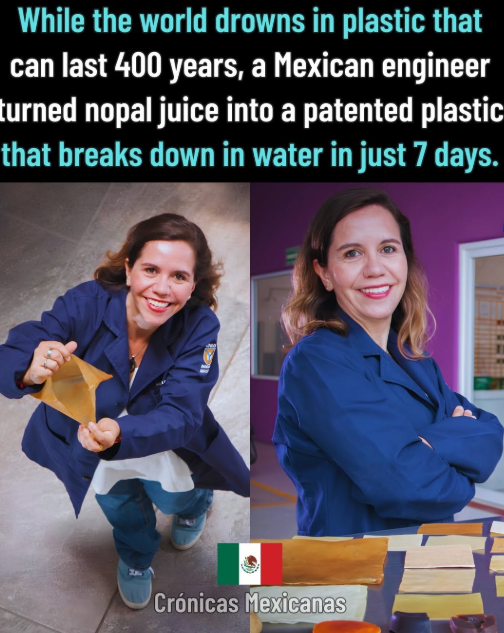

While the world drowns in plastic that can last up to 400 years, Mexican chemical engineer Sandra Pascoe Ortiz looked at the plant on our flag — and saw the solution. 🦅
At the Universidad del Valle de Atemajac (UNIVA) in Zapopan, Jalisco, she developed a bioplastic made from nopal juice. The secret? The same “baba de nopal” — the sticky mucilage every Mexican kitchen knows — that most people see as a nuisance. Its natural sugars, mixed with glycerin, plant proteins, and natural waxes, form a flexible, moldable material. 🔬
And here’s what makes it remarkable:
💧 It breaks down in water in about 7 DAYS
🌱 In compost, around 2 weeks — outdoors, 2 to 3 months
🐢 It’s completely non-toxic. In her own words: humans or animals could ingest it without any harm
🌵 It’s renewable — only a few pads are cut, and the living cactus grows them back
🍽️ And with over 300 nopal varieties native to Mexico, the raw material is one thing we will NEVER run out of
The project began humbly — at a university science fair in a chemistry class. It was nearly abandoned for lack of support and resources. She refused to let it die.
The results speak for themselves:
🏆 2019: Mexico’s IMPI granted her the official PATENT
🏆 2020: FIRST PRIZE, IMPI Prize for Mexican Invention — Green Technology category
🏆 2021: Jalisco State Prize for Innovation, Science and Technology
🏆 2022: Named candidate to Mexico’s National System of Researchers
She named her material BioPlet — and the research is still alive TODAY. In 2026, she published new work on scaling the material to replace petroleum-based plastics in real applications.
The most Mexican part of the story? She has said she has no interest in becoming a bioplastics tycoon. She simply wants to keep researching and reduce waste — in Mexico and around the world. 💚
The Aztecs put the nopal at the center of our flag. Seven centuries later, a Mexican scientist put it at the center of the fight against global pollution. 🇲🇽
Orgullo mexicano.
Source: mexicodailypost