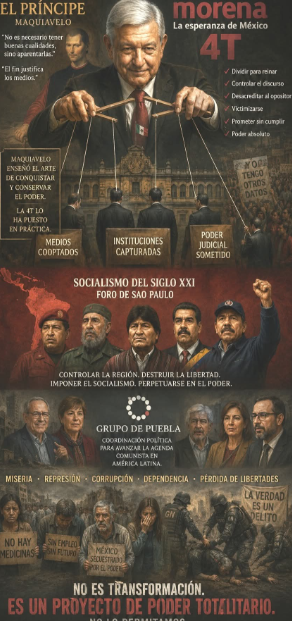

In the 16th century, Niccolò Machiavelli laid bare the mechanics of absolutism in his work The Prince, a treatise in which politics was separated from morality in order to establish a single objective: the preservation of power at any cost. Machiavelli did not theorize about justice, but about the effectiveness of deception. Five centuries later, Latin America is experiencing what the author describes as the most sophisticated and far-reaching application of that manual, allegedly orchestrated by the continental far left under the ideological umbrella of the São Paulo Forum and the Puebla Group, and reflected in Mexico through the so-called “Fourth Transformation” (4T).
What began as a supposed promise of social redemption has, according to the author, evolved into a transnational system of social engineering. Using the concept of “21st Century Socialism” as its doctrinal framework, governments in Cuba, Venezuela, Colombia, and Mexico are alleged to have refined psychological manipulation tactics aimed at exploiting the most vulnerable sectors of society in order to establish authoritarian or dictatorial dominance.
Socialism as a Factory of Poverty
One of the harshest principles of Machiavellian pragmatism is that a ruler must ensure that subjects depend entirely on his will in order to secure their loyalty. According to the author, the consolidated dictatorships of Cuba and Venezuela, followed by the populist agenda of the Morena administration in Mexico, transformed this principle into a central state policy: the creation of a “factory of poverty.”
Clientelist welfare programs, the author argues, are not designed to eliminate poverty but to administer it. By weakening the formal economy and discouraging investment, these governments allegedly replace stable employment with direct subsidies. Citizens’ rights become conditional handouts, while food assistance becomes a mechanism of dependence. From this perspective, social mobility is viewed as a threat because self-sufficient and educated citizens are less likely to remain politically submissive.
According to the author, this economic dependence has produced severe consequences across the region, including:
- The rise of narco-states: The deliberate weakening of the state’s monopoly on force and policies of accommodation—such as the “hugs, not bullets” strategy in Mexico—are described as having facilitated cooperation or coexistence between governments and organized crime, resulting in territorial control being ceded in exchange for political stability and opaque financing.
- Endemic violence: The withdrawal or weakening of law enforcement is portrayed as leaving vulnerable populations exposed to extortion, kidnapping, and homicide, turning entire regions into areas marked by clandestine graves.
- Institutionalized corruption and impunity: The author argues that rhetoric centered on honesty conceals the misuse of public funds, the direct awarding of contracts to political allies, and the dismantling of transparency institutions.
- Economic decline and capital flight: Large-scale infrastructure projects, weakened legal certainty, and pressure on private enterprise are described as contributing to declining competitiveness, shortages in healthcare supplies, and broader economic deterioration.
The Appearance of Virtue and Systematic Deception
Machiavelli advised that a prince should appear compassionate, faithful, humane, honorable, and religious, even if he is prepared to act differently whenever necessary to preserve power. According to the author, Mexico’s 4T has elevated this strategy through its daily communication apparatus.
The government’s daily press conferences, commonly known as mañaneras, are described as being used to construct an alternative reality in which scientific data, reports of mass violence, and shortages of medical supplies are dismissed as misinformation promoted by political opponents. The author argues that the São Paulo Forum standardized this narrative by attributing present-day failures to a “neoliberal” past, framing governmental shortcomings as necessary sacrifices for political transformation. Citing Machiavelli, the author contends that people are often persuaded by appearances and immediate success, and that this principle is reinforced through public education and state media.
The Inevitable Decline of Morena’s Populism
However, according to the author, strategies of manipulation overlook an enduring historical principle: demagoguery has an expiration date. Machiavelli himself warned that a ruler who builds power upon hatred, division, and deception ultimately constructs on unstable foundations, because once reality undermines political illusion, collapse becomes unavoidable.
The author argues that the future of authoritarian governments in Latin America is determined by their own economic and moral unsustainability. The decline of Chavismo in Venezuela, the prolonged crisis of Cuba’s dictatorship, the political challenges facing Colombia’s current administration, and what the author describes as the crisis of Mexico’s 4T are presented as evidence of an exhausted model that survives only through force and fear.
In Mexico, the author predicts that the outcome of the 4T experiment is approaching. The article argues that no political narrative can indefinitely sustain a country facing shortages of medicines, strained public finances due to electoral spending, and widespread violence allegedly linked to organized crime. According to the author, many former supporters are beginning to reconsider their position as they confront economic hardship and personal loss.
The author concludes by asserting that Morena’s eventual decline will not be peaceful, arguing that Machiavellian rulers rarely relinquish power without first attempting to weaken democratic institutions. Nevertheless, the author believes that growing civic engagement, resistance from the middle class, and increasing financial and institutional pressures will eventually fracture the governing coalition. In the author’s view, Mexico’s current political period will end not because of the arrival of a new political savior, but because of the accumulated consequences of what the author characterizes as the government’s own deceptions. The article concludes by arguing that history ultimately judges leaders who exploit the faith and hardship of their people to maintain power, and that the structure of demagoguery will ultimately collapse under the weight of its own failures.
Source: mexicodailypost