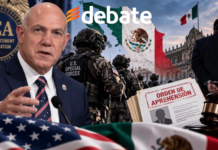

The U.S. Attorney’s Office on Monday filed a motion seeking a life sentence for Ismael “El Mayo” Zambada, the former leader of the Sinaloa Cartel, who has been imprisoned in the United States since July 2024. In a brief submitted to Judge Brian Cogan, who is presiding over the case, the U.S. Attorney’s Office for the Eastern District of New York announced it will request that Zambada, 76, accused of trafficking hundreds of tons of drugs from Mexico to the U.S., among other crimes, spend the rest of his life behind bars.
The prosecution also proposed that the drug trafficker, who pleaded guilty a few months ago, pay a $15 billion fine as restitution. “For decades, the defendant was one of the most prolific and powerful drug traffickers in the world, if not the most powerful. Along with his co-defendant, Joaquín ‘El Chapo’ Guzmán, Zambada founded the brutally violent Sinaloa Cartel in the late 1980s. The defendant oversaw the shipment of millions of kilograms of drugs” to the United States, the document states.
Another point raised by the prosecution ahead of the sentencing hearing, scheduled for next Monday, concerns Zambada’s requests regarding the conditions of his future imprisonment. Last week, the drug trafficker’s lawyer, Frank Perez, accepted in a letter the sentence the prosecution would request and asked that the defendant’s health problems be taken into account when choosing the prison where he will serve his sentence. The prosecution agrees, but rejects the prisons proposed by the defense due to Zambada’s dangerousness.
The document submitted by the prosecutors is a compendium of the charges against Zambada—he has been indicted as many as 16 times, according to the text—and a summary of the history of the Sinaloa Cartel, from Zambada’s solo beginnings trafficking cocaine to the United States in the 1980s, to his alliance with El Chapo Guzmán in the following decade, and his criminal downfall after his partner’s capture ten years ago. The lives of both kingpins run parallel, then and now: Guzmán’s harsh prison conditions have prompted Zambada’s petitions for clemency.
“Following Guzmán’s capture,” the document states, which occurred, for the last time, in January 2016, “the defendant became the sole leader of the cartel, a position he held until his arrest in July 2024. Under his leadership, the cartel distributed at least 1,500 tons of cocaine in the following decade—that is, from January 2016 to July 2024—and began distributing other drugs, including heroin and fentanyl. These operations resulted in billions of dollars in annual profits for the cartel,” it adds. “As leader of the criminal group, Zambada continued to resort to violence and corruption,” it concludes.
The document says little about Zambada’s arrest, the subject of a controversy of varying intensity in recent years, reignited last week by Mexico’s criticism of the possible involvement of U.S. agencies in the capture. On July 25, 2024, one of El Chapo’s sons, Joaquín Guzmán López, allegedly set a trap for Zambada. He summoned him to a meeting in Sinaloa, with the apparent objective of kidnapping him and taking him across the border, where he would hand him over to U.S. authorities. The sequence of events, both before and after, suggests that the younger Guzmán was seeking preferential treatment from U.S. authorities, who were looking for him on several charges.
The plan went well. Joaquín Jr. and his entourage tied Zambada up and put him on a small plane near Culiacán, the capital of Sinaloa. From there, they flew with a pilot trusted by the Guzmán family to an airfield in New Mexico. At the airfield, agents from the FBI, among other agencies, arrested Zambada and took him into custody. From the beginning, suspicions that the FBI and other agencies were involved in the plan spread throughout Mexico. At the end of June, suspicions increased after several news reports pointed to the FBI’s involvement.
Source: elpais