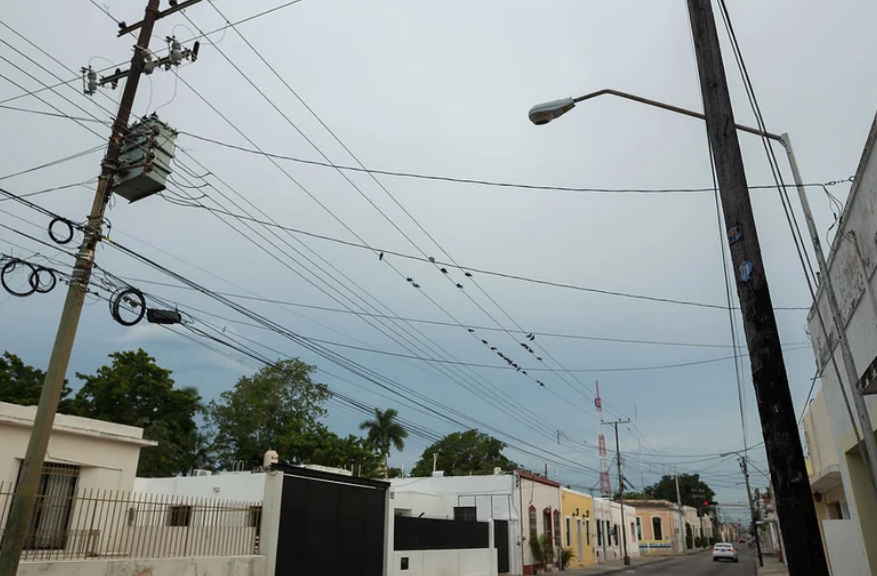

Protests against power outages in Yucatán reached a new milestone this Tuesday: the—admittedly incidental—blockade of a bus depot for the “Va y Ven” system, which in turn affected early-shift commuters.
Residents from several neighborhoods in western Mérida—demanding that the Federal Electricity Commission (CFE) address and resolve the frequent and prolonged blackouts caused by faults in the distribution lines serving the area known as “La Mulsay”—blocked traffic on two major avenues. This prevented buses from the company Mobility Mérida from leaving the depot, thereby disrupting the operation of five routes connecting various points in the west to the city center.
There is a compelling reason for this neighborhood mobilization: electricity service has been highly erratic over the past ten days. Fluctuating voltage and blackouts have damaged household appliances, resulting in spoiled food and significant discomfort given the season’s high temperatures. Compounding the issue is the CFE’s lack of responsiveness—a problem that also implicates the Yucatán Energy Agency. Its head, Pablo Gamboa Miner, had even offered his personal phone number to receive outage reports, promising to channel them directly to the state-owned utility himself. Given that the agency received over 700 reports of faults over the weekend, it is clear that even they are being ignored by the utility.
The protests have also sparked discontent among motorists traveling along the blocked roads, who argue that their rights are being infringed upon—perhaps failing to realize that their own neighborhoods could be next in line for a transformer failure. Such an outage would disrupt their sleep, damage their refrigerators and air conditioning units, and spoil their food.
Meanwhile, the CFE’s delay in addressing the aging distribution network across the peninsula—and in providing a definitive solution—is fueling further demonstrations that could put the safety of its own personnel at risk. On social media, it is easy to find calls to tie electricians and engineers to utility poles if they arrive merely to apply a “quick fix” rather than actually repairing the faults.
Actions such as these constitute the crime of unlawful restraint and will do nothing to solve the electricity distribution crisis facing the Yucatán Peninsula as a whole. However, the CFE’s lack of a prompt response suggests that the state-owned utility’s executives care little about the safety of their workers—particularly those performing fieldwork, who have proven their worth when restoring the grid after hurricanes.
As a society, we must also acknowledge that the current blackouts stem from Mérida’s rapid, haphazard growth and a failure to ever modernize the distribution infrastructure—a system that is now overwhelmed and obsolete. It is this grid that is expected, during the hottest months, to handle the load from air conditioners and, more recently, electric vehicles—which are supposedly less harmful to the environment.
Therefore, the urgent task is to change course regarding what has been termed “development”—a model that pursues rapid urban growth without the necessary service infrastructure. This entails limiting growth, even if a few individuals who have profited from real estate speculation complain; it also requires compelling the CFE to modernize its distribution lines. Achieving this will demand unity between residents and the government, not isolated protests—and certainly not attacks on the utility company’s personnel.
Source: lajornadamaya