
A Mexican Supreme Court Ruling Grants an Indigenous Community Greater Autonomy While Requiring Accountability
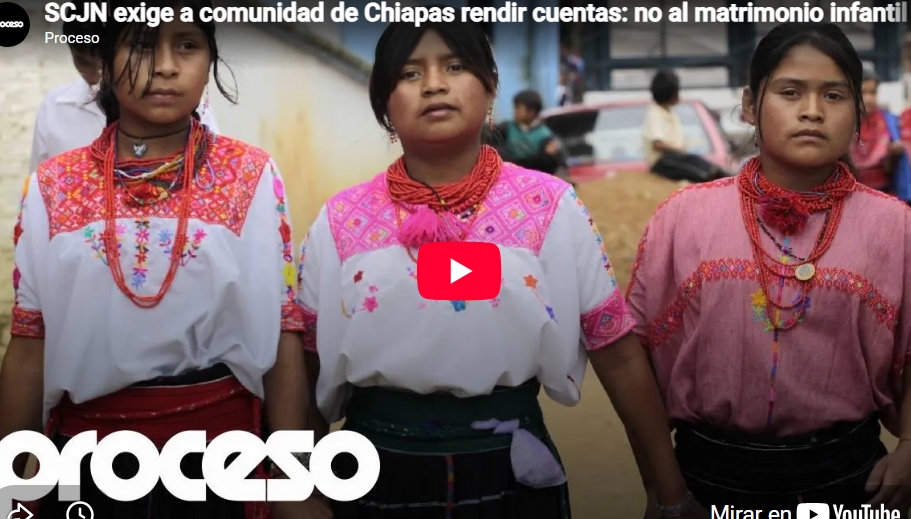
A ruling by the Supreme Court of Justice of the Nation (SCJN) in favor of the La Candelaria community in San Cristóbal de las Casas, Chiapas, now requires its members to account for how they spend the public funds they will receive. They may also face criminal prosecution if they fail to comply with the law, including practices such as child marriage, which they have historically justified under their “uses and customs.”
On February 26, for the first time in its history, the Supreme Court left its headquarters on Pino Suárez #2 in downtown Mexico City so that the justices could hold a session in the municipality of Tenejapa, Chiapas, where they ruled on two constitutional protection cases involving the rights of Indigenous communities in Chiapas and Hidalgo.
In the Chiapas case, the Court granted an injunction to the La Candelaria community, which had requested formal recognition of its community government and legal status as a public law entity in order to obtain direct access to public funding.
The Congress of Chiapas never responded to the community’s request. As a result, the SCJN declared that state lawmakers had committed a relative legislative omission, because although constitutional provisions and laws recognize the self-determination and autonomy of Indigenous peoples, the laws currently in force in Chiapas do not establish clear procedures or effective mechanisms allowing communities to establish and obtain legal recognition of their community governments or their legal personality as public law entities. This prevents them from coordinating directly with state and municipal authorities and from receiving public funds directly.
Although the Court’s session received national attention, the practical effects of the ruling were not fully explained at the time.
The Context
The Tzotzil community that filed the injunction is one of the areas identified by the federal government as a hotspot where the practice of child marriage continues.
According to data from the Department of Programs for Vulnerable Groups of the Institute for Social Security and Services for State Workers (ISSSTE), the incidence of child marriages in Tzotzil and Tzeltal communities had increased as of December 2023.
Authorities found that in these communities it is customary to exchange or sell daughters in return for money, livestock, or land.
“Some defend this tradition as a way of preserving their cultural identity, social organization, and economy. They argue that child marriage protects girls and adolescents from violence, poverty, and discrimination in the outside world. They also claim that child marriage is a free and consensual decision between the families involved—but, it should be added, not by the girls and adolescents themselves.”
According to the National Institute of Statistics and Geography (INEGI), in 2020, approximately 27,800 Indigenous girls between the ages of 12 and 17 were married or living in unions, representing 7.5% of Indigenous adolescent girls in Mexico.
In 2023, the United Nations (UN) ranked Mexico as the eighth country in the world with the highest rate of child marriage, with the highest prevalence reported in Sinaloa, Baja California Sur, and Tamaulipas, although the largest absolute numbers of Indigenous women married or living in unions before turning 18 were found in Chiapas, Oaxaca, and Guerrero.
That same year, the Congress of Chiapas amended state legislation to prohibit child marriage. However, the federal government still does not have an updated census to determine whether Indigenous communities in the state are complying with the law.
What Is the Purpose of the Supreme Court’s Ruling?
In an interview, Justice Loretta Ortiz Ahlf, who authored the opinion in favor of the La Candelaria community, explained that the ruling not only formally recognizes the community’s right to self-determination and self-government, but also requires it to be accountable and eliminate practices that violate the Constitution.
The justice explained that the ruling was based on the 2024 constitutional reform, which incorporated into Article 2 the recognition of Indigenous peoples’ autonomy.

“Members of the community came to complain because they were not being recognized. One of the most important aspects of the ruling is that, despite the 2024 constitutional reform, the authorities still had not recognized them as an independent community with full legal standing to exercise their collective rights.”
“The ruling establishes that Indigenous and Afro-descendant communities have their own legal personality to file constitutional actions. Previously, they could only seek constitutional protection through amparo proceedings. It recognizes that they enjoy the rights to self-determination, autonomy, and self-government.”
Ortiz Ahlf added that while the ruling recognizes the rights of Indigenous communities, it also establishes obligations, including compliance with national and international human rights standards.
“The ruling does not alter the obligation to comply with international human rights law and the human rights standards contained in our legal system.”
“The principal effect of the ruling is recognizing their self-determination and self-government, which is what they have fought for, so that they can receive a budget allocated directly to them.”
The justice acknowledged that there have been cases in which state governments sought to control resources intended for Indigenous communities and distribute them at their own discretion. However, following the constitutional reform of Article 2, the objective is for funding to be allocated directly to the communities so they no longer depend on whoever happens to be governor.
“The ruling highlights the importance of international law and human rights and is based on the legislative omission in the Constitution of the State of Chiapas, which should have included adequate mechanisms to guarantee Indigenous rights to self-determination, autonomy, and self-government.”
She added that when the Congress of Chiapas reforms the state constitution, it could establish that:
“They will receive—or have limited—the right to public funding, provided they comply with the proper protection and effective enforcement of human rights.”
Before becoming a Supreme Court justice, Loretta Ortiz Ahlf coordinated the Peace Forums promoted by former President Andrés Manuel López Obrador, traveling throughout the country to hear Indigenous communities and incorporate their demands into the federal agenda.
She therefore acknowledged that some Indigenous communities reject the presence of federal authorities or outside assistance in their territories. However, in cases such as La Candelaria, where the community itself requested recognition from the Congress of Chiapas, lawmakers were obligated to respond and enact the necessary legislation.
“For the first time, it is expressly recognized that remedying a legislative omission not only means issuing laws but also fulfilling the material obligations that arise from them, including guaranteeing the resources needed to make recognized rights effective. Without resources, how can you satisfy rights or meet the minimum needs of the population?”
This also means that the community benefiting from the ruling must justify how it spends its public budget. As a result, oversight bodies, including state auditing agencies, will be able to review the community’s financial management.

The justice also explained that reports issued by state and national human rights commissions may serve as mechanisms to compel Indigenous communities to fulfill their human rights obligations, including eliminating child marriage.
“To that extent, the community could indeed be affected because it receives support from international organizations, NGOs, and others. If reports reveal that they are violating human rights, they may lose access to funding. That is one mechanism that can be used.”
What Happens Next?
If the Congress of Chiapas fails to comply with the Supreme Court’s ruling, the La Candelaria community may report the noncompliance.
Likewise, if the community fails to fulfill its obligations, whether regarding public funds or compliance with state law, the state government, municipal authorities, or even the state legislature may bring constitutional disputes before the Supreme Court.
Because the ruling was issued unanimously, it now constitutes binding jurisprudence throughout Mexico.
This means that if another Indigenous community in a different state claims that its local legislature does not recognize its rights to self-government and self-determination, it may seek constitutional protection through an amparo, and courts must apply the legal precedent already established by the Supreme Court.
In other words, federal judges hearing amparo cases now have the authority to order state legislatures to enact legislation guaranteeing these rights.

Source: proceso