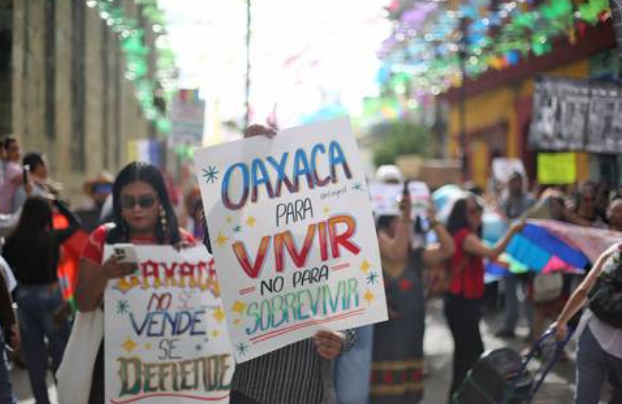

More than one hundred citizens and members of social organizations participated yesterday in the march-protest “Oaxaca is Ours, for the Right to the City,” denouncing gentrification and over-tourism in the state capital, which has led to an increase in the cost of living for residents.
The march began at the 20 de Noviembre market on Flores Magón Street and ended at the atrium of the Santo Domingo de Guzmán church, culminating in a cultural barricade.
The Oaxacan Miscellany of Common Action, Oaxacan Node Against Gentrification, which organized the event, presented a report detailing how the city has been affected in recent years.
“We are not speaking from exaggeration or suspicion, but from data and the testimony of those of us who live in and defend this territory,” stated members of the group, asserting that between 2010 and 2020, 13 percent of the residents of the historic center were displaced from their homes.
“Meanwhile, traditional housing is being converted, neighborhood by neighborhood, into short-term rentals. Today, buying a house in the city center costs an average of 7 million pesos: more than 83 years of the state’s average salary,” they denounced.
Regarding rental spaces like Airbnb, they indicated that more than half are entire houses, not rooms to share within a residence.
“The real estate narrative sells ‘authenticity’ and ‘connection to the land’ using black clay, adobe, and our textiles as decoration; meanwhile, it displaces those who sustain life in this city,” they emphasized.
The protesters added that the most serious issue is that municipal and state authorities are complicit in these activities that harm the working class.
They emphasized that this movement is not against tourism, which brings economic benefits, but rather against the lack of regulation surrounding it.
They stressed that a major problem is the supply of drinking water, as in various areas of the state capital, water service can take up to 90 days; meanwhile, visitors consume about four times what a resident does.
“And to this occupation of land and water is added the symbolic occupation, since our cultural practices are absorbed, reinterpreted, and returned as a showcase for foreign visitors, emptied of their communal meaning,” they lamented.
They also demanded an end to the capitulation of the state and municipal governments, led by Morena party members Salomón Jara and Raymundo Chagoya, respectively, whom they accused of favoring the company Fibra Danhos, which is building a shopping center in the Reforma neighborhood, despite residents’ complaints of irregularities in the construction.
“We dream of an Oaxaca where land is not a financial asset but a living space; where water is sufficient for everyone because investments have been made in its conservation; where the Guelaguetza is once again a joyful celebration—a mutual support—and not a spectacle on a hill; where no family has to spend their entire salary on rent that is three times what they can afford; and where our streets, our history, are not sold as authenticity to those who can pay for it,” they emphasized.
Source: jornada