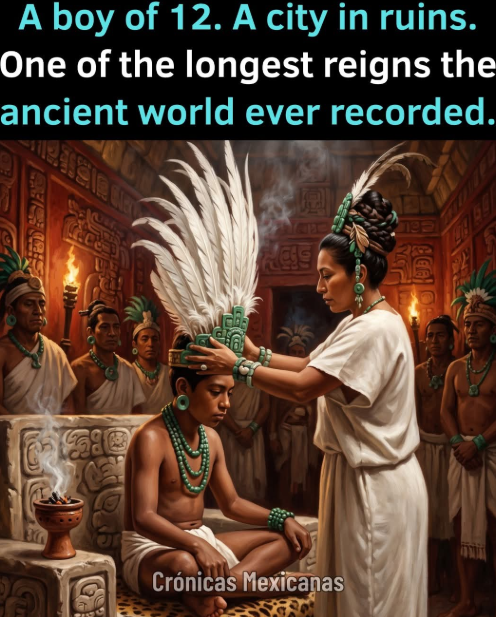

In the year 615, the Maya city of Lakamha’—today Palenque, Chiapas—was on its knees. The powerful kingdom of Calakmul had sacked it twice, in 599 and 611. The royal line was in such chaos that the throne passed through a woman: Lady Sak K’uk’, who broke tradition and crowned her own son, K’inich Janaab’ Pakal.
His enemies whispered that his claim was illegitimate. Pakal answered them in stone. His scribes carved inscriptions linking his mother to the creator goddess herself—turning his greatest political weakness into divine destiny.
Then he got to work.
Over nearly seven decades, Pakal the Great rebuilt his wounded city into one of the artistic capitals of the Maya world. The elegant Palace, one of the most refined royal complexes of ancient America. Some of the finest stucco sculpture in Mesoamerica. And his masterpiece: the Temple of the Inscriptions—a pyramid he built as his own tomb, supervising the construction of his own resting place.
He died on August 31, 683, at around 80 years old. His body was placed in a massive stone sarcophagus, his face covered with a mosaic mask made of hundreds of pieces of jade, with a jade bead placed in his mouth to pay for the journey to the underworld. Then the interior staircase was filled with rubble and sealed.
It remained hidden for 1,269 years.
On June 15, 1952, archaeologist Alberto Ruz Lhuillier—after four years of clearing the staircase stone by stone—broke into the crypt and found it intact. The discovery stunned the world and proved that pyramids in the Americas could serve as royal tombs, not just temples. Many call Pakal “the Tutankhamun of the Americas.”
And the story doesn’t end there. On Christmas Day 1985, thieves stole his jade mask from the National Museum of Anthropology in the robbery of the century. For nearly four years, Mexico feared it was gone forever. In 1989, it was recovered. Today it shines once again in the museum in Mexico City, while Pakal’s sarcophagus still rests inside his pyramid in Chiapas.
One more thing: if you’ve ever seen the viral claim that his sarcophagus lid depicts an “ancient astronaut”—no, primo. Archaeologists decoded it long ago: it portrays Pakal at the moment of death, descending into the underworld along the sacred World Tree. The real story doesn’t need aliens. It’s greater than any myth.
A boy king. A mother who defied tradition. A city reborn. A tomb that waited thirteen centuries.
This is Mexico. 🇲🇽
Source: mexicodailypost