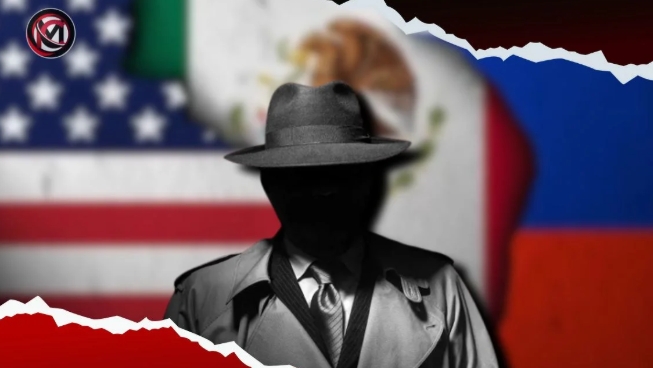

It is the follow-up to last week’s meeting on what the United States describes as radical left-wing terrorism, held in Washington, D.C., with the participation of security and justice ministers from 65 countries. The U.S. Department of State released a report on the infiltration of the Cuban government in the United States and other countries, stating that “the presence of senior Russian intelligence officials in Mexico—posing as diplomats to gather information about the United States—has been a source of diplomatic tension between the two countries in recent years.”
This is not a new issue. It is a reiteration of concerns repeatedly raised by the U.S. government since the beginning of Andrés Manuel López Obrador’s administration. When the war in Ukraine began, many Russian spies were expelled from the United States and Europe, leading Russia to redistribute its intelligence operations worldwide, significantly increasing its presence in Turkey and Mexico. At the same time, political groups closely aligned with Vladimir Putin’s government, such as Podemos, established themselves in Mexico, while Cuba’s presence in the country expanded more than ever before.
In December, The New York Times published a front-page investigative report on the expansion of Russian espionage networks in Mexico. According to the report, the issue escalated after the CIA provided Mexican authorities with a list containing more than two dozen identified Russian intelligence operatives, many allegedly posing as diplomats in Mexico. According to the article, none of them were expelled. The warning was reportedly ignored, allowing the agents to continue operating.
According to U.S. sources cited by The New York Times, officials also alleged that during the previous administration, Mexico’s National Intelligence Center (CNI) leaked to Russian intelligence the identities of all U.S. intelligence agents operating in Mexico. Responsibility for the alleged leak was attributed to the then-director of the CNI, Audomaro Martínez.
According to the same sources, Russian agents reportedly travel from U.S. cities to Cancún, Los Cabos, or Puerto Vallarta, posing as tourists. There, in hotels, bars, and beaches, they allegedly meet with informants who provide information collected inside the United States. The newspaper reported that this movement between the United States, Mexico, and Russia complicates U.S. counterintelligence efforts because operating outside U.S. territory allows agents to avoid surveillance systems that are considerably stricter within the United States.
Mexico as an Operational Hub
According to the report, Mexico functions as an operational intermediary where Kremlin intelligence personnel can meet, exchange encrypted information, and return without attracting significant attention.
The investigation also stated that some of Russia’s most skilled intelligence operatives are based in Mexico City. Historically, this is not unprecedented. During the Cold War, Mexico was often referred to as the “Vienna of Latin America,” serving as a meeting point for intelligence services from multiple countries. Even before and during the Second World War, numerous Nazi spies were reportedly based in Mexico.
The Russian invasion of Ukraine in 2022 altered global intelligence dynamics. According to the article, while Washington sought to strengthen its security posture and Moscow required new intelligence channels, Mexico became an attractive location for discreet operations due to its government’s more distant stance toward U.S. strategic interests.
Information Operations and Digital Influence
The article argues that Russia’s strategy extends beyond traditional espionage to include information campaigns.
Authorities in the United States, the United Kingdom, and France have expressed concern over an increase in disinformation campaigns allegedly originating from Mexico. According to the report, automated accounts and bots amplify messages intended to damage the image of the United States and Europe, intensify domestic political tensions, and promote narratives related to Mexico’s internal politics.
The article describes this as a combination of traditional intelligence gathering and modern digital information warfare.
Mexico’s Response
The administration of Andrés Manuel López Obrador dismissed the U.S. concerns, characterizing them as “paranoia.” According to the article, U.S. officials instead viewed the situation as one of complicity.
Under diplomatic pressure, Mexico agreed to allow U.S. officials to provide input on new diplomatic credential requests submitted by Russian personnel. Since then, some applications have reportedly been rejected. However, according to the article, Russian intelligence operatives already established in Mexico were never expelled.
Russia’s Intelligence Model
According to the article, Vladimir Putin places particular emphasis on so-called “illegals”—intelligence agents operating under false identities in foreign countries. The possibility that several of these operatives are active from Mexico aligns, the article argues, with Putin’s broader worldview, in which espionage remains a central instrument of Russian state power.
Today, the article states that approximately 80% of senior Russian government officials have backgrounds in the country’s security apparatus. Rather than simply inheriting a culture of intelligence operations, Russia has made espionage a fundamental pillar of its political system.
The article further argues that China has adopted elements of this model. It claims that China’s National Security Law reflects aspects of Russia’s approach to internal control and foreign intelligence. Although Russia has become increasingly dependent on China, the article maintains that Russian intelligence services have historically developed highly effective espionage capabilities.
It also notes that Cuban intelligence, which has maintained a presence in Mexico since before the Cuban Revolution, has worked closely with its Russian counterparts for approximately 70 years.
A Broader Geopolitical Issue
The article concludes that this issue extends far beyond current political circumstances. It describes it as a central component of today’s global geopolitical landscape and of the evolving strategic vision of the White House, emphasizing that Mexico occupies a key position within that framework. It argues that this significance has yet to be fully recognized within the country itself.
Source: excelsior