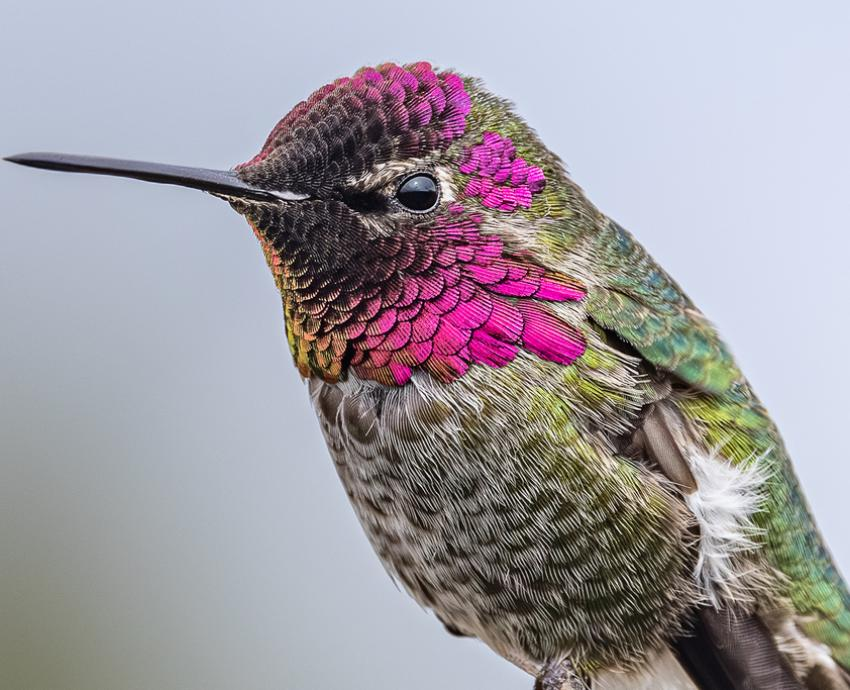

Weighing only about 3 grams and distinguished by its striking bright pink-red iridescent head and throat, the Anna’s hummingbird (Calypte anna) is a species typically found along the west coast of the United States, Canada, and northern Mexico. For the first time, however, it has been documented in the forests of Jalisco.

Researchers believe its unexpected appearance could be related to several factors, including reduced food availability in its usual range, habitat changes, or shifts in the flowering patterns of the plants on which it feeds, according to Dr. Sarahy Contreras Martínez, a researcher at the Department of Ecology and Natural Resources at the University of Guadalajara’s South Coast University Center (CUCSur).
“There may be several factors. One is climate change, with the hummingbird seeking temperatures it considers suitable. Another possibility is the search for food, as changes in the synchronization between flowering seasons and hummingbird populations may be occurring,” she explained.
Unexpected Discovery in Jalisco

Calypte anna is normally a resident species along the western coast of the United States and may migrate into western Canada or northern Mexican states such as Sonora, Baja California, and Baja California Sur.
Researchers have now documented individuals in Ahuacapán, located in the municipality of Autlán de Navarro, within Jalisco’s Sierra de Amula region.
Jalisco is home to 25 recorded hummingbird species, including endemic, resident, and long-distance migratory species. According to Contreras Martínez, the state’s abundance of flowering plants during winter may also explain why Calypte anna has reached the region.

“There is an abundance of flowers here that provide food for hummingbirds. From an evolutionary perspective, migrating makes sense because food becomes scarce in the north during winter. Moving to areas with better resources increases their chances of survival,” she said.
Characteristics of Anna’s Hummingbird
Anna’s hummingbird weighs between 3 and 5 grams and has:
- A straight, medium-length bill.
- Green feathers across its back.
- Gray underparts.
- A broad tail.
Adult males display a vivid iridescent rose-pink throat and upper chest, known as a gorget, which changes appearance depending on the angle of the light. Females have more subdued grayish plumage that helps camouflage them while nesting.

The researchers captured a male during fieldwork, allowing them to place an identification band on the bird and collect measurements of its bill, wings, tail, and coloration to confirm the species using specialized identification guides.
Research and Conservation
The next stage of the study will focus on determining whether additional individuals are present in the area, documenting their behavior, and establishing whether the species is simply passing through or becoming a resident population.
According to Contreras Martínez, these observations provide valuable information about environmental changes and ecosystem health.
She warned that hummingbirds face several threats, including:
- Pesticide use in feeding areas.
- Changes in flowering cycles that reduce food availability.
- Collisions with buildings in urban environments.
- Predation by domestic cats.
She noted that these pressures can gradually reduce populations until species become threatened or endangered.
Sixth Ahuacapán Hummingbird Festival
To promote conservation and environmental awareness, the Sixth Ahuacapán Hummingbird Festival 2026 will take place from October 15 to 17 in Ahuacapán, Autlán de Navarro.
The festival will feature:
- Educational workshops.
- Cultural activities.
- Artisan markets.
- Local products.
- Guided hummingbird-watching excursions.
Contreras Martínez described Ahuacapán as a culturally rich community surrounded by diverse ecosystems, making it an ideal location where researchers have documented all 25 hummingbird species recorded in Jalisco.
Source: udg