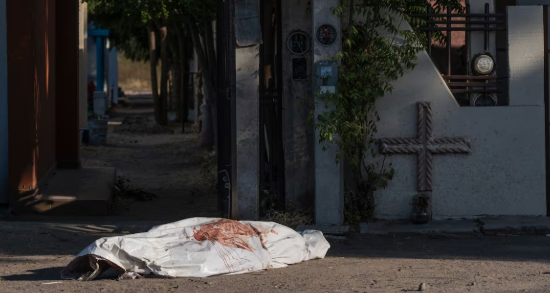

The old years of the calendar contain numerous bloody dates linked to the Sinaloa Cartel. The constant news coverage of recent days, however, fuels the impression that everything is now more violent, worse, bloodier; that there are no longer any codes, and that the motto has become “live fast and leave behind a beautiful corpse.” The past becomes idealized, strangely enough, and the 1970s and the early years of the following decade appear in the collective imagination of Mexico’s criminal world as an earthly paradise: balanced, something to aspire to, another expression of today’s nostalgia for those times and the fondness for everything vintage. The recent life sentence handed down to El Mayo Zambada sheds light on this situation, but the idea falls apart upon closer examination.
Zambada was born in 1948 or 1949 in a different Mexico, one that was closer to the Revolution and the Cristero War than to smartphones. He grew up in the village of El Álamo, south of Culiacán, and entered criminal circles almost by chance. The country of his childhood and youth was still an enigma. Historian Pablo Piccato wrote in his book Historia Mínima de la Violencia en México that “the post-revolutionary State was unable to establish an uncontested reality; instead, it consolidated itself on the understanding that there were multiple ways of interpreting the law.” Trafficking drugs did not necessarily involve a moral decision; it resolved the dilemma between surviving or letting oneself die, or barely surviving by doing whatever work was available. Whether it was legal or not did not play a role in that decision.
Widespread land redistribution was a recent development in the country thanks to President Lázaro Cárdenas, who revived the revolutionary principles of Emiliano Zapata and others. Sinaloa was learning that water could be stored to transform both the present and the future, that farming was no longer merely about subsistence but could become a source of wealth. As a child, Zambada witnessed the first years of operation of the Sanalona Dam, located near El Álamo, which transformed southern Culiacán and allowed industrial-scale agriculture to flourish in the region. As a young man, Zambada also saw the inauguration of the López Portillo Dam in the early 1980s, which completed the transformation and irrigated the valleys farther south.
Between the inauguration of one dam and the other, Zambada’s fate was sealed. Some biographies state that between the late 1970s and early 1980s he lived for a time in Southern California, where he learned how to operate on the northern side of the drug trafficking business. Others claim that he had entered the heroin trade years earlier, dealing in products cultivated in the mountains north of Culiacán, particularly Badiraguato, the birthplace of his future partner Joaquín El Chapo Guzmán and of his cousins, the Beltrán Leyva brothers, who were also his partners before later becoming his enemies. Those three surnames—Guzmán, Zambada, and Beltrán—form the three vertices of the original triangle of the Sinaloa Cartel.
There was never an idyllic balance among those three sides, only the certainty that the surrounding groups were worse than they were. This was the case, for example, with the Carrillo family, who controlled trafficking in Ciudad Juárez, Chihuahua, on the U.S. border, and who became enemies of the three families beginning in 2004. That year, gunmen murdered Rodolfo Carrillo Fuentes, creating the definitive rupture of an alliance that had begun years earlier. The war between the Juárez Cartel and the Sinaloa Cartel, which reached its peak between 2008 and 2011, permanently transformed the logic of Mexico’s drug trafficking networks because of the organizations involved, the participation of authorities, the arms race among criminal factions, and the emergence of specialized combat groups known as protection rackets.
It is true that the broad history of drug trafficking in Mexico often identifies the rise of Los Zetas as the beginning of this transformation, but at the same time the conflict in Juárez was unfolding. During that period, the city recorded more than 3,000 murders each year. Behind the violence in Juárez were El Chapo Guzmán, enjoying life in freedom after his first prison escape in 2001, and El Mayo Zambada, always discreet and never arrested until July 2024. Violence and business defined those years, guided by the two partners, who had by then become estranged from the Beltrán Leyva family, with whom they also eventually went to war. In the sentencing memorandum released this week by the U.S. Department of Justice, prosecutors stated that the cartel at one point received between 15 and 20 aircraft every night, each carrying between one and one and a half tons of cocaine.
More flamboyant than El Mayo and captivated by the myth of his own life, El Chapo Guzmán was the first to fall, marking the beginning of the end for the Sinaloa Cartel. Mexican authorities, who collaborated with the organization during the administration of Felipe Calderón (2006–2012), under the leadership of Security Secretary Genaro García Luna, intensified their efforts in the following years. They had to capture El Chapo twice because after the first arrest he escaped again through the now-famous tunnel beneath a maximum-security prison. While El Chapo was eventually captured and El Mayo remained free, the sons of both men grew into the drug trade under circumstances very different from those of their fathers, lacking the loyalty that had once united them.
The ultimate expression of that separation was the betrayal of one of El Chapo’s sons, also named Joaquín, against El Mayo. The man who had never been arrested, who had always remained discreet, who was known as a rancher and a theoretical defender of rural life, ultimately fell because of an internal betrayal. After more than fifty years of criminal activity, El Mayo became ensnared by the U.S. justice system under highly controversial circumstances: allegedly kidnapped in Sinaloa by Joaquín Guzmán López and flown by private aircraft into the custody of U.S. authorities. Did the United States orchestrate the betrayal? Did it accept the kidnapping in exchange for benefits for the Guzmán family? Those questions remain unanswered.
Source: elpais