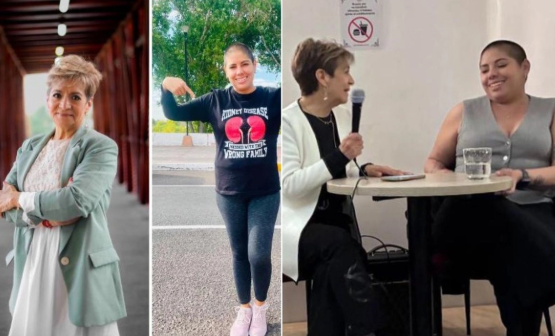

Every day, Silvia García Castañeda faces death head-on. Through her work as a thanatologist, she accompanies people during the final moments of their lives.
“It is a blessing to be able to close the eyes of someone who has passed away and be with them at the end of life. That is how I want to die—in peace, surrounded by my children and my husband.”
Last week, the Supreme Court of Justice of the Nation (SCJN) agreed to review Amparo 147/2026, filed by Silvia, a 69-year-old woman diagnosed with breast cancer. Through this legal action, she seeks a ruling from Justice Lenia Batres declaring unconstitutional the prohibition of euthanasia and medical assistance in dying (MAiD) established in the General Health Law and the Criminal Code of Mexico City.
Facing an aggressive form of breast cancer, Silvia decided to become an end-of-life doula to support other patients during the final chapter of their lives.
“That helps me face my own death. Accompanying those people gives me the opportunity to support them. I love life. But with my diagnosis, I am facing death directly, and I want to die peacefully, without pain or suffering. I have the right to exercise my autonomy and my dignity.”
She shared these reflections in her first interview with a news outlet.
Support from Senators
This legal and humanitarian effort is also being led by Samara Alejandra Martínez Montaño, a terminally ill patient promoting the citizen initiative Ley Trasciende, backed by senators from several political parties.
The proposal seeks to incorporate the term “euthanasia” into the General Health Law and repeal Article 166 Bis 21, which currently prohibits the practice.
“Underground euthanasia happens every day in Mexico. It happens in most hospitals and in people’s homes. Many doctors have offered it to me. In my case, death is just around the corner. Ley Trasciende is a movement of love for a good death. Some people cannot understand love and death together, but I see the opposite. I see freedom. I don’t know what it is like to live without pain.”
While waiting for the possibility of a dignified death, Silvia and Samara regularly attend the Death Café, a discussion space intended to reduce the stigma surrounding death by encouraging conversations about advance directives, grief, aging, illness, and end-of-life choices.
Bodies Worn Down by Illness
Silvia overcame breast cancer through treatment, but 20 years later she was diagnosed again with a more aggressive form of the disease.
“This is when I think about the decision I made after watching my relatives die. I underwent every treatment and followed every protocol, and the cancer has returned.”
She recalls caring for both her father and sister as they died from cancer.
“They were my first teachers. When I saw all the pain and suffering they endured, I knew what I wanted if I were ever diagnosed. I do not want to die the way they did. I have already gone through all the treatments and chemotherapy, always knowing that they could also lead to my own death.”
She later specialized in thanatology to accompany people through the dying process.
“It is the only thing I can offer them: my support and my respect. I help them resolve unfinished matters so they can leave in peace.”
Silvia says she has witnessed how many patients exhaust every available medical option in the hope of recovery.
“But I have also seen their quality of life deteriorate. I have watched them stop being people and become bodies that only need to be fed, cleaned, and treated for the wounds caused by lying in bed for months. After an endless struggle, most eventually surrender to their pain.”
She believes patients are often left without meaningful options because Mexico does not have a law allowing medical assistance in dying.
“Other people’s beliefs are imposed on them. We have a complete lack of understanding about death. It remains a taboo.”
“It Is Not Surrender”
Contrary to what many might expect, 31-year-old Samara approaches her campaign to legalize euthanasia with remarkable optimism.
She has lived with serious health problems since the age of 17. At 21, she was diagnosed with systemic lupus erythematosus (SLE), an autoimmune disease that attacks the body’s organs. The illness later caused glomerulosclerosis with chronic kidney failure, a terminal condition.
Samara has become the first patient in Mexico to publicly campaign for the legalization of euthanasia.
“I could spend years connected to a machine. I received a kidney transplant, lost it, and then started hemodialysis three times a week.”
She underwent hemodialysis throughout 2022 and 2023 while waiting for a second transplant.
“I stopped being able to urinate, which meant I could no longer drink liquids. I stopped menstruating. I began losing my hair because of lupus. In short, I watched my body slowly wither away.”
She received a second kidney transplant in December 2023, but after seven months in the hospital, her body rejected the organ.
“There is nothing more they can do except keep me connected to a machine for the rest of my life.”
Today she survives through peritoneal dialysis, connected to a machine 10 hours every day. She is no longer eligible for another transplant.
“I have exhausted every medical option. What comes next is natural deterioration. Doctors estimate I have about five years to live, and I have already lived two of them.”
She insists that her desire for euthanasia is not an act of giving up.
“It is not surrender. I am going to die. I may not live to see 35, and that is okay—that is simply what life has given me. But I do not want to die intoxicated or under the conditions in which I have seen others with my illness die. I think about euthanasia not as surrender, but as a way to preserve my dignity.”
Loving Life
Both Silvia and Samara emphasize that they love life. What they seek is the ability to decide whether to avoid prolonged suffering caused by severe illness.
They both acknowledge that religious beliefs have contributed to delaying legal recognition of the right to a dignified death.
“I want to leave before my body begins to decline. To say, ‘This is enough.’ I love myself so much, and I love life so much, that loving life also means loving death. I do not want to lie in a bed waiting for the inevitable.”
Samara notes that kidney failure is the ninth leading cause of death worldwide.
She says she struggles every day not only against her illness but also against what she describes as a political, social, religious, and healthcare system that resists change.
“Most of the hateful comments come from religious people, although not as many as I expected. One of their principles is love for others and compassion. Why is compassion criminalized? This law would exist for those who choose it, not to force it on anyone. It tells the world that it is okay not to want to die in agony. We should be empowered to make decisions about our own death.”
She also argues that Mexico’s healthcare system lacks the resources needed to adequately care for patients with chronic degenerative diseases.
Samara says she wants her own experience to help advance Ley Trasciende.
“My illness has taken many things from me, but it will not take away my ability to leave this world with dignity. My dream is to see the ocean one last time and move on surrounded by my family and with love.”
The Amparo and Hope
Silvia now awaits the SCJN’s decision on her constitutional challenge.
She believes euthanasia already exists in Mexico, but only in private settings accessible to those with significant financial resources, leaving most families without legal and safe options while facing devastating medical expenses.
“What is happening today is a social injustice. Through this amparo, for the first time, the State is respecting my autonomy, my dignity, and my right to decide how and when I die by agreeing to examine my case.”
She says both her husband and her two children support her decision.
“Having legal authorization would not mean I would immediately choose to die. I love life, and I love my work with patients at the end of life. I simply want the ability to decide how much of this illness I can endure.”
She also rejects the misconception that legalization would encourage people to seek death.
“Many people believe that if euthanasia becomes legal, people will line up to die. That is not true. Deciding how to leave this world is an act of great courage. I hope the State can understand that. It is not that we want to die—we simply want the guarantee that we can choose.”
Silvia concludes by reflecting on the many patients she has accompanied during their final days.
“Cancer eventually destroys patients. That is no longer life. One patient told me, ‘I just want to stop living.’ It is about bringing life to a close and perhaps meeting again somewhere.”
Source: jornada