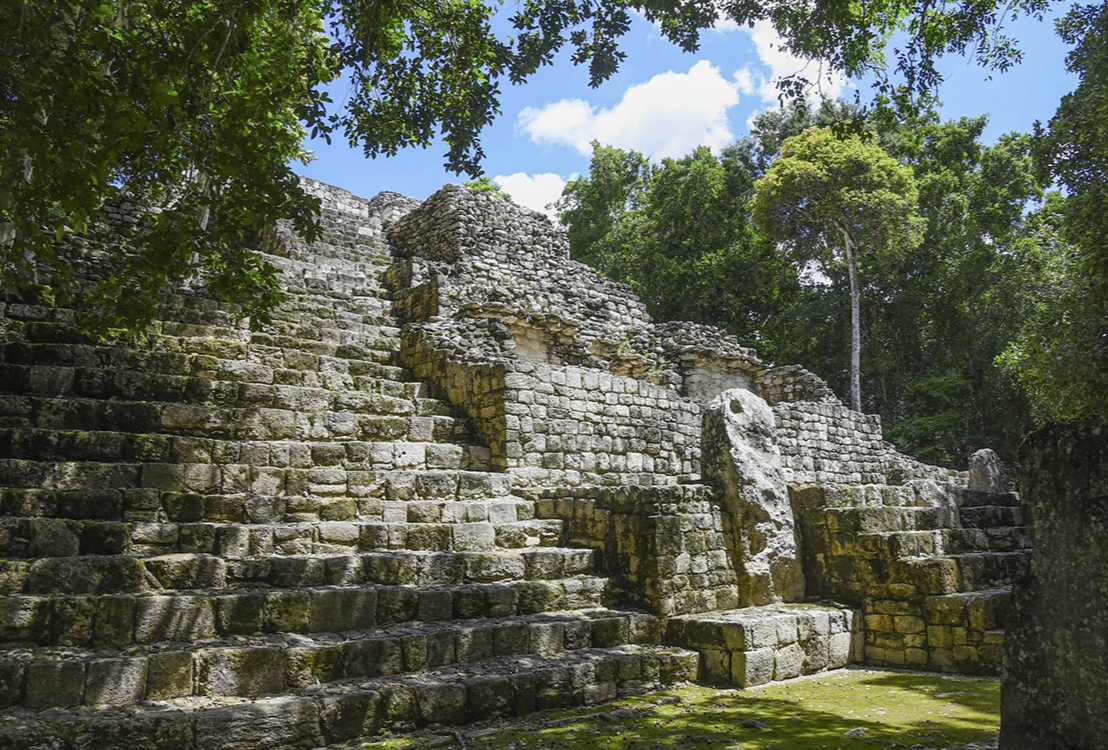

The Mexican federal government stated that the report prepared by UNESCO’s Reactive Monitoring Mission was not completed in time to be included in the documentation reviewed by the World Heritage Committee, but rejected claims that this represented a failure by Mexico to comply with its obligations.
The Government of Mexico denied that it failed to provide information requested by the United Nations Educational, Scientific and Cultural Organization (UNESCO) regarding the conservation status of the Ancient Maya City and Protected Tropical Forests of Calakmul. Officials maintained that all required reports were submitted within the established deadlines.
In a joint statement, the National Commission of Natural Protected Areas (Conanp) and the National Institute of Anthropology and History (INAH) responded to reports concerning the World Heritage Committee’s decision to postpone until 2027 the evaluation of the Tren Maya project’s impact on the site. The agencies stated that “it is incorrect to attribute noncompliance to Mexico regarding the submission of information.”
According to the institutions, Mexico delivered “each of the requested reports, including the required natural and cultural assessments,” in accordance with UNESCO’s deadlines. They also noted that between 2022 and 2026, the INAH submitted six reports on the conservation status of the site.
Additionally, the institute reported carrying out conservation work on structures open to the public, LiDAR analyses of the core area and its surroundings, preservation of the mural complex in the main building of Ch’ik Naahb, restoration of the stucco frieze, studies on early writing and iconography, and the establishment of two site museums.
The agencies explained that during the World Heritage Committee meeting held in Busan, Republic of Korea, the Mexican delegation clarified that the Reactive Monitoring Mission conducted by UNESCO in September 2025 did not submit its evaluation report in time for inclusion in the documentation distributed to committee members before the session.
The Government of Mexico also expressed its disagreement with the committee’s draft decision, arguing that it was prepared without considering the conclusions of the monitoring mission despite the work carried out by Mexican authorities.

“It is incorrect to attribute noncompliance to Mexico regarding the submission of information. The Mexican State has maintained full cooperation with UNESCO and its advisory bodies, reaffirming its commitment to protecting the Outstanding Universal Value of Calakmul and ensuring that the Committee’s decisions are based on complete, up-to-date, and properly evaluated technical information,” the Conanp and INAH stated.
The authorities further said that recommendations issued by the Conanp during the construction of the Tren Maya Hotel in Calakmul were implemented. These measures included the use of elevated structures (palafitos), reducing the number of floors and rooms from the original design, preserving the forest canopy, installing wildlife crossings, protecting and maintaining natural water bodies, incorporating rooftop pools, and using solar energy. Officials stated that all of this information was formally presented during the reactive monitoring mission.
The Mexican government argued that postponing the review of the monitoring report until the committee’s next session could result in an assessment based on information that no longer accurately reflects the site’s conservation status, given that conditions may change over time.
The statement came after Reforma reported that the World Heritage Committee postponed the evaluation of the Tren Maya’s impact on Calakmul until 2027 because Mexico allegedly did not submit the site’s conservation report on time or in full.
According to that report, during its 48th meeting in Busan, the committee requested that Mexico submit, no later than February 1, 2027, an updated conservation report accompanied by the conclusions and recommendations of the Reactive Monitoring Mission carried out in September 2025.
In its decision, the World Heritage Committee reiterated its concern that Section 7 of the Tren Maya and related infrastructure, including the Hotel Mundo Maya Calakmul, were constructed and began operating without a comprehensive assessment of the site’s Outstanding Universal Value or a Strategic Environmental Assessment, which the committee has repeatedly requested from the Mexican government.
The committee also acknowledged the existence of mitigation and monitoring programs related to the Tren Maya, the visitor center, and the hotel. It urged Mexico to continue implementing those measures, report on their effectiveness, and monitor the potential impacts of increased tourism on the site, which has been listed as a mixed World Heritage Site since 2014.

Source: aristeguinoticias