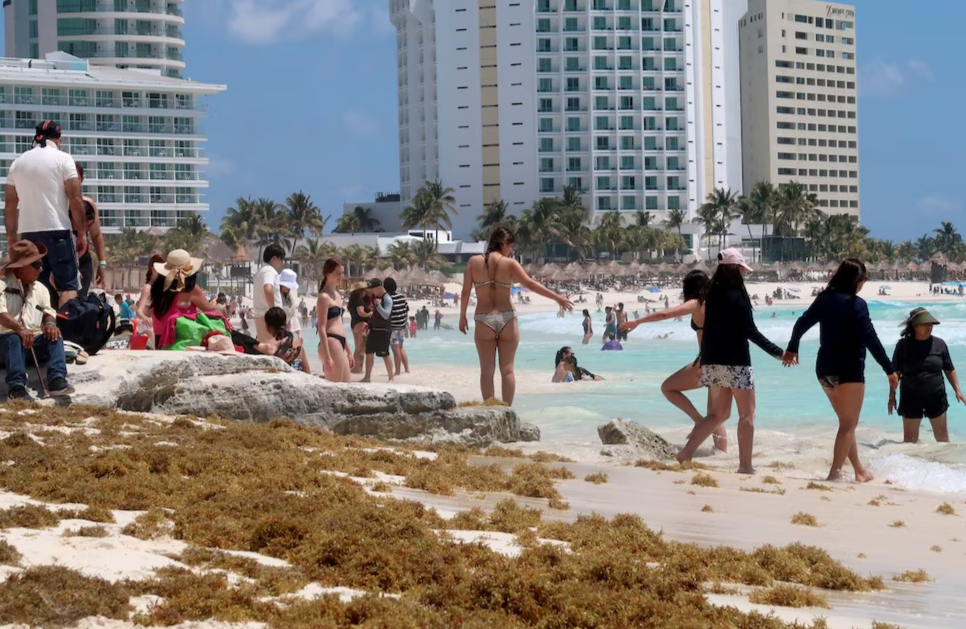

Facing a sargassum season that has already doubled the historical record in the Mexican Caribbean, the federal government is preparing to unveil a new strategy on July 30 that pursues two objectives: preventing the macroalgae from reaching beaches and transforming it into an industrial resource.
A Naval Fleet Against Sargassum
The initiative will be led by the Ministry of the Navy (Semar), the Ministry of Environment and Natural Resources (Semarnat), the Ministry of Tourism (Sectur), the Government of Quintana Roo, and private-sector partners.
Semar currently operates a specialized sargassum collection fleet consisting of:
- The ocean-going vessel ARM “Natans”
- 11 specialized coastal collection vessels
- One amphibious sargassum collector
- 18 smaller boats, two barges, and four drones
In addition, more than 9,000 meters of containment barriers have been installed in front of hotel zones. As of July 14, more than 79,900 metric tons of sargassum had been removed from Mexico’s coastline. According to the Quintana Roo government, cumulative federal and state investment has exceeded 700 million pesos.
From Environmental Problem to Industrial Raw Material
One of the most significant elements of the strategy is regulatory. Since August 2025, sargassum has been included in Mexico’s National Fisheries Charter as a “fishery resource with development potential,” allowing its commercial use in products such as:
- Fertilizers
- Biofuels
- Biomaterials
- Bioplastics
- Textiles
The strategy may also receive financial support through the Environmental Capital Fund for Mexico, introduced on July 21 with the participation of Semarnat, the Ministry of Finance, and the Development Bank of Latin America and the Caribbean (CAF).
Scientists Call for a Comprehensive Approach
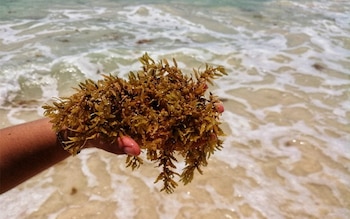
Researchers agree that collecting sargassum offshore alone will not solve the problem.
Rosa Elisa Rodríguez Martínez, a researcher at the Institute of Marine Sciences and Limnology of UNAM, explained that the amount that can realistically be collected at sea is small compared with the enormous volume floating in the ocean. She also noted that previous studies estimated the annual cost of cleaning just one kilometer of coastline at approximately one million dollars.
According to the researcher, the most effective strategy combines:
- Containment barriers installed close to the shoreline, capable of intercepting up to 90% of incoming sargassum.
- Satellite monitoring.
- Coordinated public policies involving federal, state, and municipal governments.
An Unprecedented Season
Recent data highlight the scale of the challenge.
The Optical Oceanography Laboratory at the University of South Florida reported that in June 2026, the amount of sargassum in the Atlantic nearly doubled the previous historical record, reaching five million metric tons.
Meanwhile, Conabio estimated that the Caribbean contained 34.8 million wet metric tons of sargassum during May 2026, the highest level recorded since satellite monitoring began in 2010.
With the peak season expected during July and August, tourism businesses and local residents hope the federal strategy will not only reduce the environmental impact of sargassum but also transform a recurring problem into a sustainable economic opportunity.
Source: infobae