
U.S. and Mexican Military Leaders Strengthen Security Cooperation During Meeting in Veracruz
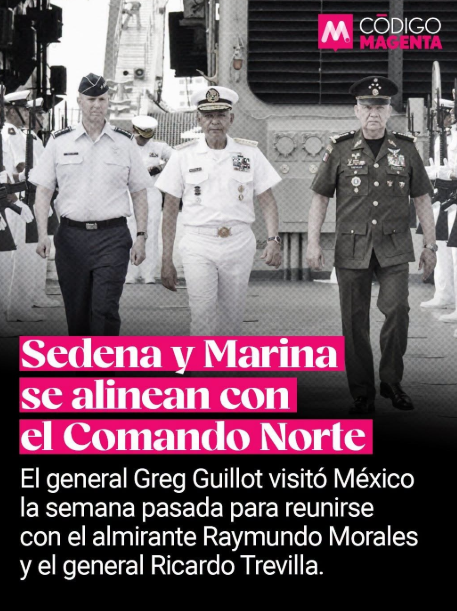
Last week, General Greg Guillot, head of the United States Northern Command, traveled to Veracruz to meet with Mexican military leaders from the Armed Forces: Raymundo Morales, Secretary of the Navy, and Ricardo Trevilla, Secretary of National Defense.
🔹 Officially, the July 22 dialogue was part of an agenda reviewing the North American Maritime Security Initiative, a bilateral cooperation policy focused on guaranteeing the security of territorial waters and maritime trade routes. Veracruz is a strategic headquarters for Mexican naval operations.
🔹 However, military experts consulted by Código Magenta interpret the meeting as another episode of collaboration that highlights the growing integration between the Mexican Armed Forces and Northern Command. The most critical voices regarding this understanding describe the relationship between Washington and the Mexican military as one of “subordination.”
🔹 The official Northern Command statement regarding Guillot’s visit to Mexico stated that the meeting “marks a significant milestone in the bilateral defense relationship.” The United States Army reported that “the leaders discussed strategic interests, including joint training of special forces for combating cartels and special operations, as well as information sharing and cooperation to combat unmanned aircraft systems (drones).”
🔹 In June, Intelligence Online, a platform specialized in covering intelligence policy in the United States and Europe, reported that the Naval Intelligence Unit of the Mexican Navy has played a central role in the war on drugs carried out by the Donald Trump administration:
“The intelligence exchange between Washington and Mexico has increased in recent weeks. In fact, U.S. agencies have identified the Mexican Navy’s Naval Intelligence Unit, as well as its Armed Forces, among their most reliable allies in the current war against drug trafficking.”
🔹 The report is consistent with the growing number of high-profile national security operations in which Mexico’s Armed Forces have used U.S. intelligence to capture or eliminate cartel leaders. The most notable example: the operation carried out by the Army’s Special Forces, “Los Murciélagos,” in which Rubén Nemesio “El Mencho” Oseguera Cervantes, leader and founder of the Jalisco New Generation Cartel, was neutralized.
🔹 The United States government has placed special emphasis on DEA and Coast Guard operations against Chinese suppliers of fentanyl chemical precursors linked to Mexican cartels. U.S. agencies have deployed technological capabilities from the company Palantir for this specific purpose.
According to Mexican government intelligence, the majority of synthetic drug chemical precursors enter the country through the ports of Manzanillo and Lázaro Cárdenas. These are two locations that have raised concerns over alleged corruption within the administration of the Mexican Navy.
🔹 The recent meeting between Guillot, Morales, and Trevilla in Veracruz addressed training, information exchange, and maritime security. The meeting took place on July 22, shortly before the interview held the following day at the National Palace between President Claudia Sheinbaum and U.S. Trade Representative Jamieson Greer.
🔹 Mexico has become a special priority for General Greg Guillot, who has visited the country twice in the last year and has met at least three times during this period with Mexican officials from the Navy and the Secretariat of National Defense.
In November 2025, Guillot led a meeting with Admiral Raymundo Morales, which was also attended by U.S. Ambassador to Mexico Ronald Johnson. According to public records, this was the first occasion in which reference was made to the Bilateral Military Cooperation Roundtable, a formal coordination mechanism between the Armed Forces of both countries.
The Roundtable has become a parallel operational scenario that allows high-profile military operations to be coordinated outside the political context of the relationship between the National Palace and the White House.
In February 2026, President Sheinbaum confirmed during one of her morning press conferences that the heads of the Navy and National Defense had been called by General Greg Guillot for a meeting in Washington:
“They are going to listen,” she said.
🔹 Bilateral military cooperation contrasts with diplomatic tensions between Mexico and the United States. The refusal of Claudia Sheinbaum’s government to comply with the request for the arrest and extradition of Rubén Rocha Moya, governor on leave of Sinaloa accused of criminal collusion by the Department of Justice, represents the center of tensions with Washington.
Sheinbaum invokes the argument of “national sovereignty” as justification for not repatriating the highest-ranking Mexican politician in government accused of materially assisting the Sinaloa Cartel.
🔹 “The security of North America depends heavily on the strength of our alliances and our ability to operate within shared objectives,” Guillot stated regarding the recent meeting.
“The agreements we made here in Veracruz highlight the deep mutual trust and commitment to addressing complex regional challenges together with our Mexican partners.”
Source: mexicodailypost