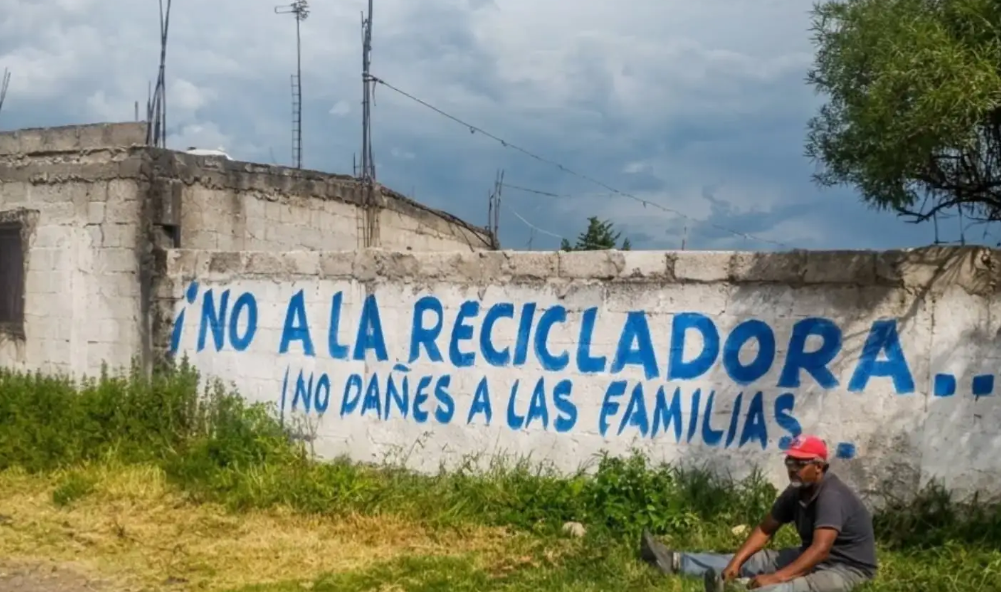

Communities in Puebla and Tlaxcala, where “Circular Economy Development Hubs” (Podecibi) are slated for installation, demanded the cancellation of these projects. They asserted that the projects constitute a form of “environmental racism” and highlight the ongoing “dispossession driven by neoliberalism” in Mexico.
In a statement issued following the Third Forum of Peoples Organized for Life and Against Landfills and Podecibi, organizations and local residents warned that the current consumerist model seeks to perpetuate itself through the displacement of towns and communities, without addressing the waste problem at its source.
Consequently, they demanded that Podecibi and industrial waste recycling plants stop being promoted as “community-friendly alternatives.” They argued that such promotion merely masks “the severity of land and water dispossession intended to benefit a handful of investors and their subservient, co-opted unions.”
“We denounce the fact that the sanitary landfills, open-air dumps, and Circular Economy Development Hubs imposed by the government pose a grave danger to public health, the soil, water, air, and life in general,” they stated. This declaration followed a meeting held on Sunday, July 26, in San José Chiapa—the site where one of these waste-recycling parks is planned.
Residents of that municipality in Puebla also condemned the threat made on July 17 by Governor Alejandro Armenta Mier to open criminal investigations against those participating in movements opposing the Podecibi projects and the Economic Development Hub for Well-being (Podecobi).
They accused the governor of using such threats to curtail residents’ freedom of expression and right to protest, arguing that his actions reveal an “inability” to govern with “transparency, dialogue, and democracy,” as he seeks to resolve the local conflict through violence. Similarly, residents of the San Pedro Ecatepec community in the municipality of Atlangatepec, Tlaxcala, reported being assaulted by state police on June 24—an incident they attributed to Governor Lorena Cuéllar—after protesting against the Podecibi project in their locality.
“The role played by the governors of Puebla and Tlaxcala is shameful; it protects the interests of the administration led by the presidency and the Secretariat of the Environment,” they emphasized.
They argued that, through the Podecibi projects, the federal government is using public funds to facilitate business deals for “Well-being investors” and is prioritizing economic profitability over the rights of the people, thereby betraying its professed principle of “the poor come first.”
In this regard, they accused the authorities of the “intentional concealment of information” concerning various “government-corporate” projects and the harmful effects they would inflict on communities.
“Governments impose environmental racism on us by promoting mega-landfills and Podecibi projects in areas where they claim there are no populations—and thus no grounds to consult us,” they stressed.
Furthermore, they asserted that the information disseminated by the government regarding these projects is essentially an advertising campaign aimed solely at imposing them; it hides the potential environmental damage and health risks while criminalizing those who oppose them.
Likewise, they expressed their opposition to the thermal treatment—or incineration—of waste proposed as part of these recycling parks, maintaining that the process generates toxic substances that directly impact human health and the environment.
The organizations and communities from Puebla and Tlaxcala participating in the forum demanded that, in addressing the waste problem, governments propose substantive solutions—such as mandating that companies and industries use non-single-use packaging materials and requiring them to take responsibility for the pollution they generate. Furthermore, among other measures, they propose that waste management be handled locally rather than regionally, and that educational programs—covering waste separation, composting, and other practices—be implemented.
Participants also demanded the implementation of remediation measures following the closure of landfills in Santa María Coapan (Tehuacán), Cohuatichan (Cuetzalan), and Ozelonacaxta (Huehuetla), as well as the definitive closure of other dumpsites, such as the one in Santo Tomás Chiautla, Puebla.
They announced that they would continue organizing communities to defend their territory, water, and way of life, and plan to hold a fourth forum in Cuetzalan this September.
Source: proceso