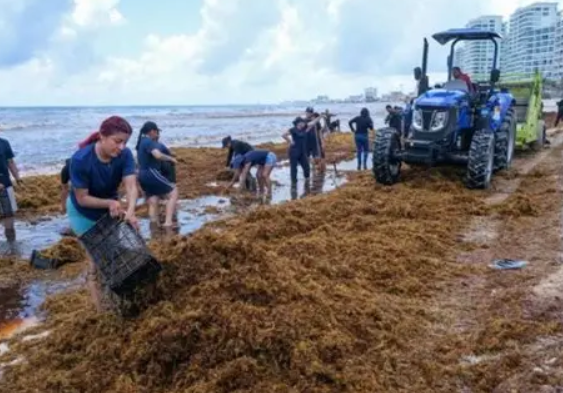

For many people, summer is synonymous with beach vacations, and every year the shores of the Mexican Caribbean once again welcome thousands of domestic and international visitors. However, this season also serves as a reminder of a challenge that has affected coastal communities, marine ecosystems, and one of the region’s main economic drivers for more than a decade: the massive arrival of sargassum.
This is a complex phenomenon driven by factors such as climate change and the alteration of marine ecosystems, with consequences that extend beyond national borders. It affects biodiversity, fisheries, tourism, and the quality of life of thousands of families. Precisely for this reason, the sargassum challenge requires cooperation, innovation, and a shared vision.
It is not just about cleaning beaches. It is about building a new value chain based on the circular economy, capable of transforming an environmental problem into sustainable bioproducts, technological innovation, green jobs, and new opportunities for coastal communities.
The good news is that, in recent years, Mexico, the Caribbean, and the European Union (EU) have demonstrated that they share this vision, moving from diagnosis to action. Where many once saw only waste, we now see a resource with enormous potential. Through the EU’s Global Gateway strategy, we are working to make this transformation a reality by promoting cleaner coastlines, new employment opportunities, and the development of sustainable businesses and industries.
A decisive milestone was the Third EU-Caribbean Conference on Sargassum, held in Brussels in October 2025. There, governments, financial institutions, businesses, researchers, and international organizations agreed to take a concrete step: transform sargassum into both an economic and environmental opportunity. Within that framework, Mexico, Grenada, and the Dominican Republic committed to collecting and processing at least 660,000 tons of sargassum between 2026 and 2027. Mexico will lead these efforts by processing 500,000 tons to protect its coastlines, support local communities, and develop a new green industry.
That same momentum was reflected during the visit to Mexico by the European Commissioner for International Partnerships, Jozef Síkela, in November 2025, where sargassum was one of the main topics on the agenda. In Quintana Roo, he visited the ARM Natans vessel of the Mexican Navy, an example of Mexico’s strong commitment to addressing this phenomenon at sea, where it can be mitigated more effectively. He also met with government officials, scientists, and business leaders to discuss how to promote a green industry capable of generating employment, innovation, and prosperity for coastal communities.
More recently, during the historic Eighth Mexico-European Union Summit, held in Mexico City this past May, our leaders agreed to deepen cooperation in strategic areas for the future and jointly organize the Fourth EU-Caribbean Conference on Sargassum, which Mexico will host this autumn. It will provide an exceptional opportunity to strengthen partnerships, attract investment, foster innovation, and continue building a regional value chain centered on the sustainable use of sargassum.
I would like to especially recognize the leadership of the Secretary of Environment and Natural Resources, Alicia Bárcena, whose vision has been fundamental in making it possible to speak today of a true partnership on sargassum. Through her commitment, Mexico has promoted a regional agenda that strengthens dialogue with Caribbean nations and the European Union, based on the conviction that cooperation is the best response to a challenge that knows no borders.
That leadership was once again demonstrated just a few days ago with the presentation of the Mexican government’s new strategy for addressing sargassum. I particularly welcome its commitment to combining prevention and collection with the valorization of sargassum as a resource. This approach, grounded in innovation and the circular economy, opens new opportunities to strengthen cooperation between Mexico and the European Union.
Sargassum will continue to be a challenge for years to come. No one can promise immediate solutions to a phenomenon of this magnitude. However, today we have an increasingly strong partnership between Mexico, the European Union, and the Caribbean countries, a shared roadmap, and the determination to transform this challenge into an opportunity for our communities and economies. International cooperation delivers its greatest value when it results in concrete solutions and tangible benefits for people. I am convinced that this partnership can become an international model of how cooperation, mutual trust, and innovation can transform a challenge into an opportunity. That is precisely the spirit that will continue to guide cooperation between the European Union and Mexico.
Source: excelsior