
“In the coral reefs of the Gulf of Mexico, I have seen species that, in ten years, I never saw in the Caribbean reefs.” That is how Mariana Reyna Fabián, Science Coordinator and Expedition Leader at Oceana Mexico, describes her experience. For her, reefs are not just colorful underwater landscapes but complex underwater cities that provide shelter and food for one out of every four marine species on Earth. That is why she expresses concern over what she calls the government’s lack of transparency regarding the condition of the reefs following the recent oil spill in the Abkatun-Cantarell area.
According to satellite imagery, the latest major spill in the region began in the first days of February, lasted eight days, and was not publicly reported as required by safety protocols. After weeks of denying responsibility, Pemex, Mexico’s state-owned oil company, acknowledged its role on April 16. However, no details were provided regarding the ecological impacts or the volume of oil released. To date, nearly 1,000 kilometers of coastline have been affected, according to the Interinstitutional Group.

This group was created by President Claudia Sheinbaum in March 2026 to respond to the oil spill and hydrocarbon contamination along the coasts of Campeche, Veracruz, and Tabasco in the Gulf of Mexico. It includes the Ministry of the Navy (Semar), the Ministry of Environment and Natural Resources (Semarnat), Pemex, the Ministry of Energy (Sener), and the Ministry of Science, Humanities, Technology, and Innovation.
Reyna earned her biology degree from the National Autonomous University of Mexico (UNAM) and holds a Ph.D. in Environment and Development. She has led expeditions to little-explored sites such as Alacranes Reef and Bajos del Norte, promoting conservation efforts. Her work focuses on understanding how these ecosystems function, their ecological role, and how their three-dimensional architecture—essential for marine life—is collapsing under the stress caused by human activities and fossil fuels.
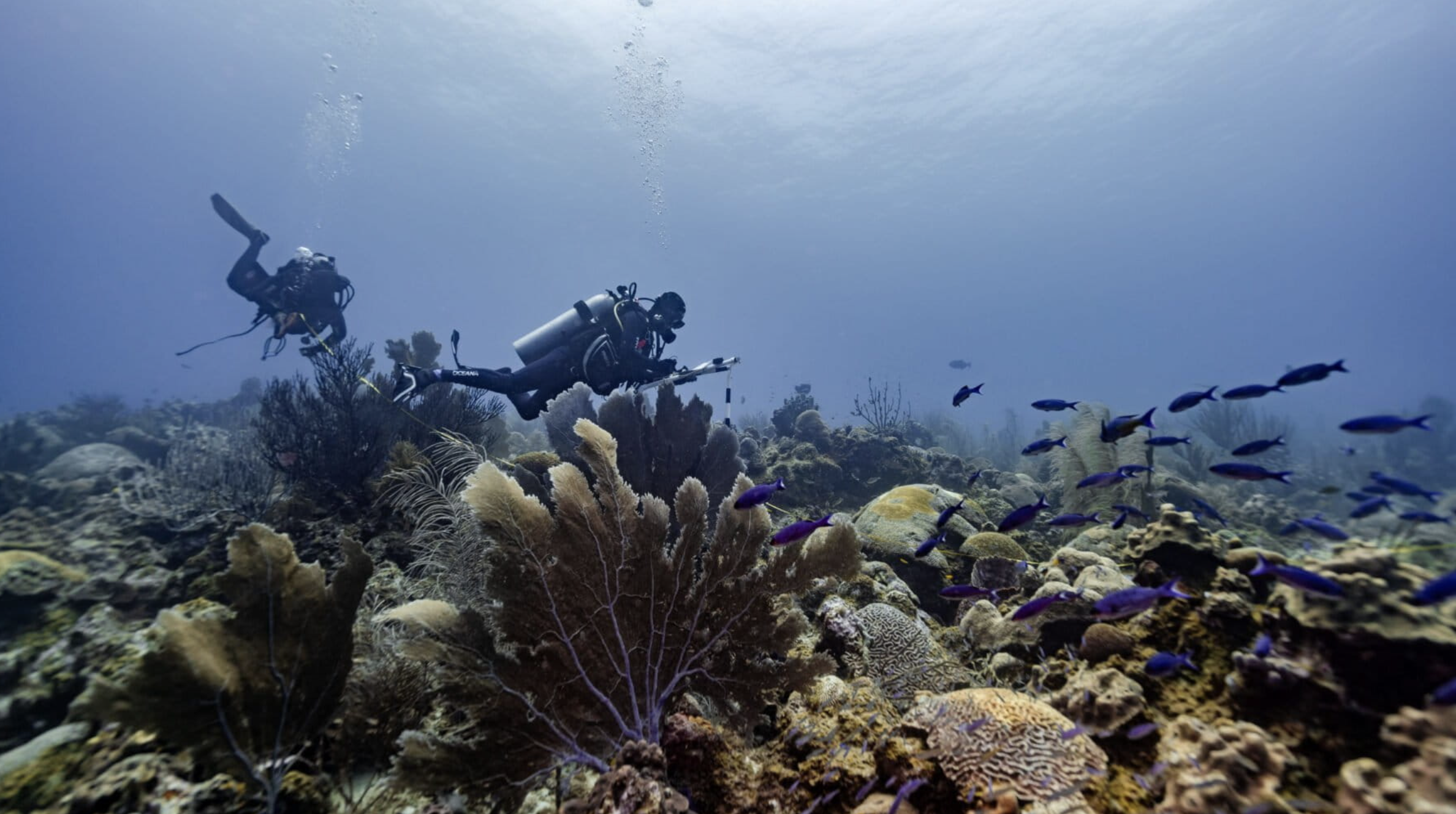
Scientists from Oceana document the three-dimensional structure of coral reefs, which provides shelter for thousands of marine species.
In an interview with Mongabay Latam, the scientist discussed lessons learned—or not learned—from previous environmental disasters, future expectations, and the hope that still remains for these hidden underwater cities.
What are the main characteristics and vulnerabilities shared by the coral reefs in the Gulf of Mexico?
In the Gulf of Mexico, we find coral reefs, rocky reefs, and mixed reefs. The best known is the Veracruz Reef System, which has proven to be highly resistant and resilient. These ecosystems face vulnerabilities related to the climate crisis, including rising ocean temperatures, acidification, and stronger tropical storms.
Corals are extremely sensitive. When water temperatures exceed normal levels, they bleach by losing the algae with which they live in symbiosis, and they can eventually die. Ocean acidification also prevents them from building their three-dimensional skeletons.
Imagine a city with tall buildings. The more structurally complex and taller the buildings are, the more shelter they provide for fish. Since corals grow very slowly, once they are destroyed, it can take thousands of years for them to recover. Many of these threats are directly connected to the global climate crisis and the continued use of fossil fuels.
Key marine species inhabit these underwater cities, which now face chronic risks from hydrocarbon pollution. Coral reefs also regulate climate and naturally protect coastlines.
Given the limited information available, how would you describe the ecological magnitude of the February 2026 oil spill?
The spill has left us with a bitter feeling. We still do not know its true scale or how much oil was released. From Oceana’s perspective, the government has a responsibility to be transparent by informing the public when the spill began and how much crude oil entered the ocean so its impacts can be assessed.

Although no official determination has been made, communities have reported finding dead birds, fish, and even sea turtles.
Oil spills immediately alter the chemistry of the water by reducing oxygen levels and causing behavioral and physiological changes that often lead to rapid mortality. However, previous disasters have shown that the impacts are not limited to the immediate aftermath. Their effects can persist for decades.
For example, research on dolphins affected by the Deepwater Horizon (BP) oil spill found reproductive impacts lasting up to 30 years afterward.
The government eventually acknowledged Pemex’s responsibility after weeks of denial. Why do you think the disaster was initially minimized?
Oceana has always maintained that there must be a public acknowledgment of responsibility to ensure accountability and prevent similar events from happening again. Transparency is essential not only for environmental protection but also for effective governance.
Once authorities acknowledge what happened, they are better able to help affected communities.
It is also important to note that this spill occurred in shallow waters—less than 500 meters deep. Studies indicate that every additional 30 meters of depth increases the probability of an accident by approximately 8.5%.
This is especially concerning because, while shallow-water drilling already exists, there are growing interests in expanding oil extraction into deep waters, even though Oceana maintains that proven oil reserves in the deep and ultra-deep Gulf of Mexico are virtually nonexistent.
We should begin imagining a Gulf of Mexico whose future is no longer dependent on oil exploration and extraction.
Although at least ten government agencies are involved in the response, very little information has been released. What data should be made public?
Knowing the exact source, duration, and extent of the spill would allow scientists to model how the oil moves, how much settles into marine sediments, and how much reaches other ecosystems.
We are calling for the creation of a transparent public observatory that includes researchers and citizens. Satellite imagery already allows these events to be monitored. Such an observatory should become a space for dialogue, prevention, and scientific collaboration.
Who should lead the ecosystem recovery efforts?

The State should coordinate the response while determining who is legally responsible. It should oversee environmental restoration and ensure that responsible parties pay appropriate fines.
Financial penalties alone cannot fully restore what has been lost, but they send an important message that environmental damage will not be tolerated.
A recovery panel involving government agencies, scientists, organizations, and local communities would also be valuable. Communities must be heard when they report damages because impacts extend beyond fishing to tourism and public health.
A coral colony may require thousands of years to build the structures that an oil spill can suffocate in only a matter of days.
What lessons from the Deepwater Horizon and Ixtoc-I disasters are being applied today?
The Deepwater Horizon disaster demonstrated how little was known about Mexico’s deep Gulf waters. In response, the Gulf of Mexico Research Consortium (SIGOM) was created, leading to extensive scientific studies.
Researchers discovered that the deep Gulf is far from an empty environment. It serves as a spawning area for tuna and as a migration corridor for five of the world’s seven sea turtle species.
Communities have also become better organized. Today, they use mobile phones to document incidents that were previously ignored. Oceana works alongside these communities to advocate for ending oil extraction in the Gulf.
One example involves fishing. Whenever an offshore oil installation is established, surrounding fishing grounds become restricted for safety reasons, forcing fishermen to abandon areas that had sustained their livelihoods for generations.
If the spill lasted only eight days, how could it affect nearly 1,000 kilometers of coastline across multiple states?
Oil movement is driven by complex ocean currents.
Scientists use hydrodynamic models that combine satellite information with seafloor data to predict where oil particles will travel.
One important factor is the Loop Current, whose behavior changes depending on rainfall, wind, and ocean conditions.
Modern models are highly accurate. If authorities released the exact duration of the leak, scientists could estimate with considerable precision where the contamination traveled.
Events occurring hundreds of kilometers offshore eventually affect coastal communities.
Fishermen report that fish “sense the danger and hide.” What evidence exists regarding behavioral changes in marine species?

When oxygen levels decrease, marine animals experience immediate physiological and behavioral changes.
Many organisms die quickly, and contaminated fish are visibly covered with oil.
However, medium- and long-term threats come from compounds such as phenanthrene, which damages the cardiovascular systems of fish, amphibians, and birds.
These contaminants reduce swimming ability, slow growth, interfere with embryonic development, and decrease overall survival.
For coastal communities that depend on ecotourism or fishing, these biological impacts directly threaten their livelihoods.
A porcupinefish (Diodon) photographed in the Southern Gulf of Mexico Reef National Park.
More than 800 tons of waste have reportedly been collected from beaches, but cleanup rarely reaches the seafloor. What happens beneath the surface?
Those underwater areas are generally never cleaned.
Oil undergoes physical and chemical transformations. It can evaporate, spread over thousands of kilometers, or become emulsified and sink to the seafloor.
Once there, it does not remain permanently buried. Ocean currents can resuspend the oil, carrying it back into the water column and transporting it over long distances.
Some lighter compounds also evaporate into the atmosphere, where they may contribute to air pollution.
What irreversible consequences could coral reefs experience?

This issue extends beyond oil spills to the broader dependence on fossil fuels.
Although coral reefs occupy less than 1% of the ocean floor, they support one-quarter of all marine species.
As temperatures continue to rise, corals die and are replaced by algae that cannot sustain the same biodiversity.
The reef becomes structurally flat—as if the skyscrapers of a city were replaced with small houses capable of sheltering only a single person.
At that point, recovery becomes extremely difficult and enormously expensive.
Nevertheless, there is still hope.
In the Gulf of Mexico, we recently found healthy colonies of elkhorn coral (Acropora palmata), a species I have not seen in Caribbean reefs in ten years.
The healthy presence of Acropora palmata in the Gulf offers hope for coral reef conservation.
What message would you give to fishing communities and government decision-makers?
To coastal communities: keep hope alive and continue raising your voices. Protect the natural resources that provide food for your families and for those of us living in cities. Your way of life is honorable and benefits all humanity, unlike extractive economic models that enrich only a small number of people.
To the government: make decisions based on the well-being of the majority rather than on the short-term interests of a few individuals who profit and leave environmental consequences that last for decades.
Main Image: Oceana scientists documenting the three-dimensional architecture of coral reefs, which is essential for providing shelter to thousands of marine species. Photo courtesy of Nelly Quijano/Oceana.

Source: revistaespejo