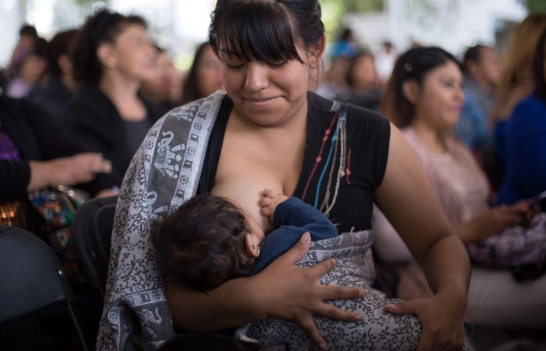

During World Breastfeeding Week, the United Nations Children’s Fund (UNICEF) stated that Mexico remains far from the global target established for 2030 of reaching 70 percent exclusive breastfeeding during the first six months of life, as currently “only one out of every three babies” receives it. This figure is even below the Latin American average, which stands at 42 percent.
This year’s theme for the week is “Breastfeeding for a sustainable start in life: strengthening what works,” the organization highlighted, adding that supporting the practice also means creating the conditions so that every mother can experience it with information, respect, and support.
“Behind every mother who decides to breastfeed, there must be a network that supports her at home, at work, in health services, and in her community.”
Separately, Aranzazu Alonso Cuevas, executive director of the Early Childhood Pact, told La Jornada that “to help mothers breastfeed their children during that period, we need to expand maternity leave. Currently, it lasts 12 weeks if all weeks before birth are transferred to the postpartum period.”
She pointed out that when women return to work, “the vast majority have to stop breastfeeding because it is extremely difficult to continue nursing a baby when you have to spend 8 hours at work, plus the commuting time. Some have to pump milk, and that is already complicated. And I am talking about the formal sector, about women who are insured, not those who do not even have paid leave.”
Both UNICEF and Alonso Cuevas explained that the infant formula industry and its marketing strategies involving healthcare personnel and influencers also hinder breastfeeding.
UNICEF stated that “in Mexico, more than half of the formulas consumed are recommended by healthcare personnel, either directly or through the presence of brands on items and gifts provided by this industry.”
Likewise, Alonso Cuevas emphasized that exclusive breastfeeding “is one of the most cost-effective public health practices because when a child is exclusively fed with breast milk during the first six months, they become sick much less frequently and with less severity, have a lower probability of dying, and continued breastfeeding has effects on intellectual development. Additionally, mothers who breastfeed have a lower probability of developing uterine and ovarian cancer, as well as postpartum depression.”
As a preview of a new manual being developed to counter misinformation surrounding breastfeeding, UNICEF referred to some of the most widespread myths in Mexico.
“Among them are the beliefs that breast size determines the ability to produce milk; that breastfeeding should hurt; that beer increases milk production; or that colostrum does not provide nutrition.
“Available scientific evidence and recommendations from the WHO and UNICEF indicate that milk production depends on glandular tissue and not breast size; that persistent pain usually indicates a latching problem; that alcohol reduces milk ejection and passes into breast milk; and that colostrum provides essential nutrients and immune and growth factors.”
The organization added that it is also false that breast milk stops providing nutrition after six months, that it does not satisfy thirst, or that a more expensive formula necessarily offers greater benefits.
“The composition of breast milk adapts to the changing needs of the baby and maintains essential nutrients and immune benefits beyond the first year. Likewise, all legally marketed infant formulas meet minimum nutritional standards, and no formula reproduces the immune and bioactive components of human milk.”
Source: jornada